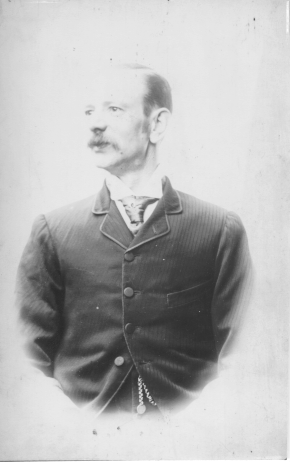
ALONZO (1857-1920) and MARY ANN HEMSWORTH (1857- 1941)

alonzo.gif (92025 bytes)


My great grandparents were married on Christmas Day 1878 at the Church of St John in the Wybourn district of Sheffield. Both were 21 at the time of the marriage with Alonzo's "rank or profession" being given as a coach-builder. They both resided in Norwich Street West Sheffield. The street disappeared many years ago when the area was redeveloped but West Norwich Street was at the extreme western end of Norwich Street, from the sharp corner (near the northern end of Bungay Lane) to the junction with Bungay Street. From the 1850 map there are indications that it would  have been a fairly steep hill; rising, from the Midland station to the corner, where it leveled out .  

Alonzo in time owned a coach body building business that was situated in Keetons Hill in the Highfields area of  Sheffield. Some of his sons worked with him in the family business. At the time of writing Keeton's Hill still exists and runs off London Road almost opposite John Street. It is a very narrow road and it is possible that the cobbles are still visible in places. I don't think there are any houses there now - mainly business premises (George Barlow's Shopfitter's offices are on the corner of London Road and Keeton's Hill).

Further details of my great my great grandparents MARY ANN and ALONZO's can be found on the page that is devoted to my grandad's Sid 's brothers and sisters including a marvellous photo taken in the garden of a house in Broughton Road Hillsborough Sheffield circa 1905.


mamyers.jpg

GEORGE (1824 - 1889) AND MARY ANN MYERS (nee RIDAL)

Mary Ann's father was GEORGE MYERS and was a Tailor at the time of his daughter's marriage in 1878. My mother stated that  her paternal grandmother MARY ANN MYERS had been born on Alderney in the Channel Islands and had a twin sister called SARAH MYERS. My research revealed that this was the case. MARY ANN MYERS (my great grandmother) was born together with her twin sister SARAH ANN on 16th April 1857 and is listed on the Civil Register under entry 881 (1857). The Church where they were christened is shown in the photograph below. Her father is given as GEORGE MYERS and her mother MARY ANN RIDAL. 

Interestingly George's occupation at the time is given as Gunner and Driver, RA. (Royal Artillery) and so he must have been stationed there at the time. As an aside it is worth quoting Watt and Watt on the subject of Army wives' in the nineteenth century

"The army had always disapproved of marriage as detracting from a soldier's loyalty, but had authorised a ratio of six wives to one hundred men up to the first half of the 19th century. This proportion was strictly applied when regiments embarked for foreign service. These "on the strength" wives were actually allowed to live with their husbands, usually in an area screened by blankets at the end of the barrack room, in return for the performance of chores such as cleaning, cooking and mending. "Off the strength" wives received no rations or allowances. By about 1870 the married establishment had been formally set up with married quarters, although there was still a limit to spaces."
 

From the information I have received it appears that MARY ANN RIDAL (my great great grandmother) was christened in what is now Sheffield Cathedral on 16th June 1822 and was the daughter of JOSEPH and ANN RIDAL. The marriage with GEORGE MYERS took place in Rotherham in the September quarter of 1845 (GRO REF Rotherham Volume 22 Page 371). For a few years I had difficulty in locating the marriage - the reason was that  MARY ANN RIDAL is down in the indexes as MARY ANN RYDLE.

The first mention that I can find of GEORGE is in the 1841 Census for Sheffield which finds him employed as a 17 year old apprentice tailor in West Street, Sheffield. But ten years later he appears as a married 27 year old Gunner/Driver with the Royal Artillery based at Weedon Beck in Northamptonshire (see note 1)


St Anne's Church, Alderney, Channel Islands

In December 2003 I was researching a different aspect of local interest when I came across a publication that was issued be The Friends of The General Cemetery (in Sheffield). It was titled "Into The Valley of Death - A Military Tour of Sheffield General Cemetery" . The Guide was specifically published to show some of the graves and memorials in the Cemetery that had military links and/or were connected to the wars that Britain had fought over the last two hundred years. On page 5 there is an entry for my great great grandfather GEORGE MYERS which states

"George Myers Crimea This gravestone has a lovely relief sculpture of a canon carved upon it. You will find it lying flat on the top of the catacombs, on the edge of the main path, among many other gravestones thus placed. They were moved here by the Council when the 1978 clearance took place. He was an Army Pensioner of the Royal Artillery and died on 3 March 1889 aged 66. He fought at the Battles of Sebastopol and Inkerman in the Crimean War in 1854 and 1855. He gained medals in the Crimean and Turkish wars for good conduct." 

The actual inscription is as follows

UBIQUE

SACRED TO THE MEMORY OF

GEORGE MYERS

ARMY PENSIONER LATE ROYAL ARTILLERY

WHO DEPARTED THIS LIFE THIRD DAY OF MARCH 1889 IN HIS 66TH YEAR

PRESENT AND ENGAGED AT THE BATTLES OF SEBASTOPOL AND INKERMAN

THE CRIMEA WAR 1854

CRIMEAN AND TURKISH GOOD CONDUCT

MAY HE REST IN PEACE

ERECTED BY HIS SURVIVING SONS AND DAUGHTERS AS A MARK OF RESPECT AND ESTEEM


The BMD indexes give his age as 65 but his death is registered as GEORGE MYERS PRO REF Sheffield March 1889 Volume 9C Page 250

The burial record is as follows

burial no: 16135
grave no: R1 146
death date: 03 Mar 1889
burial date: 05 Mar 1889
name: George Myers
sex: Male
age: 65
cause of death:  
description: Tailor
birthplace:  
residence: 58 Sherrington Road
parents:  
informant:  
minister: J G Richardson
burial type: consecrated


This information ties in with what I know of GEORGE MYERS to date. After he came home from the Crimea he must have stayed in Alderney where his twin daughters were born. My mother does vaguely seem to recall that his wife's health was not very good and that was one of the reasons why the family were in the Channel Islands. They were certainly there in 1859 because there was a son born called John

In July I received an e-mail from my cousin who had in his possession George's Army Record. As you can imagine after over 160 years it is in a fragile state but it does record the following information

Thomas George Myers 1824-1889-

Enlisted to the Royal Regiment of Artillery on 29 June 1845, aged 21.

Born- Wath

Trade- Tailor

Size- 5ft 9inch

Eyes- Hazel

Hair- Brown

Marks- Tear on left eyebrow

Stationed at:

 1845-1849 Woolwich
1850 Birmingham
1850-1853 Weedon
1854 Woolwich
1855-56 Crimea
1857-1866 Alderney

The other contents mainly consist of an itinary of his kit and wages. He left the Royal Regiment of Artillery in 1866 after serving for a total of 21 years
 

JOHN and KATE MYERS (nee EADES)

JOHN is on the 1881 Census as a 21 year old "Driver" at the Royal Barracks at Ipswich (Census Place: Ipswich St Mathew, Suffolk, PRO Ref RG11 Piece/Folio 1872/109 Page 5). He is unmarried. I am assuming that he followed his fathers footsteps in joining the Royal Artillery.

JOHN must have left the Army sometime between 1881 - 1886. In the December quarter of 1886 he married in Sheffield, a KATE EADES (PRO Ref Volume 9C Page 682). The 1891 Census JOHN and KATE living with Kate's parents SAMUEL and SARAH EADES at Cross Gilpin Street in the St Philips district of Sheffield. John's occupation is given as " Horse-keeper" Also living there were their two young daughters EMILY MYERS age 4 and ADA MYERS age 3. His wife KATE incidentally was two years older than JOHN and was born in Sheffield. In March 2009, I found the following entry in the Parish Registers of Christ Church, Pitsmoor

"Eades, Kate (of Rye Bank, born ??). Baptised July 31, 1857, by Hy. Barlow at Christ Church, Pitsmoor.  Parents name(s) are Sarah & Samuel (Warehouseman)".

JOHN and his family appear again on the 1901 Census for Sheffield, JOHN MYERS as a 42 year old "Cab driver". The family were living at 80 Morpeth Street which was in the Shalesmooor/St Philips area of Sheffield (RG13/4365 Page25). In addition to his two daughters EMILY and ADA, there was now a third daughter JESSE who was 8 years old. His mother in law SARAH EADES, a 78 year old widow was also living with them as well as his 19 year old nephew DAVID EADES. SARAH died age 79 in the December quarter of 1903 (PRO REF Sheffield Volume 9C Page 330)

A photo taken in 1930 that shows the corner of Morpeth Street and Upper Allen Street. The pub on the corner is The Morpeth Hotel

As for his father GEORGE he must have outlived his wife for the 1881 Census shows his status as a widower. He is living with his daughter and son in law MARY ANN and ALONZO at 19 Marple Street Sheffield (Public Records Office Reference RG11 Piece/Folio 4637/144 Page 27) and his occupation is given as Tailor.  

SARAH ANN MYERS (1857 -

MARY ANN MYERS (my great grandmother) was born together with her twin sister SARAH ANN on 16th April 1857 in Alderney, Channel Islands. SARAH ANN has proved a lot more elusive to trace that her sister. The first record I can find to date is in the 1871 Census when she is listed as a 14 year old scholar in the Green Hill Soldiers Daughters Home in Hampstead, London. From what I can ascertain the home was a charitable institution that had its origins in the Crimean War. Quite why SARAH ANN was there is not clear but I would hazard a guess that it may have something to do with the health or even death of her mother, MARY ANN MYERS. As I stated earlier my mother does vaguely seem to recall that his wife's health was not very good. There is a record of as death registered in the June quarter of 1864 (PRO Ref Sheffield Volume 9C Page 240) for a MARY ANN MYERS. To date I have yet to confirm whether or not it was SARAH's mother. If it was, it would have meant that GEORGE would have had to look after at least three children all of whom were under eight years of age. Given his service in the Crimean War with the Royal Artillery it is perhaps understandable that SARAH ANN would be placed there.

Ten years later she is in a  different part of the country altogether. The 1881 Census reveals her as a 24 year old unmarried Ward Maid working at Salop Infirmary (see note2) in Shrewsbury (Public Records Office Reference RG11 Piece/Folio 2649 Page 8). In each case I was helped by the fact that although Sarah Myers in by no means a rare name, the fact that each entry gives a birthplace of Alderney Channel Islands and a date of birth 1857.

The problem then is finding SARAH in the 1901 Census. There certainly is no entry for a SARAH ANN MYERS born 1857 in the Channel Islands and as my mum remembers her as "Aunt Sal" she did not die. The obvious step is to assume that SARAH ANN got married sometime after the spring of 1881. The problem is of course finding the marriage. The only clue I have been able to pick up on is when I interrogated the 1901 Census for women born in the Channel Islands in 1857. There is an entry for a 43 year old widow SARAH ANN BURNETT born in Alderney Channel Islands circa 1857 who is employed as a trained nurse (sick) at 447 Glossop Road Sheffield. (Public Records Office Reference RG13 Piece/Folio 44351 Page 6).

The head of the household is a 81 year old women called SARAH NEEDHAM and living with her are her 41 year old daughter SARAH JANE MORTON and 45 year old son in law WILLIAM HENRY MORTON who is employed as a solicitors clerk (Law). All the family are Sheffield born.

To date I can find no record whatsoever between a BURNETT and a SARAH ANN MYERS and until I do 1901 census entry is not proven. Superficially it does look promising given the age, birthplace, occupation and residence (Sheffield) but you never can be certain

NOTES

1 Weedon-beck in 1839 Weedon-beck is in Fawsley hundred, 4 miles south-east of Daventry. Its distinctive epithet ‘Bec,’ was derived from the circumstance of a religious house being established here as a cell to the abbey of Bec in Normandie. It is sometimes also called Weedon-in-the-Street, from its situation on the Watling Street. Wulfhere, king of Mercia, had a palace here. The church is an ancient building, and contains portions in the Norman and the various styles of English architecture. There are one or two dissenting places of worship. The royal military depot at Weedon contains extensive barracks ; spacious storehouses for artillery, small-arms, and ammunition ; an hospital, and workshops for artisans : it is one of the finest establishments of the kind in Europe. The population of Weedon-beck, in 1831, was 1,439.
From  - Old Towns is a resource of 19th century English historical data, extracted and digitized from articles written between 1833 and 1848 which were originally published in 'The Penny Magazine' by The Society for the Diffusion of Useful Knowledge


2. The Salop Infirmary, was first founded in April 1745. The present Infirmary, built on the site of a former structure at a cost of more than £18,000, and opened for patients in 1830, is of freestone in the classic style, with a Doric portico in the centre, from designs by Messrs Haycock, of Shrewsbury. A wide terrace extends along the eastern front, whence an extensive and interesting view is obtained. An additional wing was completed in 1869 at a cost of £4,000, and in 1877 the interior was renovated and re-arranged and several out-buildings added at a further cost of £5,000 and the Infirmary contains 120 beds.

3. Fron Wikipedia - Ubique is Latin for "everywhere", and may refer to:

and is the motto of the;

Return to Main Family History Page

This page was last updated on 19/10/09 09:36