THE EXECUTION OF GEORGE
AINLEY (1898 – 1918)
The following information
was obtained from the web-site of the Commonwealth War Graves Commission.
The first table gives the bare details of George's military career and his place
of burial
|
Nationality: |
United Kingdom |
|
Rank: |
Private |
|
Regiment: |
King's Own
Yorkshire Light Infantry |
|
Unit Text: |
1st/4th Battalion. |
|
Age: |
20 |
|
Date of Death: |
30/07/1918 |
|
Service No: |
202893 |
|
Additional
information: |
Son of George and
Alice Mary Ainley, of 82, Randall St., Sheffield, Yorks. |
|
Casualty Type: |
Commonwealth War
Dead |
|
Grave/Memorial
Reference: |
II. D. 5. |
|
Cemetery: |
HAGLE DUMP
CEMETERY |
The Hagle Dump Cemetery is located 7.5 km west of Ieper town centre on the Sint Pietersstraat, a road leading from the N308 Poperingseweg, connecting Ieper to Poperinge. From Ieper town centre the Poperingseweg (N308), is reached via Elverdingsestraat then directly over two small roundabouts in the J. Capronstraat. The Poperingseweg is a continuation of the J. Capronstraat and begins after a prominent railway level crossing. 6 km along the Poperingseweg, after passing through the villages of Vlamertinge and Brandhoek, lies the right hand turning onto Galgestraat. 1 km along the Galgestraat lies a staggered crossroads. The cemetery lies 300 metres after this crossroads on Sint Pietersstraat.
The CWGC
site also gives a brief history of the Cemetery. Elverdinge
was behind the Allied front line throughout the war, and Hospital Farm and Ferme-Olivier
Cemeteries, both in the commune, were used in the earlier years for Commonwealth
burials. The cemetery at Hagle Dump was begun in April 1918, during the Battles
of Lys. It was used by fighting units and field ambulances until the following
October and was enlarged after the Armistice when more than 200 graves were
brought into Plots III and IV from the battlefields of the Ypres Salient.
Brielen Military Cemetery, from which 20 graves were brought to Hagle Dump, was
used from April 1915 to September 1917. Hagle Dump Cemetery contains 437
Commonwealth burials of the First World War, 140 of which are unidentified. The
cemetery was designed by Sir Reginald Blomfield.
Notes
From the 1901 Census for the UK I have obtained the following details of his family His father George was aged 29 in 1901 and his occupation is given as a Silver Stamper. His wife, and George's mother Alice was four years younger than George. The family lived at 15 Mary Street, Sheffield (PRO ref RG4369 Page 10 ent 70) which is only about a half a mile away from where they were living in 1918
| SURNAME | Age | Rel | Occupation | Place of Birth |
| AINLEY George | 29 | Head | Silver Stamper | Sheffield, England, Yorkshire |
| AINLEY Alice Mary | 25 | Wife | Norton, England, Yorkshire | |
| AINLEY Alice M | 4 | Dau | Sheffield, England, Yorkshire | |
| AINLEY George | 2 | Son | Sheffield, England, Yorkshire | |
| AINLEY Albert | 1 | Son | Sheffield, England, Yorkshire |
Like his father before him, George he was born in Sheffield in the June quarter of 1898 (PRO ref Volume 9C Page 526) and was aged 2 at the time of the 1901 Census. George was their eldest son. His parents were married in the September quarter of 1895 in Sheffield - PRO Ref Sheffield Vol 9C Page 503. His mother Alice Mary had a maiden name of LIVERSIDGE and was the eldest daughter of David and Selina LIVERSIDGE. The 1881 Census gives their address as Court 10, The Wicker - (Brightside Bierlow PRO Ref RG11 Piece/Folio 4656/7 Page 8). Her father David was employed as a Fluter (metalworker)
George's father GEORGE AINLEY was also the eldest son in the Family. The 1881 Census shows George as a nine year old scholar living with his parents GEORGE and CAROLINE AINLEY (nee PADLEY) at 161 John Street, Sheffield. (next to Bramall Lane, the home of Sheffield United) - PRO Ref RG11 Piece/Folio 4652/78 Page 11.
The last record I have of George is from the 1911 Census
Relationship to Head of Household Son
Condition Single
Gender M
Age 12
Estimated Year of Birth 1899
Occupation School
Employed Y
Working at Home N
Place of Birth Yorkshire Sheffield
Enumerator Information
Address 82 Randall Street Sheffield
Parish Ecclesall
Town Sheffield
Type of Building Private House
Number of Rooms 4
Inhabited Yes
Reference RG14PN27820 RG78PN1592 RD509 SD6 ED9 SN94
Administrative County Yorkshire (West Riding)
Registration District Ecclesall Bierlow Registration Sub District Sharrow
| SURNAME | Age | Rel | Occupation | Place of Birth |
| AINLEY George | 39 | Head | Silver Stamper | Sheffield, England, Yorkshire |
| AINLEY Alice Mary | 35 | Wife | Norton, England, Yorkshire | |
| AINLEY Alice Mary | 14 | Daughter | Sheffield, England, Yorkshire | |
| AINLEY George | 12 | Son | School | Sheffield, England, Yorkshire |
| AINLEY Beatrice May | 7 | Daughter | School | Sheffield, England, Yorkshire |
| AINLEY Winifred | 4 | Daughter | Sheffield, England, Yorkshire |
George was a 12 year old schoolboy in 1911
In their book "Shot at Dawn", Julian Putkowski and Julian Sykes speculate that George was possibly conscripted into the Army. Certainly there is a record that shows that George had been tried on 28 January 1918 for incurring a self inflicted wound. By the end of July he had deserted no less than three times. His commanding officer submitted a written statement to the Field Court Martial which stated that “Private Ainley appears to be lacking a sense of responsibility and his military character in consequence is not good” He was shot on 30th July 1918. His grave is in the same cemetery as another soldier from Sheffield who was executed Walter Dossett
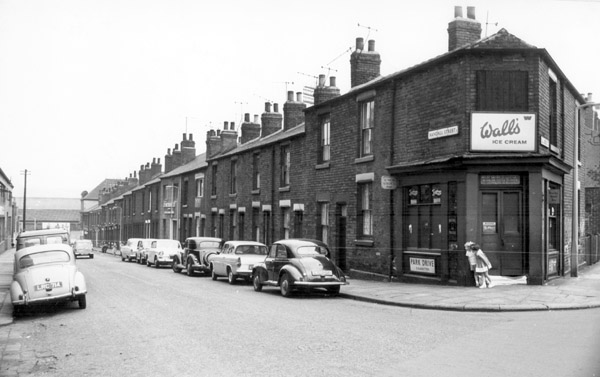
The family house in 1918 on Randall Street in Sheffield joins Bramall Lane with Hill Street. In fact it is directly opposite the Bramall Lane stand at Sheffield United's ground. The photograph below was taken in 1960 and shows Randall Street at it's junction with Hill Street. At the bottom of the street is Sheffield United's ground. All the houses are now demolished.
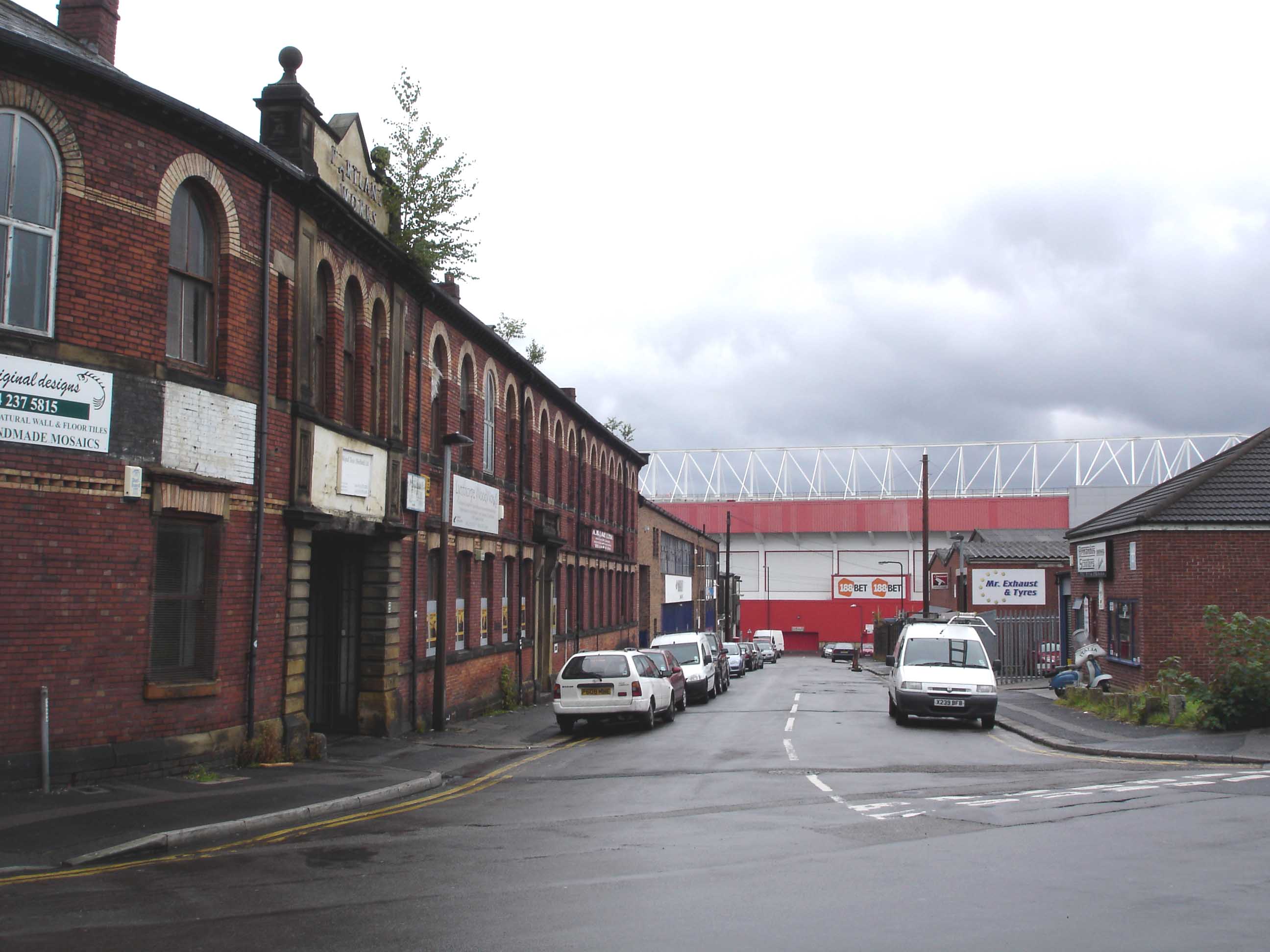
Randall Street 2012
The Burgess Rolls (Register of Electors) for the Spring of 1921 (St Mary's PD - Sharrow) shows that George and Alice Mary were still living at 82 Randall Street in Sheffield. I would like to know if they were aware of the fate of their son or were they like many others totally unaware of the circumstances surrounding George's death. Did they ever suspect that their eldest son GEORGE, who had shared their lives for some twenty years, was going to be gunned down by his colleagues on the orders of his employers.
In February 2007 I received an email from a descendent of George who supplied me with the following information which more or less confirms my suspicions
"While researching my wife's family tree, I came across your entry on the net regarding the execution of George Ainley. George`s father and my wife`s grandfather William were brothers. (children of George and Caroline). In that terrible war it was no wonder that men broke under the strain. I know that my father - in law was ill for the rest of his life due to shellshock and having been gassed . I discussed poor George`s death with my wife and she said that she never heard a thing from anyone in spite of it being a close-knit family. (my wife is 78 and I 81.). I am indebted to you for your website and the truth being finally revealed"
The 1911 Census also provided me with some more sobering news with regards to George's family. For the first time it was written by the householder rather than by an enumerator, and it also asked for the first time how long the couple had been married, and how many children had been born to the couple. George and Alice had been married 15 years and during that time had seven children, but only four were living at the time of the census.
As I often do when trying to trace families, I checked the excellent Sheffield Indexers site and found the following burial entries in Sheffield's City Road Cemetery
AINLEY, Albert Edward (Child, age 5).
Died at 15 Mary St; Buried on January 6, 1905 in Consecrated ground;
Grave Number 12148, Section X of City Road Cemetery, Sheffield.
AINLEY, Alice Mary (wife of George, age 46).
Died at 82 Randall St; Buried on May 20, 1922 in Consecrated ground; Grave Number 12148, Section X of City Road Cemetery, Sheffield.
AINLEY, Allan Ibberson (Son of George, age 3months). Consecrated ground;
Grave Number 12148, Section X of City Road Cemetery, Sheffield.
AINLEY, Dorothy Selina (daughter of George, age 7weeks).
Died at 82 Randall St; Buried on August 18, 1917 in Consecrated ground; Grave Number 12148, Section X of City Road Cemetery, Sheffield.
AINLEY, Willie Liversidge (child, age 13 months).
Died at 15 Mary St; Buried on January 12, 1907 in Consecrated ground; Grave Number 12148, Section X of City Road Cemetery, Sheffield.
Damms, John (child, age 8mo).
Died at 6ct Sylvester Gardens; Buried on May 2, 1883 in Consecrated ground; Grave Number 12148, Section X of City Road Cemetery, Sheffield.
Damms, Mary Ellen (child, age 18mo).
Died at 2ct Turner St; Buried on August 31, 1885 in Consecrated ground; Grave Number 12148, Section X of City Road Cemetery, Sheffield.
Heath, Elizabeth (Child, age 2mo).
Died at 6ct Norwich St; Buried on April 22, 1895 in Consecrated ground; Grave Number 12148, Section X of City Road Cemetery, Sheffield.
Singlehurst, May Eth. (Married, age 52).
Died at 3 Jessop St; Buried on January 27, 1886 in Consecrated ground; Grave Number 12148, Section X of City Road Cemetery, Sheffield.
The three children who died were all boys - Albert, Allan and Willie and so George was there only surviving son. And what happened the British Army executed him because his "military character was not good". You could not dream of a bigger indictment of the British Army than that. Of course they were in all probability totally unaware of George's family and their tragic history, but I get the strong impression that it would not have mattered one jot if they had have been. Compassion and understanding were scarce commodities amongst the generals of the British Army.
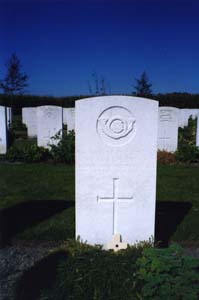
George's grave in Hagle Dump Cemetery
As a final footnote, George appears on St Mary's Church Roll of Honour, Bramall Lane, Sheffield, another indication that his relatives may not have been told the manner of George's death.
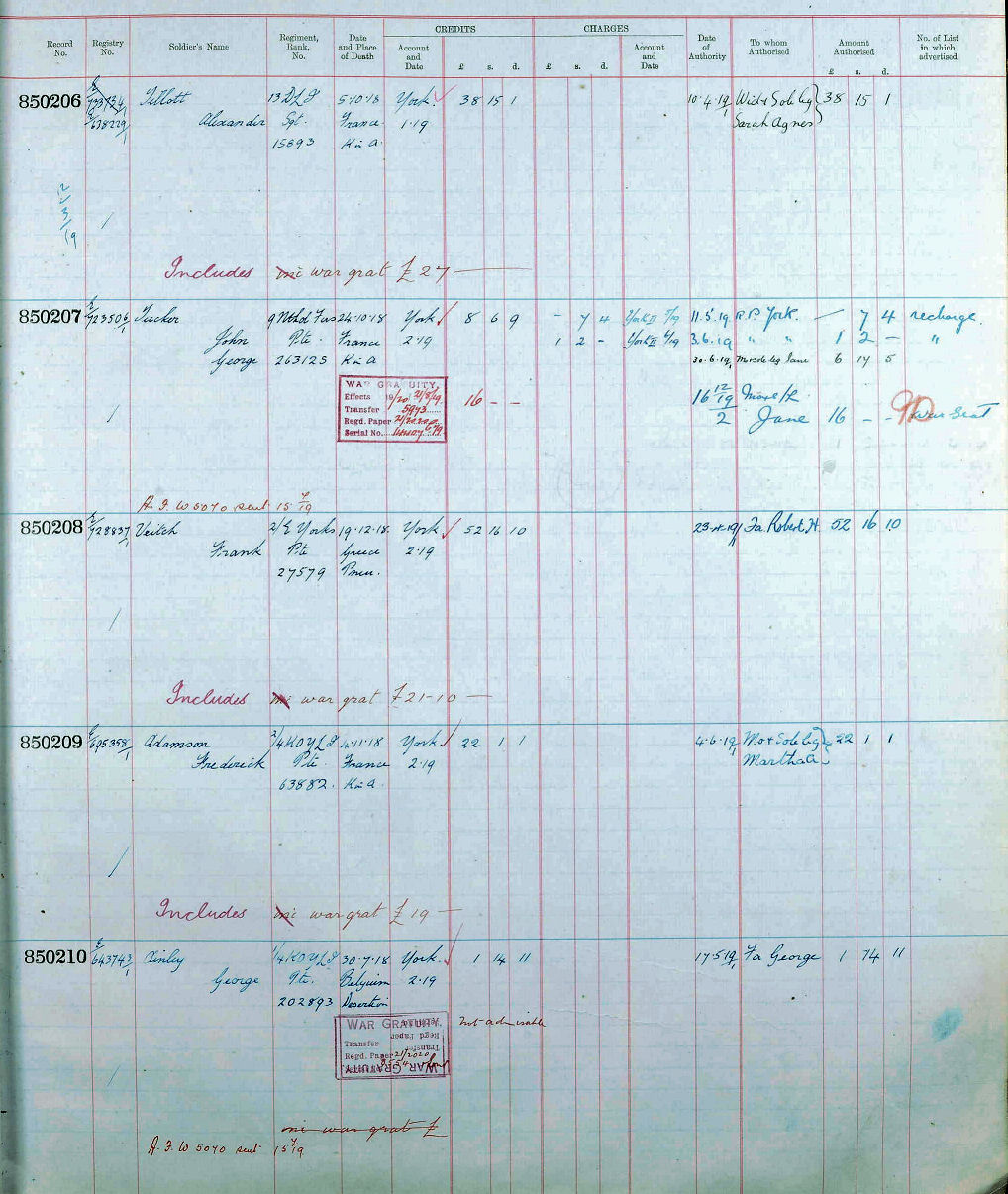
In November 2015 I came across this document which is a record of payments made to families after the cessation of hostilities. Those soldiers that feature of the sheet were killed in action (k.i.a) and their next of kin received a war gratuity plus any monies owing. The one exception was Record No 850210 George Ainley who is recorded as "30.7.18 Belgium Desertion" (it is worth noting that they did not use the word executed). The entry was stamped with the red war gratuity stamp but then in red ink next to the stamp is the term "not advisable". There is further writing below the stamp with war gratuity crossed out. And so having shot and killed their last surviving son, the British Army then refused to issue a war gratuity to George's parents. It really does beggar belief !
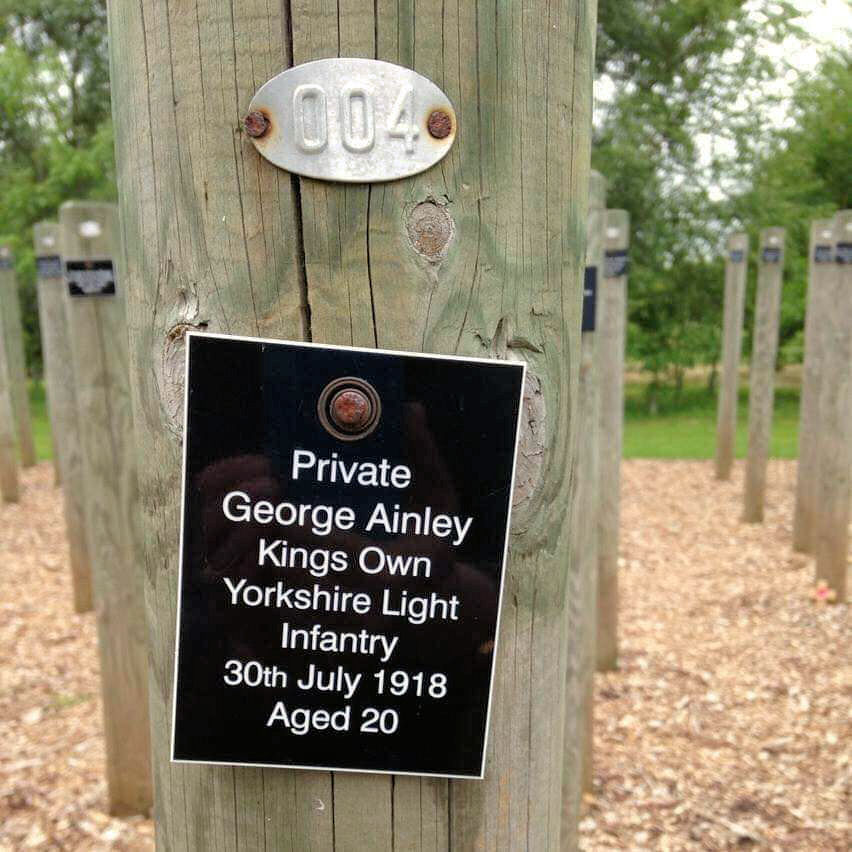
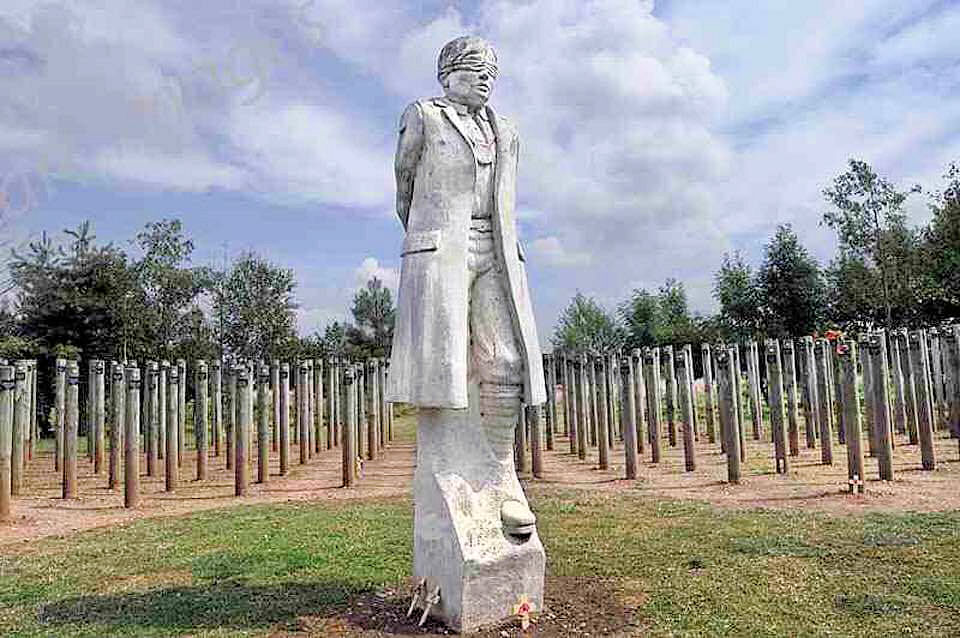
In November 2020, descendents of George kindly sent me the following photographs. They were taken at the National Memorial Arboretum.
Sources
Unquiet Graves Guide Execution sites of the First World War in Flanders - Piet Chielens and Julian Putkowski
Rusteloze graven gids – Executieplaatsen uit de Eerste Wereldoorlog in de Westhoek
The Guide is centred on the countryside around Ieper (Ypres) and Poperinge in the Westhoek of Flanders and visits the places of execution and graves of men 'shot at dawn' by the British Army in the Great War.Shot at Dawn - Julian Putkowski and Julian Sykes - The standard reference work about soldiers executed under the British Army Act in the First World War (1989).
Commonwealth War Graves Commission
1911 UK Census
Sheffield History Forum
This page was last updated on 19/11/20 15:22