
RAB HOWELL (1869 – 1937)
“..is believed to be the only true Romany to play for England”
Rabbi (Raby) Howell (born. October 12, 1867 in Wincobank, Sheffield - died. 1937) was a nineteenth century professional footballer who played for Sheffield United and Liverpool, and won two England caps. He was notable as the first, and probably only, full-blooded Roma ("gypsy") to play for England.
The two internationals that Rab played in were
The Pall Mall Gazette (London, England) dated Saturday, March 9, 1895; Issue 9347 gives some additional information on the fixture

Howell was born in a Roma caravan in Wincobank, Sheffield. His father was a horse dealer who sold pots and pans. He began his career with the Sheffield club Ecclesfield and also played for Rotherham Swifts before signing, with three other Swifts players, for Second Division Sheffield United in March 1890. It appears that they were lured to the Lane by the offer of 10/- a week in wages. He started at the club as a centre forward and then centre half. However in his second full season at the club he moved to wing half and when the club joined the Football League in 1892 he took up the right back position with Ernest Needham on the left. This is what Needham said in later years about his partner
"a gypsy by birth, perhaps owes some of his inexhaustible vitality to his lucky parentage. Certain it is that no man is more untiring. In his right-hand position this light-weight player (9st.12lbs or 57.3kg.) always excels. He rejoices at meeting the best of forward wings, and should the outside man indulge in dribbling he sticks to him like a leech. Many duels have I seen between him and [Fred] Spiksley [of Sheffield Wednesday], and generally Howell has come off best. Unfortunately he is a little too fond of keeping the ball too long, and loses many opportunities."

So Rab had become by common consent a highly skilled player despite his small size (5 feet 5 inches or 1.65 metres). Dennis Clareborough in his book “100 Greats – Sheffield United Football Club” states that many players were frightened of Rab as he was “hard as nails”, a ball winner who stuck to opponents like glue. He was fast and “terrier like” although his game was let down by both his passing and shooting.
In the book, Famous Association Footballers (1895), Howell is described as: "Formerly he played centre-half, but for his present club he has always occupied the position of right half with conspicuous success. He is small, but for his size he has not many equals. Very quick in his movements, he never tires, and plays equally well to the end of the game."
He won promotion with the Blades, and, in 1897-98, a Championship medal. He played for 5 years with United, making 155 League appearances for the club with 6 goals. He also played in 22 F.A. Cup ties without scoring, and 63 other games, scoring five goals. His overall total for the Blades was 240 appearances and 11 goals.
However his departure from the club was, and still is mired in controversy. During the five years at the Club, he was often in trouble for “off the field activities” and the United Committee would on occasion sanction Rab extra money so that he could meet his obligations. However matters came to a head in an away game against Sunderland at what was then their home ground, Newcastle Road (they did not move to Roker Park until the following season). United were in the midst of trying to win their first League Championship. But on two occasions during the match crosses came in from the Sunderland right, passed in front of Billy Foulke in the United goal, and looked as though they were going out for goal kicks. But both crosses were intercepted by Rab Howell who in attempting to clear the them, put both in the Sheffield United net.
Graham Phythian in his book "The True Story of William Foulke" recounts both goals. The first goal was a result of a hopeful cross by the Sunderland winger Morgan from somewhere near the corner flag. Billy Foulke moved forward to collect the cross but Rab Howell intercepted it, slipped in doing so and sent the ball into the net. The next goal came in the second half. Howell raced back to forestall a Sunderland forward and in doing so help the ball pass a bewildered Foulke and into the net. The Blades lost this vital game 3 - 1. Foulke was of the opinion that a player of Howell's skill and experience would not have committed two such appalling blunders in the same match, and such a crucial one at that. Foulke no doubt let it be known what he thought about the events surrounding Howell's goals. He was said to be incensed

Sheffield United FC circa 1895 - Rab Howell is sat down bottom right
In March 2014 I was contacted by a researcher who kindly provided me with the match reports from the newspapers of the time. They have been abridged and focus on Rab's performance.
"Sunderland Echo (microfilm photocopy, not terribly legible)
Sunderland v Sheffield United.
Teams representative of the above clubs met in a league match at the Newcastle Road ground on Saturday afternoon, in the presence of about 25000 spectators. The gate receipts amounting to ??? over £800. Sunderland were the first to score, Howell, in trying to save a shot from ???? putting through his own goal. Cunningham equalised the score about five minutes from the interval, and the teams crossed over with the scores level - one goal each. The second portion of the game opened in a sensational manner, Wilson scoring a second goal within a few seconds of the kick off. Shortly afterwards Morgan put the ball in the net a third time, but the point was disallowed on the plea of offside. Leslie eventually scored a third goal. The game ended in favour of the Wearsiders by three goals to one.
Sheffield Telegraph ….(relevant extracts only and mentions of Howell)
….Howell doing well to stop a fast run by the home left and Foulkes saved easily from Brown……
It was nine minutes from the start when Morgan put the ball across, and just as it was going out at the far side of the goal Howell got to it, and hooked it into his own net, Foulkes having no chance. This was hard lines as there was no home player near.
….It was left to Howell to stop another onslaught of the home left whilst Wilson outwitting him a second later put the ball beautifully across, but Foulkes cleared…
Close on five minutes from the interval a kick by Bennett was kicked out, but Howell returned it well, Cunningham got to it with his head, and made the scores equal, the goal being greeted with almost perfect silence. A bad blunder by Johnson then let in the home left, but Cain and Howell cleared in turn, Saxton, however, again getting hold, but being offside.
The kick off came to Wilson, and with only Needham touching the ball, he dribbled up and scored a superb goal, the ball going just inside the far post…. …Fine work by Dunlop was again noticeable and Howell had to kick out after a lot of good work in his goal. …
the third goal came at the end of a quarter of an hour , Morgan getting clear away and banging the ball across, Howell again being unfortunate enough to hook it through. … A foul to the home team close on the corner flag followed but Bennett relieved with a fine dribble from which Howell secured the ball, just missing with a fast low shot….United, however, gained a corner following a free kick, but Doig cleared from under the bar from Howell.
Independent (relevant extracts only and mentions of Howell)
Editorial commentary:
Howell kicked the ball through his own goal to the utter dismay of his comrades, and of Foulkes in particular….
…The game itself is one which will not readily be forgotten by those who saw it, and Howell’s feelings when all was over cannot have been pleasant. To score goals against one’s own team is to undergo just about as unhappy an experience as can be imagined, and in this case had a very apparent effect upon the remainder of his side. In the second instance, Foulkes would have easily saved without the slightest difficulty; in the first instance there was no need for interference at all, as the ball was actually going into touch on the far side of the goal – a long yard from the post. However, Howell in attempting to hook the ball out, had the mortification to slip in the mud each time, and shoot it past his own keeper….
…Howell was a long way below his usual form. In this I am not hitting a man because he is down; it was common talk after the game that he was not himself. It was in tackling that, for once, he was weak. …
Independent match report:
….Morgan shot across from the right-hand corner, and the ball glanced past Foulkes from Howell amid tremendous cheers…
..The home right took the ball up and Leslie had a contest with Howell. The result was that he got round the latter just on the goal line, and pushed the ball through, Foulkes having no chance to save owing to the closeness to him of the two players.
Athletic News
I haven’t been able to get at The Athletic News as it was out of bounds as Manchester do up their library. However, Graham Phythian had this in his notes, which is good enough for me:
(1) - on Howell's first own goal: "Howell slipped and hooked the leather into the net before Foulke had a chance to get near it."
(2) - on Howell's second own goal: "The ball appeared to glance off Howell's foot and go into the net." (Athletic News 7/3/1898)
So, I conclude that the first one was properly an own goal and that Howell slipped attempting to clear. The second was more of a deflection close to the line and the keeper was not able to get close. He didn’t have a great game but the conditions were absolutely terrible (pitch and crowd trouble etc) and he wasn’t the only one under par.
There are no other newspapers reports to go on that I could find (not in Newcastle or Birmingham or Liverpool)."
Now it may have have been an unfortunate accident but
the club did not see it that way. Their actions after the game seem to indicate
that they believed that Rab Howell was participating in some form of corrupt
practice. He was left out of the challenge match against Celtic and the Dewar
Shield match against the Corinthians. He played in the next match against West Bromwich
Albion
in which the Blades lost 2 - 0, with Howell having another poor game. The
rumours and no doubt the invective that Howell received led to him in
April 1898 being transferred to Liverpool FC for a fee of £200, with Rab making his
debut for the club in a game against Aston Villa. This was the last game of the
season and resulted in an impressive 4-0 win for Liverpool. The Anfield club
finished championship runners-up a year later with Howell missing only four of
their 34 games.
However by the time Liverpool landed their first title in 1901 Howell had lost his regular place in the team and that summer he moved on to Preston North End. In all, he played 68 times for Liverpool, scoring no goals.
His career was ended by broken leg in 1903 whilst playing for Preston. In April 2008 I was informed that after retiring from the game Rab opened a fruit and vegetable shop making local deliveries by horse and cart. Furthermore one of Rab's daughters married into a wealth mill owner's family.
Three years alter I was contacted by a football historian who stated that an extract in the Lancashire Evening Post when he died reported that around Xmas 1936 he had become practically blind. He had been a general labourer and night watchman. Rab died in Preston on 21st July 1937. His age was given as 69
In March 2012, I was contacted by the webmaster of England Football Online who was updated the biographies of those players that had in their time played for England. From our researchers we found out that Rab seems to have had a "varied" personal life as well as a professional one
According to the 1871 census, Rabbi is
the sixth child of eight to Thomas and Elizabeth. They're living in Stock's Hill
in Ecclesfield. His father is an agricultural labourer. Rabbi's birthplace is
stated as Brightside
According to the 1881 census, Raby is a scholar and has another sister. He is
one of five children remaining with their parents in Ecclesfield. His father is
a general labourer.
According to the 1891 census, Rabi is married to Selina, with one daughter,
Elizabeth. He is a coal miner and they live at the back of 147 Dunlop Street, in
Attercliffe cum Darnell, in the Carbrook area of Sheffield. His birthplace is
stated as Ecclesall.
According to the 1901 census, Selina, who is still stated as being married, is
living with her father Dennis Smith at 16 Newark Street in Attercliffe cum
Darnell. Rabi has three more children, Selina, Rabbi and Edith.
Rabbi however is remarried to Ada with one son, fourteen month old Leo, and
living at 3 Lilian Road in Liverpool, where he plys he trade as a professional
football player.
According to the 1911 census, Rabbi has retired and is now a small shopkeeper
along with his wife, Ada. Who also work at the shop. They have four more
children, Madge, James Joseph, Maria and Percy Vincent. They live at 27 Paradise
Street in Preston. The census reveals that they had ten children altogether, and
that five had tragically died in childhood.
Married twice, to Selina Smith [registered as Rabbi, Sheffield, March 1888],
then to Ada [married in 1898, but no registration found, so no maiden name
found]
Died summer 1937, aged 69 years n/k days [registered in Preston, Lancashire,
September 1937].
In February 2014 I received this e-mail from an author who had researched Rab's life and he offers this explanation for Rab's abrupt departure from Sheffield United
"You ask on your website if anyone has any information on Rab. I have done quiet a bit of research and written a novel about him. Official launch on 22nd Feb at the Copthorne, Sheffield. I've put more stuff on my website
He didn't marry the second time: to Ada. They just lived together. She was Ada McGrail: family ran a fruit and veg shop on Bridge Street. One of Rab and Ada's great grandsons still lives in Preston.
Rab lived in Brightside but was born in Dore: probably in a tent as the lane cited on the birth certificate isn't on contemporary maps but there is a lane that fits the bill with a well at the bottom.
I don't believe he was sacked due to match fixing. There is no evidence for it. Match reports do not give a reading to anything other than bad luck at the Sunderland game. Also I do not believe that Needham would have even mentioned him in his book if there had been such corruption at the heart of it. I believe the match fixing rumour was made up to fit known facts at the time. The bigger scandal, that required the club (founded on good Methodist principles) to cover it up, was him going off with another woman whilst still married.
He died on 21st July 1937
It is a perfectly feasible explanation and one that would be churlish to ignore. Rab had always been a thorn in the side of the United directors, and it is possible in the light of the Sunderland game that they "played up" Rab's performance and inferred that he thrown the game. It is also true that Sheffield football at the time was dominated by men who had strong Christian and Temperance beliefs and they would have been aghast at the way Rab was conducting his life off the field.
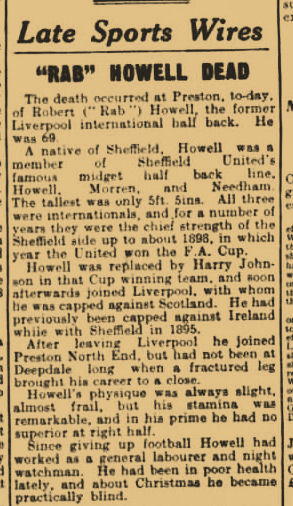
His death was widely reported in the regional press but usually as a footnote. The following obituary is more substantial and is taken from the Lancashire Daily Post dated 21st July 1937

There was also an obituary in the Liverpool Echo dated 21st July 1937. It seems from the report that Rab ended his life in poor health
A small notice also appeared in the Births Marriages and Deaths

In November 2015 I received an e-mail from a reader who informed me that on Friday 20th November 2015 a headstone was unveiled on the previously unmarked grave of Rab Howell - 78 years after he died. Full details of the ceremony and a photo can be found on the Football Unites Racism Divides website. There is also an article in the Lancashire Evening Post dated 21st November 2015
References
The Pall Mall Gazette (London, England), Saturday, March 9, 1895; Issue 9347
Needham, Ernest (2003 reprint of 1901 original). Association Football. Cleethorpes: Soccer Books.
Wikipedia, the free encyclopaedia
Dennis Clareborough 100 Greats – Sheffield United Football Club
Graham Phythian -"The True Story of William Foulke"
The Complete Record of Sheffield United FC
Famous Association Footballers (1895)
Football Unites Racism Divides
Lancashire Daily Post dated 21st July 1937
Liverpool Echo dated 21st July 1931
Notes
I have stated that Rab Howell is believed to be the only “true Romany to play for England” The former England international and England manager Sir Alf Ramsey was supposedly descended from Roma’s. A review in the Daily Telegraph 30th April 2006 of a biography of Sir Alf quotes the following story
“As for (Bobby) Moore, whom Ramsey had made captain at the unusually tender age of 22, the manager recognised that he was a pillar, for all his indiscipline and his cheek - towards even Ramsey, who, when young, had been nicknamed 'Darkie' and occasionally (almost certainly mistakenly) held to have gypsy blood. The journalist Nigel Clarke tells of Ramsey's fury one day when the team coach was going through Czechoslovakia: 'It passed some Romany caravans. And Bobby piped up "Hey, Alf, there's some of your relatives over there." Alf went absolutely crimson.'
Sheffield United did eventually win the League Championship in 1898 for the first and sadly the only time. They finished the season on 42 points, three points ahead of their nearest rivals Sunderland and seven points clear of the third club Wolverhampton Wanderers
Wednesday, July 21 – 1937
The death occurred in Preston to-day at the age of 69 of Robert “Rab” Howell, one of the famous “midget” half back line of Sheffield United 40 years ago. Howell, Morren and Needham were a notable middle line, the tallest being but 5ft. 5in. All three were internationals, Howell being capped against Ireland in 1895, and against Scotland in 1899 when he was with Liverpool.
(Nottingham Evening Post, 21-07-1937)If you can supply any further information on Rab Howell, especially after his career finished, please contact me.
This page was last updated on 12/05/20 10:59