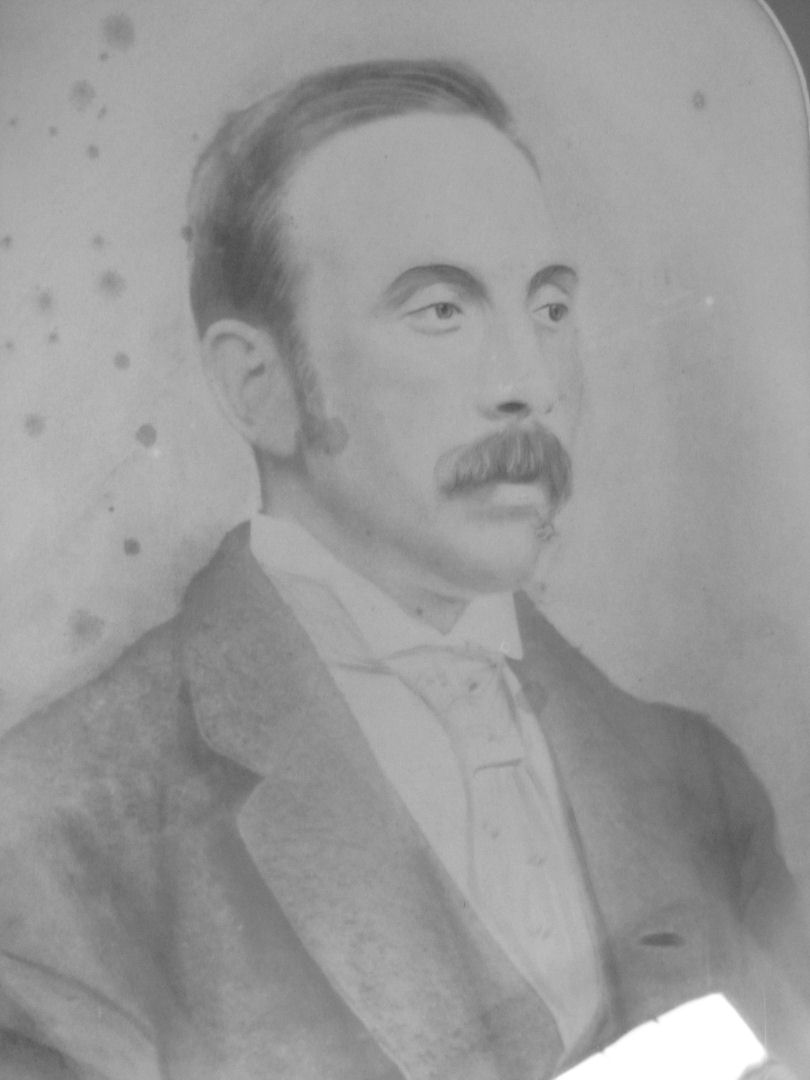
PRIVATE GEORGE SANBY
York and Lancaster Regiment No 4929
There is a soldier who is honoured by the Commonwealth War Graves Commission who was in all probability is related to my grandmother. For a number of years I was unable to establish the exact relationship apart from the fact that he is not her brother. But in late 2010 I established that he was the son of Joseph and Jane Sanby, my gran's uncle and aunt and so he was my gran's cousin, He was born in Sheffield in 1885, and married a MAUD UNWIN the daughter of THORNHILL UNWIN early in 1916.
In Memory of
|
As I have stated a few of my ancestors are be buried in St Mary's Cemetery. St Mary's is one of three cemeteries on the hillside between Rivelin Valley Road and Bole Hill Road Sheffield. On the lower slopes there is St Michael's RC cemetery. Above that is St Mary's cemetery which is the cemetery for St Mary's Church, Walkley (CofE). St Mary's cemetery is now closed and in many places quite overgrown. There is still an occasional burial but that is in existing family plots.
I know very little about the life and indeed the death of Private G Sanby. The 1901 census just states that he is a 15 year old wood turner living with his parents JOSEPH and JANE SANBY in some slum in Sheffield's Park district.
The 1911 Census gives the following information on George
Name George Sanby
Relationship to Head of Household Son
Condition Single Gender Male
Age 25 Estimated Year of Birth 1886
Occupation Unemployed Moulder Lab
Employed Yes Working at Home No
Industry Steel Works
Place of Birth City Of Sheffield County Of Yorkshire
Enumerator Information - Address 48 Bray Street Sheffield Parish Sheffield Town
Sheffield
Type of Building Private House Number of Rooms 4 Rooms Inhabited Yes
Reference RG14PN28021 RG78PN1600 RD510 SD7 ED33 SN275 Administrative County
Yorkshire (West Riding)
Registration District Sheffield Registration Sub District Attercliffe
Enumeration District 33
Reference Information Folio 549 Page 1 Piece 28021 RD number 510 SD number 7 ED
number 33 Schedule 275
His widowed mother JANE was head of the household. Living at the same address were his brothers HENRY and JOSEPH, and two sisters NELLIE and MINNIE
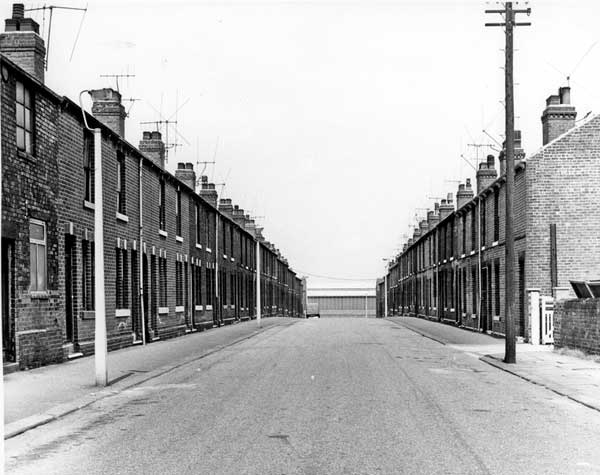
Bray Street Darnall Sheffield 1966 - the whole street was demolished and is now a meaningless cul-de-sac
Given the Regiment and the date of death it would be fair to assume that he fought in the Battle of The Somme which started on 1st July 1916. I can however state that George died in this country rather than in France. The Imperial War Museum have stated that NO British soldier who died abroad during the two World Wars was brought back to this country for burial. The war graves that people see throughout this country belong to those who actually died here, presumably through ill-health, the result of wounds received in active service or in accidents. The reasoning behind the decision was that all should be equal in death and consequently all bodies would be buried where they had died. This was to prevent those who could afford it, repatriating the remains of their loved ones for burial whilst those who could not afford it had the double distress of bereavement and no access to their graves. From the death certificate it looks as though he died in a hospital in Manchester Lancashire from the wounds he sustained in the battle. His body must then have been repatriated to his family for burial in Walkley. His wife of a few months was just 22 years of age when George was buried. She died in 1918 but to date I do not know the cause of death.
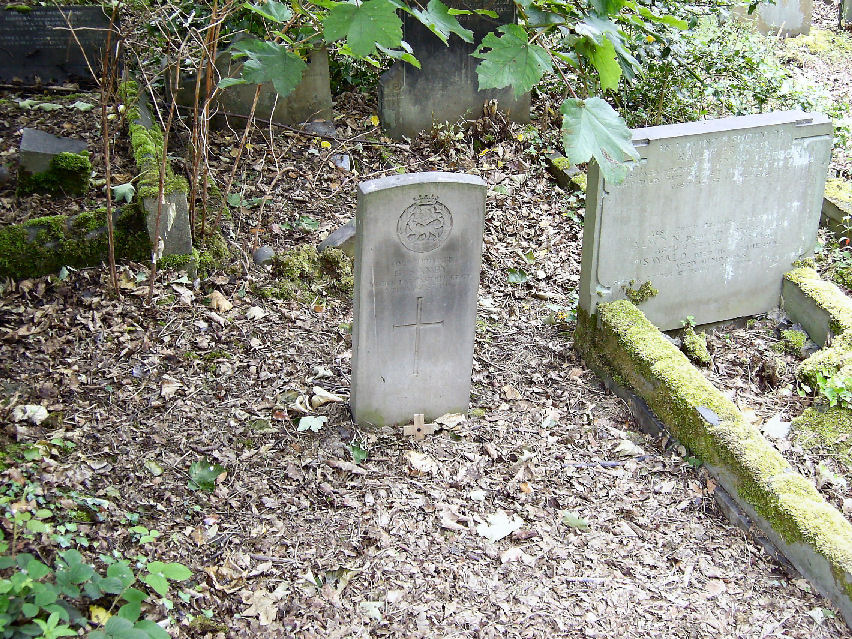
I visited the grave on a number of occasions since finding its location. I must admit it does seem rather lost and forlorn amongst the other civilian graves. The photograph of the George's last resting place was taken in June 2006
Dulce et decorum est Pro patria mori by Wilfred Owen M.C.(1893-1918)
My friend, you would not tell with such high zest
To children ardent for some desperate glory,
The old Lie: "Dulce et decorum est Pro patria mori."
Translation: "It is sweet and meet (fitting) to die for one's country."
George appears on the Roll of Honour in St Bartholomews Church, Primrose View, Langsett Road, Sheffield
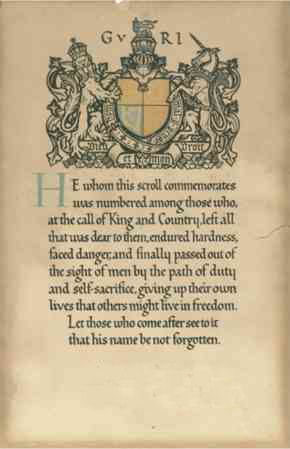
Those that lost members of their family in the war also received a scroll. Sadly I do not know what happened to George's but I would like to think that it hangs on a wall somewhere, and is viewed with both pride and admiration by his descendents.
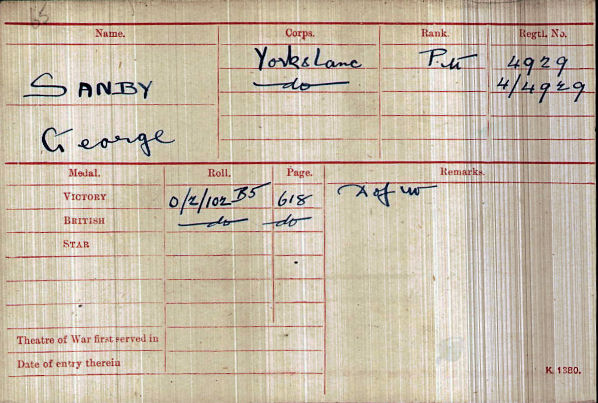
George's Medal Card
In November 2012 I was researching another branch of the SANBY family when I came across the following
Sold Date: 05/19/2012
Channel: Online Auction Source: eBay UK
Category: Militaria & Weapons
WWI British War Medal and Victory Medal with ribbons, marked with the name Pte G
Sandy Yorks & Lancs, who I believe was a friend of my Grandmother.
Both medals and ribbons are original and came from her house. Any question
please ask.
I've just remembered. my Grandmother said that the G was for George. As adding
this note I've noticed that the name I've typed is wrong, it's Sanby not Sandy.
To say I was dumbstruck with this revelation would be an understatement.

The seller did include a photograph of the medals which are pictured above.
And so it looks as though the medals are now in the hands of a collector and not the family.
I have also just accessed George's World War 1 Service record. It notes that the medals were sent to THORNHILL UNWIN, George's father in law, who was his next of kin after the death of his wife Maud. I can only assume that the grandmother the seller identifies as the previous owner of the medals must have been either the daughter or grand-daughter of Thornhill Unwin.
And on 27th October 2014 I received this fascinating information from someone who had come across this page whilst researching his own ancestor
". I was interested because my grandfather (John Wallace) was in 1/4 York and Lancs (Hallamshires) before the start of the war and served right through it. His number was 2251. He could well have known George. My grandfather was born in 1896 and lived in Sturges St (Heeley? - not sure) and he was 18 or 19 when the battalion sailed for France in April 1915. He was a machine gunner and was transferred to Machine Gun Corps (new number 23625) in January 1916. We think he continued to serve alongside his old battalion. He was awarded a DCM for action on 7th July, near Thiepval “in repairing his gun during a German counter attack, covering the infantry retirement and destroying his gun at the last moment” (MGC 149 Coy war diary). Subsequently he seems to have been transferred back to Y&L and was finally moved to "Z Class Reserve" on 28th Feb 1919. Before and after the war he worked at Laycock's. He died in 1947 after suffering from Parkinson's disease for a long time and is buried at Tinsley cemetery. I've heard that the illness might be associated with being exposed to noxious chemicals, so the war might have had something to do with it.
Just in case you haven't got this interesting link - here is the link to a film of the Hallamshires marching through Sheffield (presumably to the station) on November 3rd
1914:
One week today will be the centenary of that march. George and John are in it - maybe some genius will be able to identify them!"
And in November 2015 I finally received this information regarding George and his medals.
"I attach a photo that my Dad said was George but my Grandmother had died and could not confirm this. The picture had been in her attic as long as my Dad could remember, and is not of my Granddad or Dad. Hopefully you can confirm that it’s George. Is he too old for somebody who died at 31?"
A mystery solved!
NOTES
Birth registered in the June quarter of 1885 Sanby George
Ecclesall Bierlow Vol 9c page 340
Marriages Mar 1916 Sanby George Unwin Maud Ecclesall B. 9c 568
Deaths Sep 1916 Sanby George 30 Chorlton 8c 607
Deaths Sep 1918
SANBY Maud 23 Wortley 9c 401
Births Dec 1894
Unwin Maud Ecclesall B. 9c 369
St Bartholomew's Church Marriage Records
4 Aug 1912 - HOBSON Ernest Jeffcock Bach 22 son of Henry Jeffcock
SANBY Nellie Spinst 19 dau of Joseph (Dec)
23 Mar 1913 - SANBY Joseph Bach 30 son of Joseph (Dec)
KAY Mary Spinst 23 ---
13 Feb 1916 - SANBY George Bach 29 son of Joseph Dec)
UNWIN Maud Spinst 21 dau of Thornhill
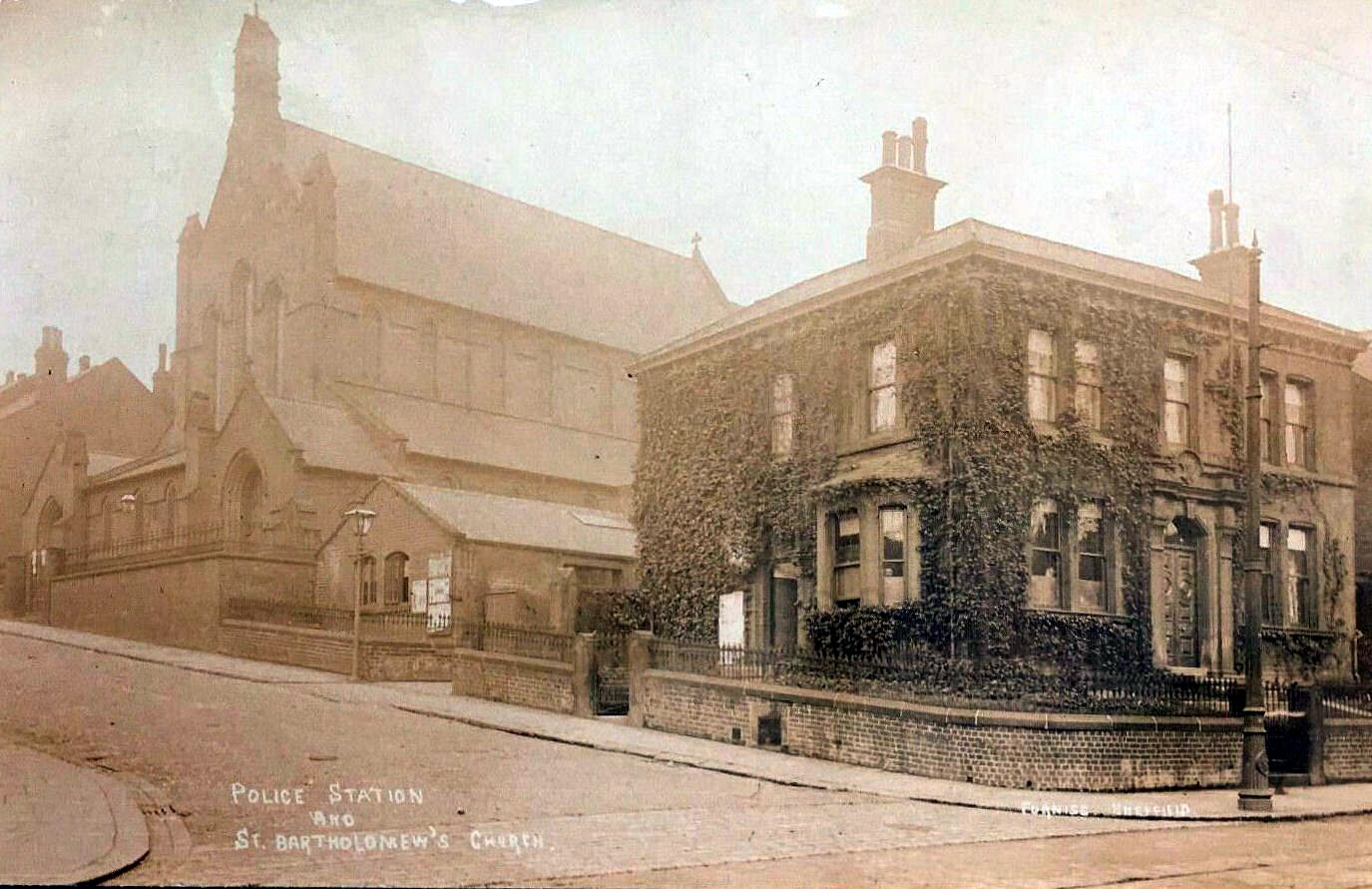
St Bartholomew's Church, Sheffield
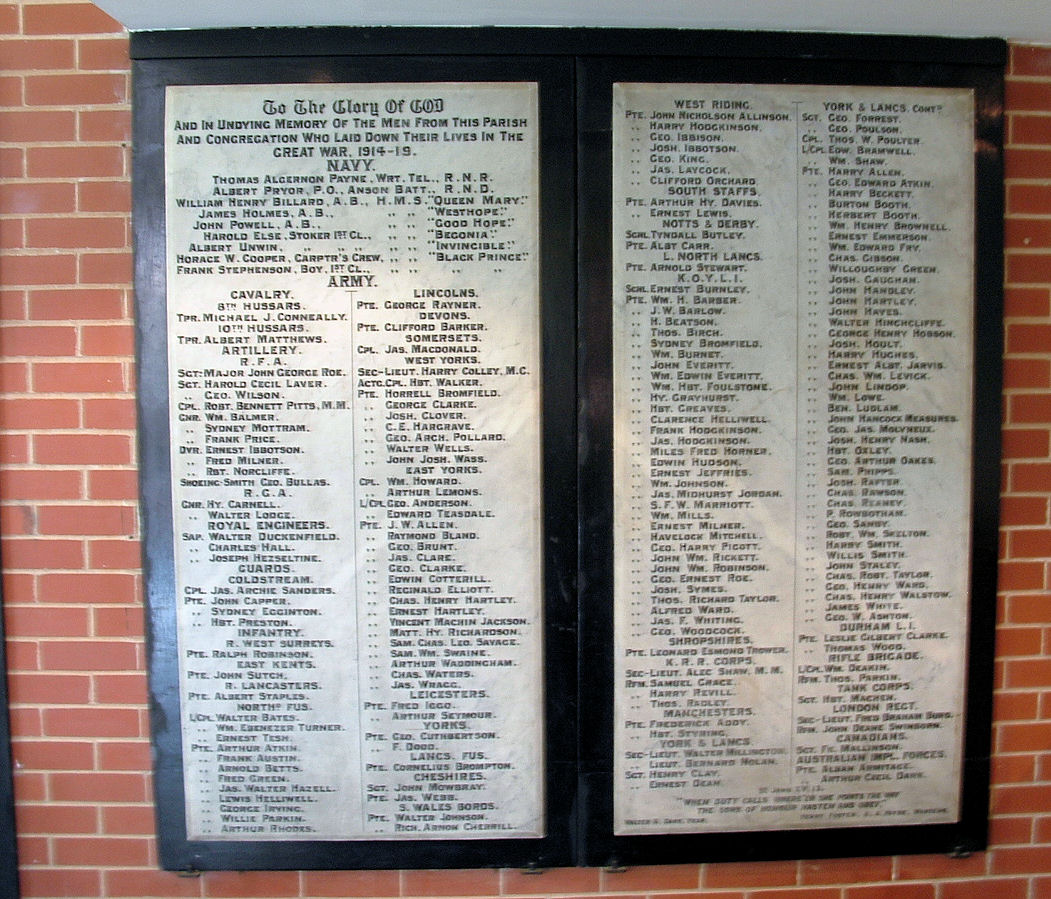
St Bartholomew's Church War Memorial
George is remembered in the fourth column - Pte Geo. Sanby
The only person I can locate in the 1911 Census who "fits" the profile for George's bride is
Personal Information Name Maud Unwin Relationship to Head of Household Daughter Condition Single Gender F Age 16 Estimated Year of Birth 1895 Employed N Working at Home N Place of Birth Sheffield Yorks Enumerator Information Address 403 Penistone Road Sheffield Parish Ecclesall Town Sheffield Type of Building Shop Number of Rooms 5 Rooms Inhabited Y Reference RG14PN27714 RG78PN1587 RD509 SD1 ED14 SN68 Administrative County Yorkshire (West Riding) Registration District Ecclesall Bierlow Registration Sub District Ecclesall North Enumeration District 14
The Military Geneology website gives the following information on George
Regiment, Corps etc: York and Lancaster Regiment
Battalion/etc: 1/4th (Hallamshire) (T.F.) Battalion.
Surname: Sanby
Christian Name: George
Born: Walkley, Sheffield
Enlisted: Sheffield
Residence:
Rank: PRIVATE
Number: 4929
Died Date: 07/08/1916
Died How: Died of wounds
Theatre of War: Home
The 4th (Hallamshire) Battalion, The York and Lancaster Regiment (Territorial
Force) owed its origins to the Hallamshire Rifle Volunteers formed in the
parishes of Sheffield and Ecclesfield (referred to as Hallamshire) on 30 Sep
1859. The battalion was ordered home after only a week of annual camp at Whitby
in Jul 1914 in order to prepare for war. In common with other territorial
infantry battalions split itself into two and eventually three lines during
World War I. These were numbered 1/4th,2/4th and 3/4th Battalions respectively.
The 1/4th (Hallamshire) Battalion, The York and Lancaster Regiment (Territorial
Force) was mobilised on the outbreak of war on 4 Aug 1914 at Sheffield and was
assigned to the 3rd West Riding Brigade in the Wes Riding Division. In Aug 1914
it moved to Doncaster and in Nov 1914 to Gainsborough, Lincolnshire. Feb 1915
found the battalion in York. The battalion landed in France on 14 Apr 1915 at
Boulogne. On 12 May 1915 the formations were retitled 148th Brigade and 49th
(West Riding) Division. The 1/4th Battalion first saw action in the Ypres
salient in Jun 1915, where they were to remain, in and out of the trenches, for
six months, losing 94 killed and 401 injured. After a period of rest in the
Calais area, the battalion moved to the Somme where, on 1 Jul 1916, the
battalion was in the follow-up assault wave. In the three months the battalion
was engaged in this battle, the 1/4th Battalion lost 27 officers and 750
soldiers killed and wounded. Enduring what was described as "wearying routine of
six days in the line followed by six days in reserve", the battalion at Nieuport
in the last two weeks of Jul 1917, had the dubious honour of being subjected to
the first use of mustard gas, sustaining some 288 casualties.
From here, it was back to the Ypres salient where the
battalion suffered further heavy casualties in the German spring offensive of
1918. In the final Allied Advance to Victory, the Hallamshires were ordered on
13 Oct to reach the line of the river Selle, that was supposedly undefended on
the western bank. The battalion advanced across open ground without artillery
support to find strongly defended enemy positions. The 1/4th Battalion achieved
its objective but with only 4 officers and 240 men present of the 20 and 600 who
had started the advance. The 1/4th Battalion's last action of the war was 28 Oct
1918 when the Commanding Officer, Lieutenant Colonel D S Branson was severely
wounded. The battalion ended the war on 11 Nov 1918 in the same formation at
Leforest, north of Douai, France.
Return to Main Family History Page
This page was last updated on 02/02/26 11:26