SIR JOSEPH JONAS (1845 - 1921)
Before I can recount the events of 1918, it is necessary to give a brief biographical account of Joseph's life and career up to the point.
The most succinct account is in The Story of Old Attercliffe (Part3) by C.R.Vine B.Sc
Born at Bingen, on the Rhine, in 1845,(see note 7) and educated there, Joseph Jonas came to Sheffield about 1870 and commenced in a small way as steel manufacturer in Bessemer road. Two years later he was joined by Robert Colver, of Western Bank, and in. 1875 the firm had become Jonas, Meyer and Colver, manufacturers of steel for tools, files, saws and other things. By 1890 'Jonas and Colver ' formed one of the most prosperous concerns in the district, and when, later on, the famous high-speed steel (to which they gave the name of 1 Novo') made its impact upon the industrial world, Messrs. Jonas and Colver, were amongst the first in the market with the new steel. Extending business necessitated drastic enlargements, and their new premises eventually covered a very large area.
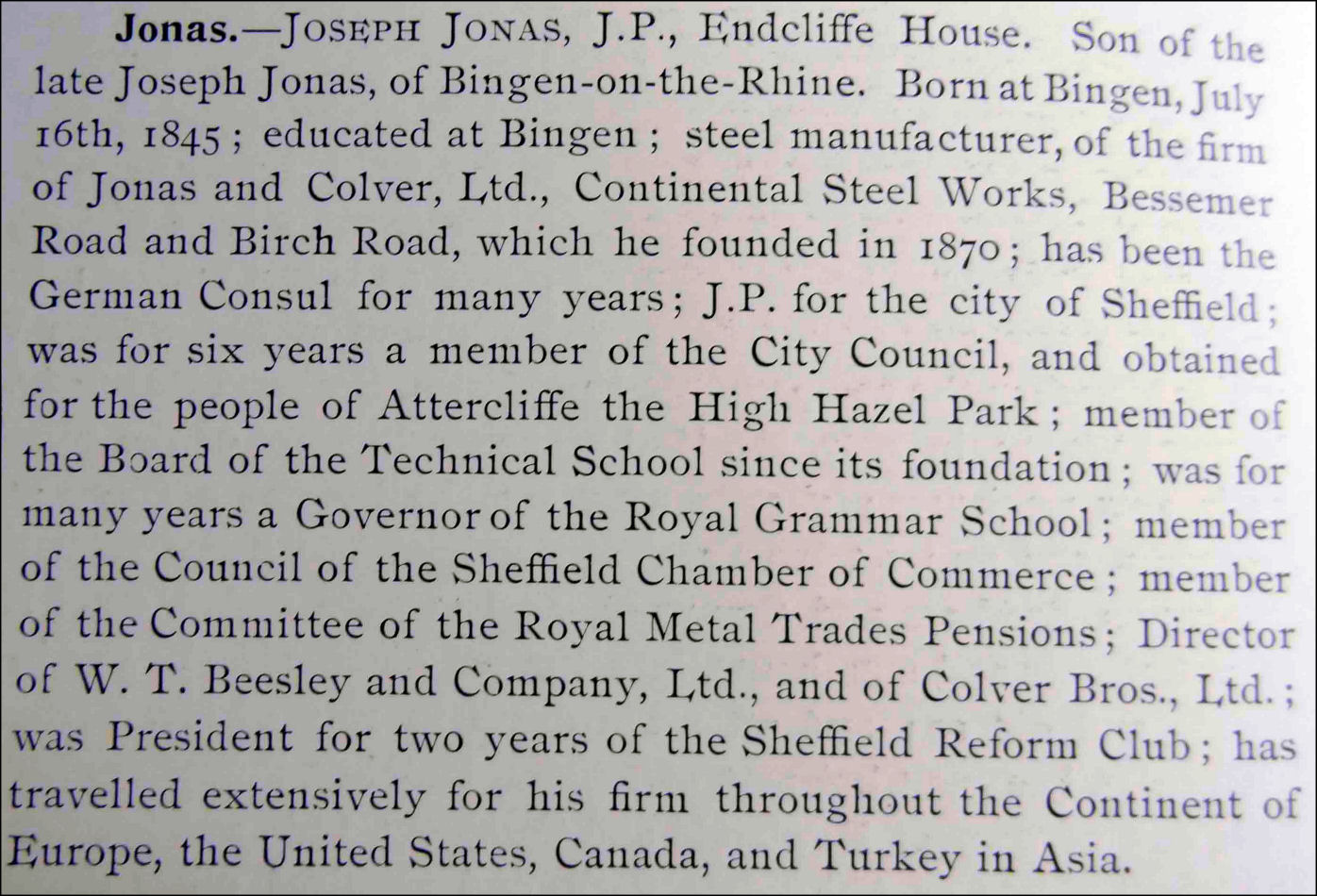
A volume that is kept at the Local Studies Library - Sheffield at the Opening of the Twentieth Century - Contemporary Biographies has the following entry
together with a photo of Joseph

The next cutting is from The Financial Times dated 20th December 1907
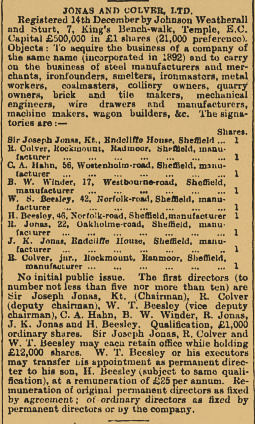
Mr. Jonas was returned unopposed as town councillor for Attercliffe in 1890,
following Mr. Edward Langton in the Council Chamber (which
eventually became the main room of the former Reference Library in Surrey
street). Thanks to the initiative of Mr. Langton, who, with
his brother, resided at High Hazels for some years, and subsequently to
Councillor Jonas's good efforts, the park was acquired, by
purchase, for the benefit of Sheffield in 1894, including the house built in
1850 by the first mayor, Mr. William. Jeffcock, which is
now, among other admirable features, a gallery of. valuable, and valued, old
Sheffield pictures. Mr. Jonas became Lord Mayor in 1904
and received the Royal favour of Knighthood in the same year. His partner, Mr.
Colver, likewise shared his townsmen's confidence, being
elected to the time-honoured office of Master Cutler in 1890...."
Apart from his contributions to civic life, he was also a valued benefactor to the newly formed University of Sheffield, as well as contributing to many other local charities and institutions. By achieving the post of Lord Mayor in 1904 as well as been rewarded with a knighthood, he had reached the pinnacle of local civic life. He was one of Sheffield's leading figures at the turn of the twentieth century.
Perhaps this is best illustrated from the front page of The Daily Mirror dated 11th April 1908

The photo in the bottom centre shows Sir Joseph just behind the new Prime Minister Herbert Asquith who was just returning to Britain after meeting King Edward V11 in Biarritz.
In the 15th May 1916 edition of The Times, there is a small paragraph entitled "£32,000 for Sheffield University." It states that "Under the will of the late Mr Edgar Allen, steel manufacturer of Sheffield, the University of Sheffield has received the sum of £32,000. Five thousand of this is for the Applied Science Department and to this sum Sir Joseph Jonas has added £5,00. The total of £10,000 will be devoted to the provision of a material testing laboratory to be called the Allan and Jonas Laboratory"
I knew of Jonas & Colver, as a Sheffield steel firm but did not bother much about the company until I came across the following article in The New York Times Archive. Whilst some of the information is incorrect, I was astounded to find that a former Lord Mayor of Sheffield acted in a manner prejudicial to the interests of the state.
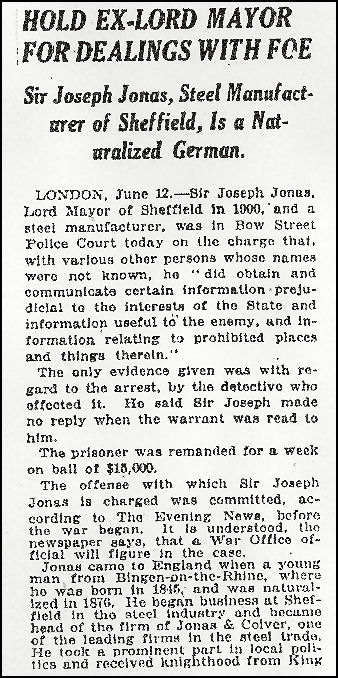
The following month the following article appeared in
NEWS OF THE WORLD Date: 21st. July1918; Section: Front page; Page:1
AN INTERESTING CASE
SIR JOSEPH JONAS TO STAND HIS TRIAL THIS WEEK
|
Two interesting trials will take place at the Old Bailey this week, before Mr Justice A. T. Lawrence. In the one case Sir Joseph Jonas , 73, the millionaire steel manufacturer, and ex-Lord Mayor of Sheffield, who was born at Bingen-on-Rhine, and subsequently naturalised in this country, will be indicted, in company with Chas. Alfred Vernon, 37, an official of the Ministry of Munitions, and August Kahn, Vernon's father, for conspiracy to contravene the Official Secrets Act by obtaining and communicating for a purpose prejudicial to the interests of the State, information prejudicial to the interests of the State, viz., information relating to a new rifle which Messrs. Vickers were making and to their Crayford works, a prohibited area. The other case concerns Mrs Wohlgemuth, of Church-crescent, Muswell Hill, the French wife of Dr. Adolf Wohlgemuth, a naturalised British subject, whom she is alleged to have shot in the back. The injured man was removed this week to a Harringay nursing home, and it is possible that he may be able to give evidence. At the police-court his depositions were put in. The charge is one of attempted murder. There are 52 cases in the list. The only murder charge is that in which Bertha Carbuccie stands committed for the murder of her husband, a French soldier at Staines |

Sir Joseph Jonas leaving Bow Street Magistrates Court after the initial hearing
Daily Mirror 13th June 1918
A week later the News of the World disclosed the following details of the trial
NEWS OF THE WORLD Date: 28th July 1918; Section: Page Two; Page:2
EX-LORD MAYOR ON TRIAL SENSATIONAL CASE AT THE OLD BAILEY
_______
CHARGE UNDER OFFICIAL SECRETS ACT.
Great interest was taken at the Old Bailey in the trial, before Mr Justice
Lawrence, of Sir Joseph Jonas, the wealthy steel-master and an ex-Lord Mayor of
Sheffield, who was indicted with Charles Alfred Vernon, 38, and Karl Auguste
Hahn for conspiring to contravene the Official Secrets Act by obtaining and
communicating for a purpose prejudicial to the interests of the State
information which was calculated to be, might be, or was intended to be useful
to an enemy. Sir Joseph Jonas, who is 73, appeared to have aged since he
appeared at Bow-street. He followed the proceedings with evident anxiety. Hahn
who is 66 and the father of Vernon, was separately indicted for conspiring with
Paul von Contard, of Berlin, and Richard Zieschang, formerly a foreman at
Vickers' Works at Crayford, to contravene the Official Secrets Act, but was
acquitted early in the trial. Vernon's name was originally Hahn but he changed
it in August, 1914. He was the London agent of Sir Joseph Jonas' firm, and was
recently employed in the Ministry of Munitions. The Attorney-Journal (Sir F. E.
Smith, K.C) said that Jonas was a native of the Grand Duchy of Hesse, and was
naturalised as a British subject in 1870. Hahn was also of German origin and was
naturalised in 1884. Sir Frederick, continuing, outlined the result of the
police searches in the office of Sir Joseph and in the rooms of Vernon. "No
material documents were found in the possession of Vernon," he said, "which
indicates that he had hidden them in some other place. It is clear, however,
that Vernon had been in communication with Jonas for a considerable period on
forbidden matters. In November, 1913, a man, Zieschang, was employed as foreman
at the Crayford Works of Vickers Ltd. Since the prosecution began he had been
discharged. another person who figures prominently in the correspondence is Paul
von Gontard, who from the tone of it is an intimate friend of Jonas. He resides
in Berlin, and is connected with an armaments firm which manufactures small arms
on a very large scale. "The glaring impropriety of any one in this country
obtaining information as to our small arms and making it over to a German in an
official position and connected with a company making similar goods for the
German Army needs no words from me." The Attorney General said that at the time
of the correspondence Vickers were making
A NEW RIFLE FOR THE ARMY
and the plans and specifications were stored at Crayford. The documents showed
that through Vernon Jonas obtained particulars of what was going on at the
Crayford factory from Zieschang. The bulk of the documents were found in a
locked cupboard at Sir Joseph's office, and one with the printed heading of the
firm ran:-
Alfred who has a friend named Zieschang, who lives at Crayford, tells me that at
Vicker's works there they are filling up with an American machine, and laying
themselves out to supply the British Government with small arms in a very big
way.
This was signed "C.A.H.," and in Sir Joseph's handwriting was the inscription,
"Please let me have this letter back when I am in Sheffield." On receipt of that
document Sir Joseph, apparently without any request from von Gontard, the Berlin
magnate wrote to him about the contents of the letter, and received a reply
declaring that von Gontard would be grateful if he could give him the
approximate area of Vicker's new works and other important details concerning it
and the new rifle. Then Sir Joseph Jonas appeared to have dictated the following
memorandum to Vernon:-
. . . . What is the size of the new rifle works at Vickers; where are they
situated; how many rifles do they propose to make a day; how many men have they
employed; and could you get to know whether they have any orders from abroad,
and perhaps from your Government? Your information, of course, will be treated
as strictly private. Possibly your friend could get me this information, which
kindly post to me privately.
The Attorney-General added:- "I ought to add here
A FACT THAT MAY ALARM YOU
It will be proved before you that the information Vernon obtained from Zieschang,
and supposed to relate to a gear box, really related to new gear, which Vicker's
were manufacturing to be used in the steering of His Majesty's ships." Another
letter in 1913, written by Jonas, asked Vernon to get the information as soon as
he could. A letter from Vernon followed, giving facts as to Vickers' rifle
factory, and a letter from Jonas to Vernon asked for positive news as to the
small arms, and stated:- "I am pressed for the information." A long letter from
Jonas to von Goulard contained the following:
"Vickers and another firm have together expended £100,000. The Japanese were to
pay the rest, but the worthy Poles did not pay, and the company is now in a hole
... I know still more about the proposed steel works. Please do not mention the
Vickers matter to anyone, because we are not gossips."
After an interview with Zieschang on November 28, 1913, Vernon wrote to Jonas-:
"I am at last able to give you a little more reliable information, after having
today paid a visit to Crayford." The letter declared that 4,000 would shortly be
employed at Crayford. The Attorney-General continuing, quoted from the letter:-
"I gather a very elaborate system of machine ............ with the intention of
automatic production by girl labour. In addition, I am told, preparation is
being made to manufacture 200 flying machines with engines of 200-horse power.
They are also interested in the varying speed gear to which I made reference in
my last. If there is any other information I can later on procure I shall be
glad to tender any further service."
Later con Gontard wrote to Sir Joseph Jonas recording his best thanks " for your
kind lines", and concluding "Best wishes from home to home." Hahn had
erroneously supposed to be dead, and he was not included in the original charge,
but afterwards appeared at Bow-Street with the others. "The charge is a very
grave one," the Attorney-General concluded "even at any time and in any
circumstances. It is made much graver by the terrible situation in which this
country finds itself today." After police and other evidence, Col Stuart Brown,
experimental instructor in small arms at Hyde, expressed the opinion that the
information contained in the documents produced in court would be useful to the
enemy. On the close of the case for the prosecution Mr Tindal Atkinson submitted
that there was no case to go to the jury. Mr Justice Lawrence said the Act of
Parliament was clear. It was passed to protect the Government from having plans
and acts communicated to others which was deemed prejudicial to the State. Mr
Atkinson said his defence was that Sir Joseph Jonas had not the slightest
intention of doing anything prejudicial to the State. He obtained this
information merely to satisfy a trade inquiry made to him by a customer, and not
with any purpose of prejudicing the State. Counsel argued further that Vickers
Ltd, was not a prohibited area within the meaning of the Act. Sir Ernest Wilde
submitted that there was no evidence again Hahn. After legal argument, Mr
Justice Lawrence held that there was no evidence against Hahn, and the jury, by
his direction returned a verdict of not guilty, and Hahn was discharged. Sir
Joseph Jonas in the witness box, gave particulars of his German origin and
connection with Sheffield, and said that both before the war and since he had
always been against the military party in Germany. He had known von Gontard for
between 30 and 35 years. Von Gontard was in Sheffield as a young man, and was
his
VERY OLD AND VALUABLE FRIEND
and also a valuable customer. In September, 1913, he went to Berlin and met
Gontard, who said: "I say Jonas, I have heard Vickers are going to make small
arms. You know we are making arms for the world and evidently Vickers are going
to try to do so also. I would like to know what kind of proposition we are going
to get. Can you enlighten me?" Witness promised that he would, and asked Gontard
what he wanted to know. Gontard replied that he wanted to know how many rifles
Vickers were going to make, the size of the works, and where they were. Witness
said he would try to oblige him. Witness added that he sent on the information
to Gontard almost word by word as he had received if from Vernon. __ Sir F E
Smith (cross examining): You were German Consul at Sheffield, I believe? __ Yes,
and whilst I was I did not get much pleasure out of it. I was the man who
attacked their dumping. When I went to Germany I was told, "You are a nice
representative of Germany." I replied that I took the action I did because......
The next weeks edition gave the verdict
NEWS
OF THE WORLD Date: 4th August 1918; Section:
Page Two; Page:2
£3,000 IN FINES, SIR JOSEPH JONAS GUILTY OF MISDEMEANOUR
| After a four days' hearing at the Old
Bailey, the trial of Sir Joseph Jonas (74) steel manufacturer and former
Lord Mayor and German Consul at Sheffield, and Charles Alfred Vernon (38),
manufacturer's agent, and an official at the Ministry of Munitions,
residing at Glenmore-Road, Hampstead, indicted for conspiring with Paul
von Gontard, the head of a Berlin armament firm, and Richard Zieschang, an
employee at the Crayford works of Messrs Vickers, Ltd., came to an end.
The charge against the two men was that of conspiracy to contravene the
Official Secrets Act, 1911, by "obtaining and communicating for a purpose
prejudicial to the interests of the State information calculated to be
directly or indirectly useful to the enemy." It was alleged that in 1913
Sir Joseph Jonas, who was born in Germany, but was naturalised in 1876,
sent to von Gontard information about a new rifle and shop's steering gear
that were being manufactured at Messrs. Vickers' works at Crayford, Kent.
Vernon is also of German origin and his father, Carl Augustus Hahn, was
discharged early in the proceedings, the Judge holding that there was not
sufficient evidence for his case to be left to the jury. Mr Tindal
Atkinson, K C for Sir Joseph, said his client took upon himself the sole
responsibility for obtaining the information, which was in no sense
intended to assist a possible enemy. Sir Joseph's sole purpose was to
satisfy the inquiry made by a large customer, who, unfortunately, was in
Germany, as to certain matters connected with a firm that was about to
open business in competition with Gontard. It was deplorable in the
interests of justice that this case should be tried in reference to
matters which took place nearly five years ago, and nearly a year before
the outbreak of war. Mr Justice Lawrence said it would be most unjust for
the jury to allow their minds to be prejudiced against defendants because
of the monstrous conduct of the Germans in this war, of which neither they
nor anyone else in 1913 dreamed. If the jury found that the defendants had
no intention of doing anything prejudicial to the interests of the State,
they would probably find them not guilty of felony. __ The jury were away
for an hour and a quarter. They found both defendants not guilty of
felony, viz., conspiracy to injure the interests of the State, but guilty
of misdemeanour, namely, Sir Joseph guilty of aiding, abetting, and
procuring Vernon to obtain and communicate information relating to a
prohibited place , and Vernon guilty of having in his possession certain
information relating to a prohibited place obtained in contravention of
the Official Secrets Act, and communicating to to an unauthorised person.
__ The Judge (addressing Jonas) said he had been found guilty of
misdemeanour, and not of the crime of felony. "The very serious aspect of
the case," continued the Judge "has been negatived by the jury. I do not
myself disagree with the jury in their conclusions. I think they have come
to a merciful and reasonable conclusion. The same is true of you, Vernon,
that you have both been guilty of a misdemeanour, which, from its very
nature, is a very serious one, as it concerns the safety and interests of
the State. It is manifest that you were grossly negligent of those
interests. I do not propose to send either of you to prison, because I
think the view the jury have taken that you did not consciously intend to
injure the State is a true one. Punishment upon you by imprisonment would
be unnecessarily harsh. I must, however, show the gravity of the view I
take of your offence, and therefore, I impose upon Sir Joseph Jonas a fine
of £2,000 and upon Vernon £1,000 and you must jointly pay the costs of
this prosecution. |
If Sir Joseph thought his trials were over, and yes they were, he was sorely
mistaken. Within a week of the trial ending the national newspapers were
reporting that on 6th August 1918.
Mr Bonar Law announced in the House of Commons yesterday that the case of Sir Joseph Jonas, recently convicted for supplying information to Germany connected with the mechanism and construction of a new rifle intended for use by the British Army, would be submitted to the Advisory Committee under the British Nationality and Status of Aliens Bill, should that measure become law.
On 15th August 1918 Flight magazine announced that Mr. B. W. Winder had replaced Sir Joseph as Chairman of the company. Sir Joseph had recently retired according to the article which was not strictly correct - a more appropriate statement may have referred to a malicious persecution pursued by a vindictive government.

Just over three weeks later on 30th August 1918 it was announced that
SIR JOSEPH JONAS DEGRADED
The King Deprives Him of His Knighthood
The Home Office announces:
The King has been pleased by letters patent under the Great Seal of the United
Kingdom to degrade Sir Joseph Jonas from the degree of Knight Bachelor.
Sir Joseph Jonas was in June , with Charles Vernon , employed at the Ministry of
Munitions, charged with conspiring in 1913 to contravene the provisions of the
Official Secrets Act by communicating to Germany information respecting Messrs.
Vickers ' rifle works at Crayford , Kent . He was found not guilty of felony,
but guilty of aiding and abetting Vernon to communicate to him information
unlawfully obtained and was fined £2,000
And on 15th September 1918, the newspaper reported that
MR
Mr Joseph Jonas, who last month was degraded by the King
from the degree of knighthood has been removed from the list of Sheffield J
.P's.
And so in the space of less than six weeks Joseph had been put forward for deportation after living in this country for 48 years, stripped of his knighthood and removed unceremoniously from the Sheffield bench. And this was for a so called "misdemeanour". This in my opinion is the one key feature of the whole case. - the speed and alacrity with which Joseph was stripped of his position in society
After reading the details of the court case, it is absolutely preposterous to suggest that Joseph was in anyway prejudicing the interests of the state. At the time these so called "offences" took place Britain was not even at war with Germany. Sir Joseph was doing what he had always had done, protecting his business interests. As one of Sheffield's leading steel manufacturer's, he would naturally be keen to know of the latest developments in the fields of weaponry and ordnance - his business like many today depended on knowing the right people and being in the right place at the right time. It was what he and his partner had done for many years and so what had changed.
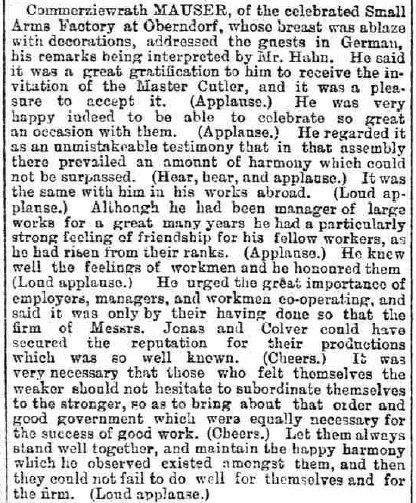
In May 2017 a fellow researcher sent me this cutting - an article regarding Robert Colver's dinner for 700 workers at the end of his Master Cutler's Week in September 1890 ("The Master Cutler and His Workpeople," 8 September 1890; Sheffield Daily Telegraph p5c4 & Sheffield and Rotherham Independent p5c3) in which one of the invited speakers was "Commerziewrath MAUSER, of the celebrated Small Arms Factory at Oberndorf."
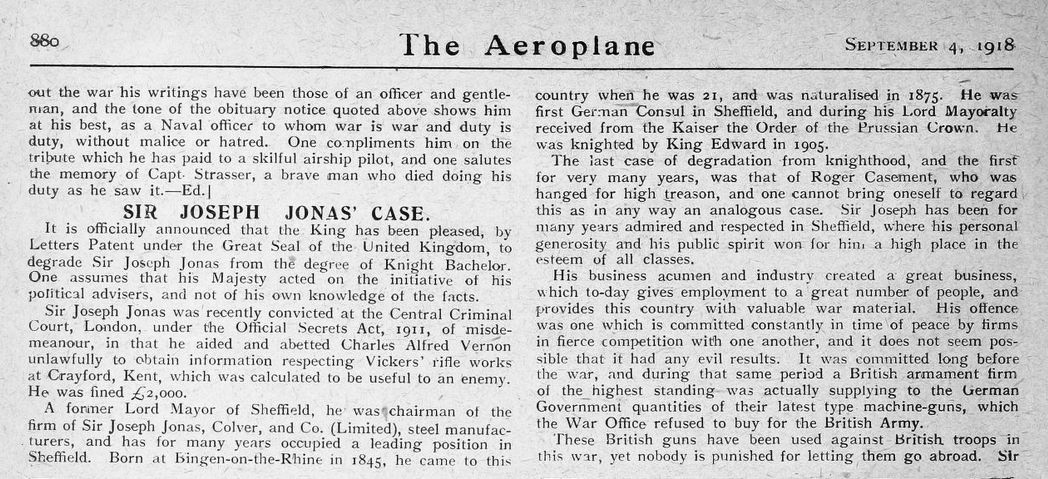
In April 2017 I was sent this cutting from the same researcher. It is from the now defunct periodical The Aeroplane dated 4th September 1918
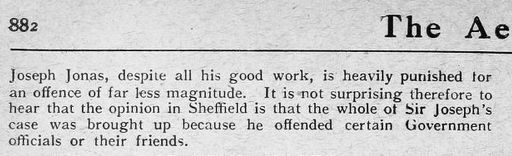

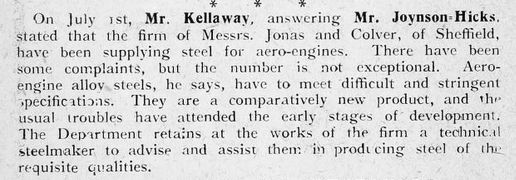
I was also supplied with this cutting that dated 1st July 1918 that shows that the firm Jonas and Colver were manufacturing aero-engines for the British Government, even though its owner was being prosecuted for "actions prejudicial to the state"
The Spectator dated 2nd August 1918 also inferred that the prosecution was more to do with matters other than the passing of information, and also raised the question of why civil servants were not prosecuted for their actions in assisting German arms manufacturers
"At the Central Criminal Court on Monday, Sir Joseph Jonas, steel manufacturer, a former Lord Mayor of Sheffield, was fined £2,000, and his clerk, C. A. Vernon, £1,000, with the costs of their prosecution, for the misdemeanour of obtaining and communicating to a German customer information, respecting Messrs.Vickers's rifle works at Crayford, Kent, "calculated to be useful to an enemy." If this had been done in war time, the offence would have been much graver than it was. The misdemeanour, however, was committed in November, 1913. Apparently Sir Joseph Jonas did not communicate to his German customer information that was not generally known. He answered a trade inquiry by a possible enemy as too many manufacturers are apt to do. One cannot of course acquit him of a serious offence. The prosecution may serve the public interest by emphasizing the wide scope of the Official Secrets Act. But when one recalls how in 1914 Krupp's agents were politely shown over several large and important British " plants," this prosecution reminds us that Government Departments themselves failed before the war to distinguish between courtesy and folly".
Flight Magazine dated 15th August 1918 carries this report of an exchange that occurred in the House of Commons between the MP Mr Joynson-Hicks and the Minister of Munitions. Mr Joynson-Hicks laid a number of grave charges against the firm of Jonas and Colver accusing them of producing and then selling "bad steel" over a long period and demanding that a full independent enquiry be established to investigate the transactions of the firm "since the war began". The Minister replying, totally repudiated the allegations and stated that the deliveries the firm made were equal to those of other firms in the sector.
It should be noted that Mr Joynson-Hicks really did not have an accurate brief when he said Mr. Robert Jonas was now the chief steel maker. No such person existed. He was referring to Mr Robert Colver who was the joint owner of the firm. The chief steel-maker who left was of course Sir Joseph Jonas and he did so in March 1918 and not 1917 as Joynson-Hicks states.

My impression and I believe that of others at the time was that the prosecution was a politically driven one. 1916 had seen the Allies incur hundreds of thousands of causalities on the Western Front. 1917-8 was even worse as conditions deteriorated rapidly at home with severe food shortages, scarce fuel supplies and widespread industrial unrest. The traditional tactic of the ruling classes in such cases is to find scapegoats, and of course the Germans fitted the bill perfectly. The Flight article of August 1918 is also very interesting in the fact that that infers Sir Joseph's firm was selling defective steel to the government and had been doing this for a long period. It was undermining the "war effort" and hinted that this was a deliberate act. Totally untrue but then when did that stop an ambitious and devious politician!

This meeting demonstrates the venal and malicious nature of the British ruling class at the time - the poster is dated 6th June 1918
The widespread anti-German sentiments fuelled by a jingoistic press even prompted the Royal Family to abandon all titles held under the German crown and to change German-sounding titles and house names for English-sounding versions. On 17 July, 1917, a royal proclamation by George V provided that all agnatic descendants of Queen Victoria would be members of the House of Windsor with the personal surname of Windsor. In Sheffield the Professor of German at the University Julius Freund was interned as an alien despite having worked there since 1908. In December 1916 the University Council shamefully removed his Chair whilst he was in prison - he had committed no offence
This coupled with the fact that Joseph was may have been perceived as Jewish to boot, (see note 6) inspired the prosecution or to my mind the persecution of Joseph. The ridiculous attempts after the trial to deport or repatriate him to Germany did nor succeed although it involved a lengthy legal battle with the Home Office.
There is no doubt that the case took a heavy toll on Joseph who was 72 years old at the time the case started. Sir Joseph Jonas died in Endcliffe House, Enfield in 1921 due to a stroke. The University of Sheffield's Centenary History "Steel City Scholars" mentions the case on page 80-81. It reveals that Sir Joseph was well liked in the city and even after his public humiliation he was still referred to as "Sir Joseph" by his workforce. It records that the general view in Sheffield was that the punishment was excessive but then curiously adds that his actions were most unwise at a time of Anglo-German tensions. If that was the case why did the authorities bring a case in 1918 and not 1913? Even as late as May 1916 was still making large and significant donations to the University of Sheffield, surely not the actions of a man who was acting in a manner prejudicial to the state.


Even though he was stripped of his knighthood, his firm were still "Contractors to HM Government"

His Obituary in The Times dated August 25th 1921 is entitled "DEGRADED FROM KNIGHTHOOD - THE JONAS CASE RECALLED" and gives a brief summary of the case. It also then goes on to state that the reason why Joseph came to England in the first place was his total refusal to do military service in Prussia. He came to England in 1867 and came to Sheffield two years later. His naturalization came in 1876 the same year he married Lucy Earle
The Manchester Guardian in its obituary also paid tribute to Joseph

The obituary appeared on the same day that Joseph's funeral took place. The following days' edition of The Times reported that
"FUNERAL OF MR. JONAS
The funeral took place at Sheffield yesterday of Mr Joseph Jonas, a former Lord Mayor of Sheffield, an obituary notice of whom appeared in The Times yesterday. The large gathering at the Cemetery included not only people assembled out of curiosity but also representatives of every side of the city's activities. The Lord Mayor and Mater Cutler attended, and the University was represented by Lieutenant Colonel H.K.Stephenson, M.P. D.S.O. Pro Chancellor and other leading officials, including dr Ripper head of the Applied Science Department of which Mr Jonas was formerly chairman and one of its largest benefactors and Sir William Clegg chairman of the department and of the Sheffield Education Committee, The Chamber of Commerce and other commercial interests were also represented."
He was buried in Ecclesall Parish Churchyard in Sheffield."
The well attended funeral and the presence of civic leaders and businessmen supports the prevalent view that Sheffield believed that the case was politically inspired and that Joseph should be remembered first and foremost as an outstanding businessman, generous benefactor and prominent civic leader.
There were also fulsome tributes paid in the local press. The Sheffield Daily Independent dated 23rd August 1921 posted this obituary.

And the same newspaper carried a report of Joseph's funeral on 26th August 1921

As a post script his widow Lucy Jonas remarried Sir William Clegg, brother of Sir Charles Clegg.
The Daily Mirror dated 13th January 1922 carried a report of the wedding under the title
KING OF SHEFFIELD WEDS
Romance of Sir William Clegg and Widow of Former Mayor
A great surprise was sprung on Sheffield yesterday by news of the marriage of Sir William Clegg to Mrs Joseph Jonas.
Sir William who is to mark his seventieth birthday was recently presented with the freedom of the city, has gained the title the "King of Sheffield" because of his municipal influence. Like his bride he has been previously married. Mrs jonas was the widow of an ex lord mayor Sir Joseph Jonas who after the war was deprived of his knighthood.
So carefully guarded were the wedding plans that only immediate relatives were present at St Marks Church when the Bishop of Sheffield (Dr Burrows) performed the ceremony
William and Lucy were married for eight years before Lucy died on January 3rd 1929
The Times dated January 29th 1929 cites the Will of DAME LUCY ANN CLEGG of Kenwood, Nether Edge Sheffield and of Bothamsall Hall, Retford who died on January 3rd, age 76, wife of Sir William Clegg and widow of Mr Joseph Jonas (who was Lord mayor of Sheffield in 1904 )left unsettled property valued for probate at £487.
There is an academic paper** which I have not read which will no doubt look into the case with far greater insight than I have. I would be interested to find out what his conclusions were.
At the same time as Lucy's death the following report appeared in The Financial Times dated 26th February 1929

On December 23rd 2007, I went to Ecclesall All Saints Churchyard in an attempt to locate Joseph's grave. For a local parish church it is quite an extensive churchyard covering eight acres and is the last resting place for as many as 14.000 people. Unfortunately I could not access the burial records and so it was a mater of following my nose. Fortunately I came across the grave quite soon as it was adjacent to the one of the main paths. As you can see from the photograph I was rather pleased to have found it!

And once more it revealed some more information that I was unaware of. Firstly buried alongside Joseph is his wife Lucy Ann even though she remarried after Joseph's death, And although the name of her second husband WILLIAM EDWIN CLEGG is on the memorial, the family did not disclose the fact that William Clegg was in fact Sir William Clegg and that Lucy Ann was DAME LUCY ANN CLEGG. All mention of public honours were omitted from the memorial which gives an indication of what the family thought. But even sadder was the inscription
IN LOVING MEMORY
OF
JOSEPH JONAS
OF ENDCLIFFE HOUSE, SHEFFIELD
WHO DIED AUGUST 23 1921 AGE 76 YEARS
ALSO LUCY ANN WIDOW OF THE ABOVE
AND WIFE OF WILLIAM EDWIN CLEGG
DIED JANUARY 3rd 1929
IN LOVING MEMORY OF
HENRY JONAS
WHO DIED ON EASTER TUESDAY
APRIL 16TH 1915 AGED 30 YEARS
I was unaware that Joseph's son HENRY had died at such a young age, but then again that was the fate of many thousands of people at the time. It must have been a traumatic time for Joseph even before the arrest and trial. The other thing that saddened me was the state of the grave. The memorial itself is in excellent condition for its age but the surround looks as though it was lightly concreted over at a later date and this has now broken up due to weathering. Plants have grown through the cracks and so it does look rather neglected. It seems to me that the original intention was to line the grave-memorial with flowers but his descendents may have moved away from Sheffield and/or died hence the decision to concrete the surround.
In April 2011, a descendent of Sir Joseph contacted me and provided me with the following information about Henry
"Henry Jonas was on an export mission to New York and caught pneumonia, and died there. Sir Joseph brought his body back to Sheffield. His only daughter - Rita - I remember well. She married very well into the Peter Dixon paper company, based in Grimsby. They made newsprint, Dixel tissues, and Bronco toilet paper"
Note: Surname First name (s) Spouse
District Volume Page
Marriages Sep 1914 Dixon Cuthbert Ecclesall B. 9c 773 JONAS Margherita Ecclesall
B. 9c 773
As for Sir Joseph's mansion it is now a University of Sheffield Hall of Residence called Halifax Hall. I do not know the exact circumstances how the University came to acquire the Hall but I can say it did occur three years after the death of Joseph in 1924. It was initially used for just women students. The same descendent who supplied me with information about Henry also said that he
"remembered when I went to the house they showed me a special toilet made for King Edward when he stayed there. It had to be wood lined inside, and the toilet seat had to have an extension at the front, because he was so well endowed that a normal seat was no good"

Photos (German Carte de Visite) of Sir
Joseph
Jonas and his wife Lucy. Apparently they came from an old photograph album and
were identified in writing underneath
Notes
1.Married LUCY ANNE EARLE (December 1876 quarter Ecclesall Bierlow Volume 9c Page 371)

2.1881 Census - Joseph is not listed but his 28 year old wife is alongside her two year old son ROBERT JONAS and one year old son JOSEPH K JONAS. The address is 452 Glossop Road, Ecclesall Bierlow, Sheffield (Reference RG11 Piece Folio 4633/152 Page 42 ). There are also three young female servants
3.1901 Census shows Joseph as a 55 years old Steel manufacturer living at 46 Endcliffe Vale Road together with his 49 year old wife Lucy Ann. As well as Manufacturer he is also listed as Justice of the Peace and German Consul. Also living there were his sons ROBERT, JOSEPH K and FRANK aged 22, 21 and 13 respectively. There is also a 10 year old daughter called Margueritta and a household of six servants. The two eldest sons are cited as being steel manufacturers but are workers not an employers like their father. No mention of a Henry Jonas though. (RG 13/4340 Folio 148 Page17)
4 1911 Census
Enumerator Information Address Endcliffe House Endcliffe Vale Road Sheffield Parish Ecclesall Town Sheffield Type of Building Private House Number of Rooms 23 Rooms Inhabited Y Reference RG14PN27750 RG78PN1588 RD509 SD2 ED30 SN49 Administrative County Yorkshire (West Riding) Registration District Ecclesall Bierlow Registration Sub District Ecclesall West Central Enumeration District 30
5.White's
1901 Directory gives the following information
"The Sheffield Reform Club, established in 1885, occupies the principal portion
of the Gladstone Buildings, at the corner of Church Street, St. James' Row and
St. James' Street, erected in 1885 by a limited company, at a cost of upwards of
£8,000, in the Domestic Gothic style. The ground floor is occupied as shops and
offices, and part of the first floor as offices; the club portion comprises
dining reading, billiard, and smoke rooms, and kitchen &c., and cost upwards of
£2,000. The Club has now about 500 members. J. Jonas, Esq., J.P. is president;
Mr. R Smith, treasurer; Mr. Arthur Neal, hon. secretary; and Mr. James L Taffe,
business secretary"
6. Sir Roger Casement - As British consul in Africa (1895–1904) and Brazil (1906–11), he became famous for his reports revealing white traders' cruel exploitation of native labour in the Congo and in the Putumayo River region of Peru. Ill health forced his retirement to Ireland (1912), where he joined the Irish nationalists and helped form the Irish National Volunteers. After World War I broke out, he sought German support for the Irish independence movement. For his additional intrigue in the Easter Rising, he was convicted of treason and hanged. His execution made him an Irish martyr in the revolt against British rule in Ireland
7. In August 2010, I was contacted by a researcher who commented that
"You mention that Sir Joseph Jonas was
Jewish, but in fact he was born and baptised a Catholic. He may have converted
to Judaism but this seems unlikely as he was both married and and buried in CoE
churches.
It is quite understandable that Sir J should have been thought to have been
Jewish, however, as the anti-German propagandists in WW1 such as Joynson-Hicks
and (Horatio) Bottomley seem also to have been very anti-semitic. They targeted
anyone of importance with a German sounding name in Britain. As many of these
would have been Jewish, they seem to have assumed that they all were. It is
not surprising therefore that a successful German born businessman such as Sir J
Jonas was taken to be to be Jewish. His friendship with Prof Julius Freund , who
was Jewish, will also have contributed to the assumption".
I must admit that I was slightly puzzled as to why Sir Joseph was buried in a Church of England churchyard, but assumed that he had renounced Judaism.
In May 2017 I received this information
"I also noticed a 1913 newspaper article referring to Sir Joseph being partly-educated in Cologne. In connection with your webpage questioning his religion, it reported that, "The majority of the students, he said, in his school were Israelites, and while certain religious observances had to be gone through, the two or three Christians had to go outside to pass their time as best they could, as there was only one instruction room. These religious observances usually lasted an hour and to kill the time Sir Joseph went to the new market square near the school to watch the soldiers drill." It then relates how, as a 16-year-old-cigar-smoker, he "went for" a teacher who had questioned if this was the best way of spending his time. "Sir Joseph said he also gave the teacher some good advice about the cause of this enforced playtime" before leaving the institute. An image of this article ("German Students, Entertained in Sheffield by Sir J. Jonas," Sheffield Daily Telegraph, 21 August 1913, p9c2"

8. The sources re the birth/ baptism of
Joseph Jonas are :
International Genealogical Index
Birth:17 JULY 1845 Christening: 18 JULY 1845 -
Roemisch-Katholische, Bingen Stadt, Rheinhessen, Hessen.
9. I have been told by the same
researcher that there is a a fascinating book "For King or Kaiser: the life of
Sir Joseph Jonas, Lord Mayor of Sheffield - Neville David Ballin, 1998 "
which gives some detail of his early life.
10 It should be pointed out that the letters patent under the Great Seal of the United Kingdom to degrade a person from the degree of Knight Bachelor is a very rarely used measure. The previous person to Sir Joseph was Sir Roger Casement (see note). The next letters patent were issued by the present Queen in respect of the traitor Anthony Blunt in 1979 and the fraudster Lord Kagan in 1881. Lord Kagan was stripped of his knighthood awarded in Harold Wilson's dissolution list of 1970 but still allowed to retain his life peerage that was awarded to him in 1976. Apparently it needs an Act of Parliament to annul a life peerage.
11. The entries in the Burial registers is as follows
JONAS Henry Date of burial 20 Apr 1915
age 30 Endcliffe House
JONAS Joseph Date of burial 25 August 1921 age 76 Endcliffe House

. Endcliffe House - Photograph taken January 2012
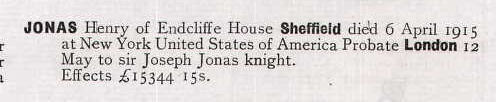
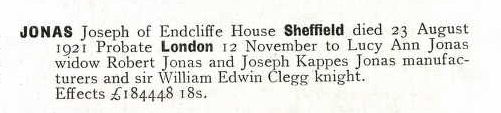
The Probate records of Henry and Joseph Jonas
12. In May 2013 an article appeared in the local newspaper the Sheffield Star featuring Joseph and his trials. As a result of the article a reader wrote to the newspaper with the following observations which make for interesting reading. It is evident from Joseph's letter that even before May 1915, there was a strong antagonism towards anyone suspected of being pro German

In Sheffield Daily Telegraph of Saturday,
May 15th, 1915 which I recently acquired, I found a letter from Sir Joseph ref
the persecution of people with German names (see attachment, sorry its not
better quality) and thought that you might be interested.
In the letter Sir Joseph comments on:
The abhorrence both by him and other people with German names about the sinking
on the Lusitania and that he had replied to a communication from the Daily Mail
on this matter.
The fact that he had never belonged to the 'German Club' nor had ever been
invited to join.
The fact that he had always supported Sheffield and served the city in a 'wide
variety of public capacities' in the last 25 years and he feels that his 'deeds
speak louder than words'.
The fact that he doesn't want to undertake the organisation of a movement among
'naturalised Germans' to 'show loyalty to the crown' but would be happy to join
one should it be formed.
The letter was sent from Llandudno where he had gone for 'rest and quiet' from
'recent worry and grief'.
There were also letters from C A Hahn, another naturalised German, who
apparently came to Sheffield in 1872 and became a naturalised British citizen in
1877. He also states that his wife is a 'Sheffield girl' and that his children
were born here. In addition to this he states that his eldest son is serving in
the British Army and his younger son is serving in the British Medical Corps and
that he wishes to express his, 'abhorrence of the inhuman acts committed by men
of the German Army and Navy'.
There must have been some anti-German incidents on the Moor on the night of 14th
May, 1915, because P Gebhardt of 191 The Moor writes to thank the police for
their protection for him and his family during an incident. He also states that
he has lived in Sheffield for 35 years and that his wife is a Sheffield woman
and his children and grandchildren were born here. He finishes by stating that
he wants to, 'assure the English public' that he is not 'an enemy of the land
which he calls his own'.
There are other letters by British nationals referring to the sinking of the
Lusitania, and one from 'Britain For The British', who feel that all Germans,
Austrians and Turks whose sons are not fighting in the British Army should be
deported and given a free passage to Holland.
In other parts of the paper there are reports of what appears to be a wide range
of anti-german incidents in Hillsborough, Tinsley and the Newhall Road area
where shops of people with German names were attacked and looted."
The phrase that "The letter was sent from Llandudno where he had gone for 'rest and quiet' from 'recent worry and grief' is quite poignant. Whilst the atmosphere that prevailed in Sheffield in 1915 certainly troubled Joseph, I believe that the worry and grief he refers to is the death of his son HENRY a month earlier.
The article that appeared in The Star dated 29th May 2013 is reproduced below

13. Joseph's home for many years Endcliffe Hall is now part of the University of Sheffield.
"Halifax Hall was originally called Endcliffe House and
was owned by Henry Cadman, a Sheffield solicitor. The house was built in the
1840 and extended in 1891. Sir Joseph Jonas was the German born Lord Mayor of
Sheffield in 1904-5 and lived in Endcliffe House. He arrived in Britain in 1867
and became a British citizen in 1876. Apart from his contributions to civic
life, he was also a valued benefactor to the newly formed University of
Sheffield, as well as contributing to many other local charities and
institutions. By achieving the post of Lord Mayor in 1904 as well as been
rewarded with a knighthood, he had reached the pinnacle of local civic life. He
was one of Sheffield's leading figures at the turn of the twentieth century. A
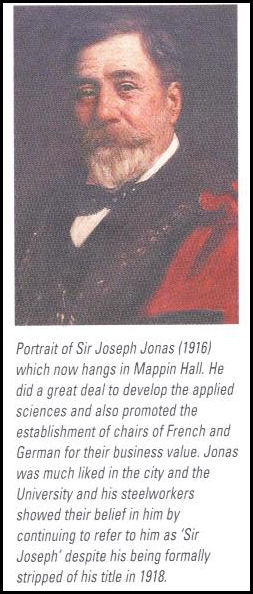
portrait of Sir Joseph Jones now hangs in Mappin Hall."
The house was purchased from the trustees of the late Sir Joseph Jonas for the
sum of £6000 in 1929 and in 1934 was opened as The University Hall for Woman. In
1959 it was renamed Halifax Hall and became the home for students at the
University for the next 50 years

15th May 2013 - A former university accommodation building in Sheffield is to
open its doors to a new kind of resident - hotel guests. Historic Halifax Hall
in Endcliffe is undergoing a £1.8 million refurbishment for a new life as a
38-bedroom boutique style hotel.
Sources
The Financial Times dated 20th December 1907
Daily Mirror 11th April 1908 - 13th June 1918
New York Times - 13th June 1918
News of the World dated 21st July 1918
News of the World dated 28th July 1918
News of the World dated 4th August 1918
The Story of Old Attercliffe (Part3) by C.R.Vine B.Sc as transcribed by Eric Youle
The Manchester Guardian dated 24th August 1921
University of Sheffield's Centenary History "Steel City Scholars" by Helen Mathers
The Times dated August 25th - 26th 1921
The Financial Times dated 26th February 1929
Sheffield Daily Telegraph of Saturday, May 15th, 1915
The Star dated 29th May 2013
The Spectator dated 2nd August 1918
The Aeroplane dated 4th September 1918
Flight Magazine dated 15th August 1918 - 30th January 1919
8 September 1890; Sheffield Daily Telegraph p5c4 & Sheffield and Rotherham Independent p5c3)
Sheffield Daily Telegraph, 21 August 1913, p9c2
The Sheffield Daily Independent dated 23rd August 1921
The Sheffield Daily Independent dated 26th August 192
Wikipedia
**Sir Joseph Jonas, University Benefactor, Lord Mayor of Sheffield 1904-5 —
German Spy?’
in: R.J. Kavanagh (ed.), Mutual Exchanges I. Papers presented in commemoration
of the 50th anniversary of the Sheffield-Münster academic links. 1999,
Frankfurt/ Main: Peter Lang, pp. 310-329
This page was last updated on 26/07/25 08:58