"The human eye is a wonderful device. With a little effort, it can fail to see even the most glaring injustice." - Quellcrist Falconer
The Execution of Lorraine Lax - Armley January 1926 -
A Family Tragedy
I have separated the case into four parts - The Murder - The Inquest - The Trial - The Appeal. The final part of the article consists partly of the background to the case and partly my opinions on the events as they unfolded.
But before engaging in this narrative, I need to stress that I firmly believe that Lorraine did kill his wife Lizzie by viciously cutting her throat with a razor. There can be no doubt about this - Lorraine did kill his wife.
HOWEVER I believe that there are certain points about the main characters that need to be highlighted so that the case can be viewed in a fuller perspective.
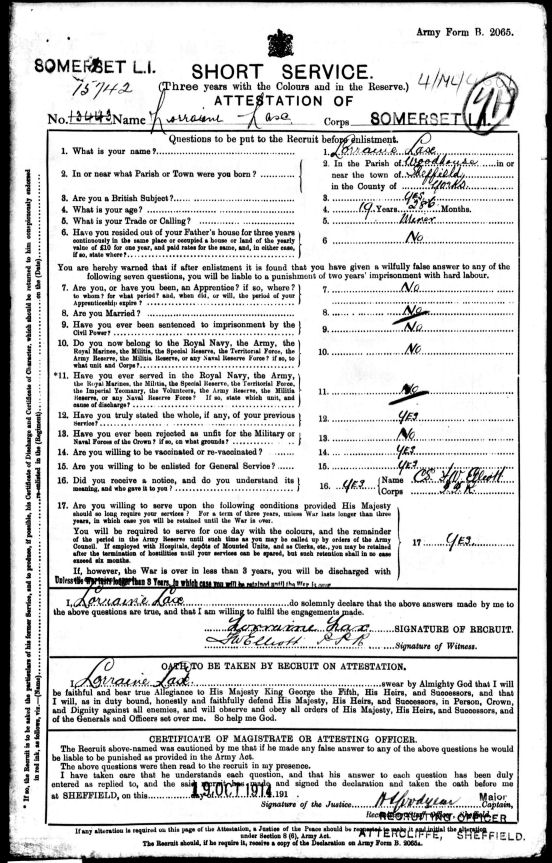
Lorraine for instance is quite a bundle of contradictions. Judge David Bentley in his book states that Lorraine was a drunken gambler who did not provide for his family. But the facts are quite different. I found it quite strange that barely no mention was made of Lorraine's war service. The only exception I can find is an interview his mother gave to the local press. She stated that he "saw considerable service during the war in France. He was badly wounded in the battle of Loos, and his nerves were shattered by his war experience". Judge Bentley repeats this in his book but if he had accessed Lorraine's Army Service record he would have found the following
On the reverse side it states that he had a height of 5ft 71/4 inches and weighed 140 lbs (10 stone). His chest measured 38 inches when fully expanded, and he had a range of expansion of 3 inches. As for his characteristics he had a fresh complexion, his eyes were grey and he had brown hair. Distinguishing marks were a "scar right shin and left of neck". He was "Church of England" by denomination. He was passed fit for service and was appointed to the Northumberland Fusiliers on 19th October 1914
Lorraine volunteered at the beginning of the war and gave his age as being 19 years 286 days. This is clearly incorrect for the FreeBMD states that Lorraine was born "Births Mar 1897 Lax Lorraine Sheffield Volume 9c Page 691". It is my contention that Lorraine (like many others) was underage when he joined up, and so he just added two years on to his real age to ensure that he would be accepted.
He was initially posted to the Northumberland Fusiliers but within a matter of days this was changed to the 8th Battalion, Somerset Light Infantry, and it was with the Somerset's that he remained, spending 3 years and 257 days under the colours before he was discharged on 26th June 1918 as "being no longer physically fit for war service"
To give an insight as to what Lorraine experienced in the war and with the Somerset's I have sourced this article from the Daily Telegraph dated 27th July 2008
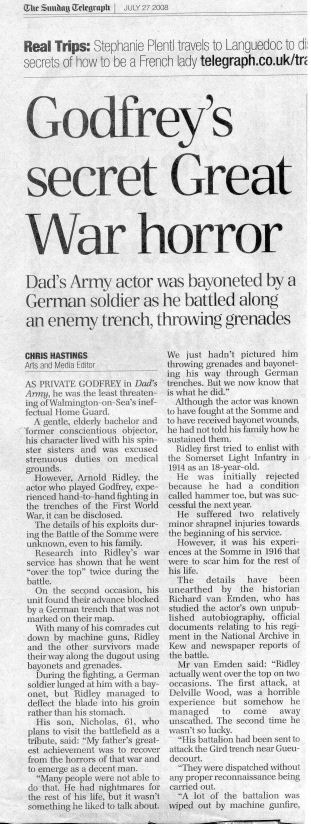
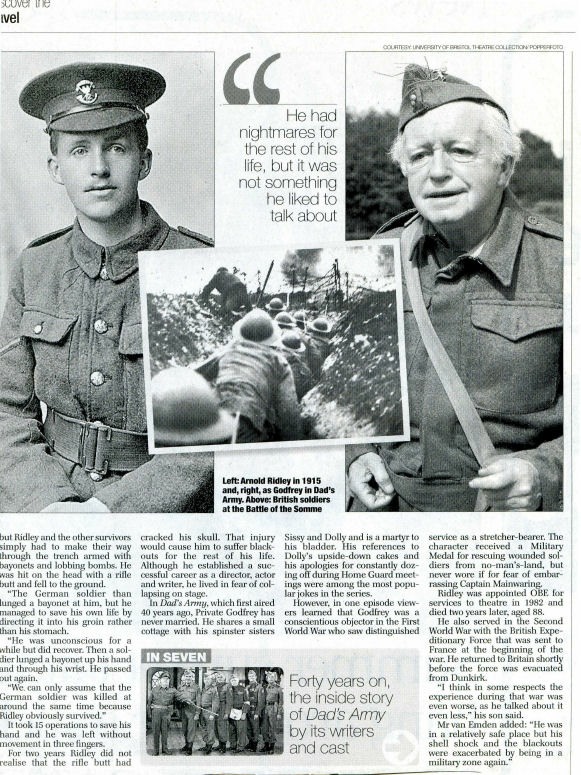
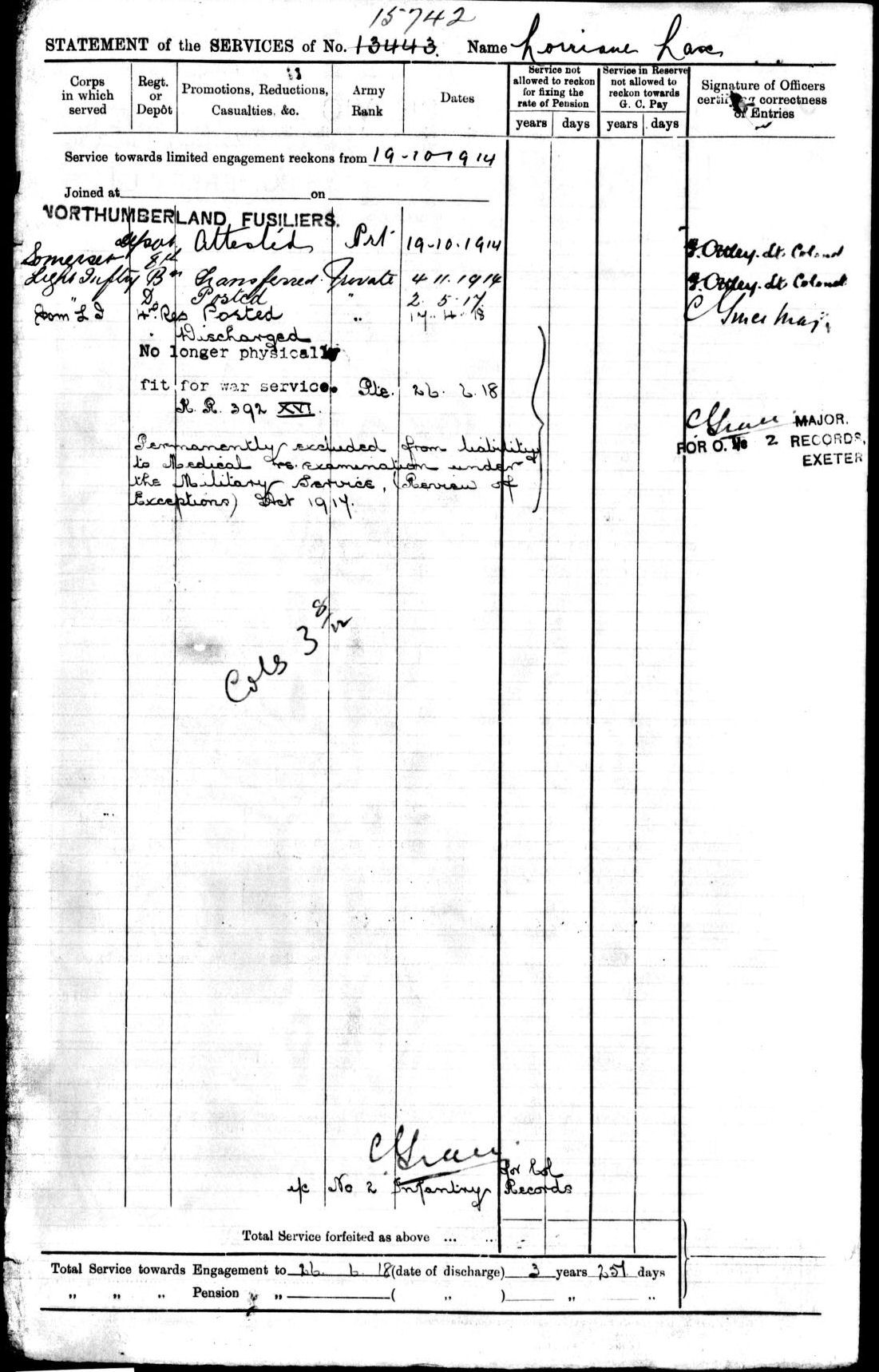
The reverse of the page details of his service and his injuries
On page 4 of his army record it states
HOME 19.10.1914 - 07.09.1915 - 324 days
5X FORCE - FRANCE 08.09.1915 - 01.05.1917 - 1 year 236 days
HOME 02.05.1917 - 22.06.1918 - 1 year 56 days making a total overall of 3 years 257 days
"GSW Eyebrow + head - (gunshot wound)
Shrapnel wound L Arm (sev)" which I now believe must mean several and not
severed
Above that it gives the date
"5X Force France 8.9.15 is the date he went to France and 2.5.17
home w" - the date he was sent home wounded.
Based on this information, it appears that Lorraine received his injuries during the Spring Offensive of 1917 or as it is now known as the Battle of Arras. Full details of battle can be found be following the link. If he was sent home on 2nd May 1917, I think that he received his injuries during the Battle of Arleux 28 - 29th April 1917 where the familiar story of high casualties and disappointing results were recorded.
And so Lorraine did receive severe injuries that eventually led to his discharge from the Army in June 1918. There is no mention in his record of any disciplinary measures taken against him. In fact his war record is one that any man could be proud of, and unlike many, many others of his generation, he survived.
And what did he return to - "the land fit for heroes to live in." ( In 1918, a few days after the armistice of November 11th, British Prime Minister, David Lloyd George, referring to the men returning home from the battlefields of the Great War, said: "What is our task? To make Britain a fit country for heroes to live in."). The reality was the opposite - many soldiers who returned after experiencing the horrors of the Great War now had to face the horrors of poverty, deprivation, homelessness and unemployment. The relentless degradation that many ex-servicemen experienced manifested itself in many forms - on a personal level depression, crime and even suicide; collectively, strikes, riots and even insurrections.
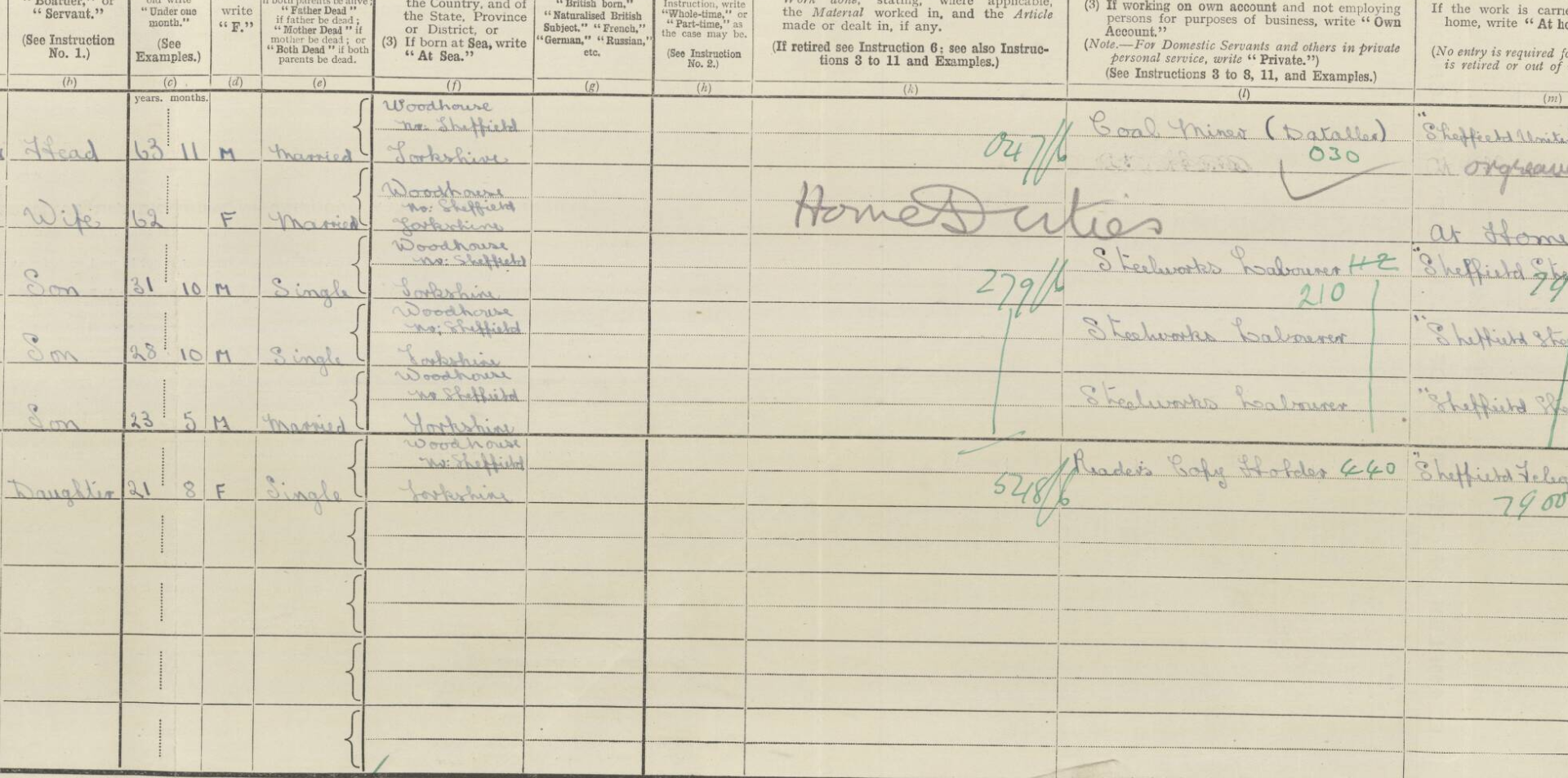
The 1921 Census has this information - it is interesting to note that Lorraine is married but living at home with his parents and siblings.
Household members (6 people)
First name(s) Last name Relationship to head Sex Birth year Age in years Birth place Occupation Employer
Thomas Wolstenholme Lax Head Male 1857 63 Woodhouse, Yorkshire, England - Coal Miner (Datallers)
Harriet Lax Wife Female 1859 62 Woodhouse, Yorkshire, England Home Duties -
Albert Gladstone Lax Son Male 1889 31 Woodhouse, Yorkshire, England - Steel Works Labourer
Harry Asquith Lax Son Male 1897 23 Woodhouse, Yorkshire, England - Steel Works Labourer
Lorraine Lax Son Male 1898 23 Woodhouse, Yorkshire, England - Steel Works Labourer
Transcript of Lorraine's record
First name(s) Lorraine
Full address as transcribed 16 Birks Avenue, Woodhouse
Last name Lax
Parish Handsworth
Sex Male
Registration district Sheffield
Birth year 1898
Registration district number 510
Census date 19 June 1921
Sub-district Handsworth
Age in years 23
Sub-district number 9
Age in months 5
Enumeration district number 6
Age as transcribed 23 y 5 m
County Yorkshire (West Riding)
Relationship to head Son
Country England
Marital status Married
Ward of borough or urban district Woodhouse West
Birth place Woodhouse, Yorkshire, England
Parliamentary borough or division West Riding of Yorkshire PC, Rother Valley Div.
Archive series RG 15 Piece number 23168
Birth place as transcribed Woodhouse, Nr Sheffield, Yorkshire
Schedule number 192
Occupation code 279
District reference RD 510 RS 9 ED 6
Occupation code with suffix 279/6
Schedule type code E
Employer Steel Works Labourer
Schedule type England household, single page, 10 entries
Employer code 210
Other household member's first name (s) Albert Gladstone, Beatrice, Harriet, Harry Asquith, Thomas Wolslenholme
Place of work Sheffield Steel Products
Other household member's last name Lax
Person making return Thomas Wolstenholme Lax
Address 16 Birks Avenue, Woodhouse
Sheffield in particular was badly affected by the return to a peace-time economy - the city saw a sharp and savage recession that was particularly pronounced in the traditional industries of steel making, mining and engineering. Lorraine certainly experienced bouts of unemployment, short-time working and depressed wage levels in the post war period. And even when he was in work he often had to travel a considerable distance there and back. The Sheffield Independent's report dated 1st September 1925 infers that that this was a major difficulty for Lorraine. He was born and brought up in the Woodhouse district of Sheffield where his family stilled lived, and is adjacent to the colliery at Birley where Lorraine worked. But due to circumstances he was renting rooms in Darnall which was then a considerable distance from the pit. The report suggests that in the months preceding the murder the family had made attempts to move back to the Woodhouse area but these had come to nothing.
Added to this were the observations made by Lorraine at his trial. He said that when his wife was expecting a baby "she was always more difficult to get on with". To use modern terminology Lizzie was a victim of "prenatal maternal stress" a condition that received scant attention in 1920's Darnall. Research has shown that when an expectant mother is exposed to stress that is caused by "stressful life events and environmental hardship" she may act in an irrational and erratic manner. In other words she becomes unpredictable in her behaviour. Lizzie certainly was bedevilled with "stressful life events" which tended to revolve around the shortage or complete lack of money, and the inability to have a settled home life. She gave birth at least three times in the space of five years, and at the time of her death she was the mother of three young boys, the eldest aged five.
There is no doubt that Lorraine and Lizzie had a volatile relationship that encompassed the whole range of human emotion. Separations and reconciliations seem to have been the norm in the relationship, and were commented upon by a number of witnesses. And yet there was no evidence to show that Lorraine had assaulted Lizzie prior to the attack. There had been heated arguments and on occasions Lorraine had to be restrained. Lizzie's father even pointed out that on one occasion Lizzie had jumped through a window to get away from her husband.
The evidence from members of Lizzie's family at both the inquest and the trial show a marked antipathy towards Lorraine which is hardly surprising given the circumstances of her death. But other witnesses point a different picture. For instance her mother stated that she was miserable and depressed on the Sunday night prior to her death. Furthermore her landlord Mr Harry Antcliffe added that on the same night she had confided in them that she was always short of money and that she feared for her and her children's lives. And yet her brother -in- law Mr Henry Gardner said that he saw the couple talking together on the same night and they seemed friendly enough.
His wife Alice Gardner stated that her sister Lizzie was always complaining that Lorraine kept her short of money and that his earnings were spent on drink and gambling but Lizzie's father said that he had seen him drunk on just one occasion since he moved back. The newspaper after canvassing neighbours said that Lorraine was of a "quiet disposition" and his landlord remarked "that the family kept themselves to themselves."
And so a rather confusing picture emerges of the family, but there is no doubt that the lack of money was the underlying cause of tension and unhappiness in the relationship. And this came to a head when they received notice to quit from their rooms in Ripon Street. The unsettling effect on an already stressed Lizzie is easy to imagine, and so I would predict that the days leading up to her death were ones of angry rows and despair.
It could well be that Lizzie did fear for her life - that is the only reason I can put forward for her taking Lorraine's razor to bed with her. Lorraine's account is the only one we have and he seemed genuinely surprised when his foot caught his wife's shoulder, and she produced the razor. He went across to take the razor from her, and she cut him across the face with it. A vicious struggle developed and Lorraine must have completely lost his temper by this time. The wounds to Lizzie's neck were catastrophic. Herb jugular vein was severed and at one point the razor was embedded in her spinal chord.
As I have stated before there is no doubt that Lorraine murdered his wife and that the judge had no option to but to hand down a death sentence once the jury had elected for a "guilty verdict" But it was what happened after the trial and appeal that I find most disconcerting
Notes
Somerset Light Infantry - 8th (Service) Battalion - Formed at Taunton in October 1914 as part of K3 and attached to 63rd Brigade, 21st Division. 10 September 1915 : landed at Le Havre. 8 July 1916 : transferred with Brigade to 37th Division.
Marriages Jun 1920 - Bedford Elizabeth Lax Sheffield Volume 9cm Page 1658 Lax Lorraine
Surname First name (s) Mother District Vol Page
Births Jun 1921
Lax George Bedford Sheffield 9c 1414
Births Jun 1923
Lax Frank Bedford Sheffield 9c 1140
There was a murder in 1920 which involved an ex-soldier who based his defence on the lasting effects of his experiences whilst in action
"Twenty eight year old Edwin Sowerby, a miner from Crofton near Wakefield, was hanged on Thursday, December 31st, 1920, for the murder of his former girlfriend,19 year old Jane Darwell. He had taken the break up of the relationship very hard and when he saw Jane at the village dance in the schoolroom at Crofton on the night of October 25th 1920, he walked over to her and cut her throat in front of several witnesses. (Crofton Infants School opened in 1877 and was then known as Crofton Board School. Local legend depicts that the ghost of Jane Darwell still haunts the infants school, and is known as The Blue Lady) .His defence at the trial was one of insanity due to war injuries in World War I, but this was not accepted by the jury who found him guilty after just 20 minutes. Sowerby was visited in prison several times by his parents and on the day before execution, his brother and sister had their last interview with him. He handed over to his sister the whole of his personal belongings except for a photograph, believed to be that of Jane, which he took to the gallows. This was the 50th execution at Armley and was carried out by Tom Pierrepoint. An inquest was held after it by the City Coroner (Mr W. H. Clarke) and the jury certified that death was due to dislocation of the vertebrae caused by hanging, duly and properly carried out."
Obviously his experiences mattered for little!
Further details of the case
Jane Darwell - Born in Arthur Little Lever, Lancashire, England on 29 Jan 1901 to Charles Darwell and Martha Ellen Hampson. She passed away on 26 Oct 1920 in Council Schools, Crofton Road.
GIRL'S SWIFT FATE AT CLUB DANCE
How a village whist drive and dance ended in tragedy in the early hours of the morning makes a terrible story that comes from Crofton. A local cricket club had arranged the festivities, which were being held in a county school, and they closed startingly with a young girl's violent death, and with the apprehension of a wounded man, who was hurried away to the Clayton Hospital at Wakefield With wounds In his throat. Before the Tragedy. Jane Darwell, aged 19, was the girl, and the man was Edwin Sowerby, a miner, aged 27, who lived at North's Yard, Crofton. At one time the young couple were a good deal In each other's company, but latterly they were become more or less estranged. Apparently, Sowerby suffered much mental distress as a result; but no one had reason to anticipate the tragedy that has happened. Suddon Cry and Collapse, Both wore present at the club gathering, and it was noticed that they kept aloof from each other most of the night. 'Janie,' as Miss Darwell was popularly named in Crofton, had only recently begun domestic work with Mrs. Harry W. Hewitt, landlady of the Royal Oak Inn, and she joined the party after the dance began. Having danced once or twice, she sat in the room watching a set of Laticera, when Sowerby, who was not dancing, crossed over to her side. He was seen to stoop down towards her as though whispering something in her ear. No one saw precisely what happened, but the next moment there was a cry, and she collapsed on the floor with a terrible gash in her throat. Mother Heard Screams. When a doctor arrived he could only declare that she was dead. It is said that when she collapsed. Sowerby was seen attempting to cut his own throat, but a number of men closed with him and succeeded in wresting the razor from his grasp and in holding him until the police arrived. An attractive and popular girl, Miss Darwell worked for a time at the Barnbow Munition Factory during the war. Her mother, who had retired for the night, heard the commotion at the school, but she did not dream that a tragedy so nearly affecting her was happening. Sowerby is well spoken of, being described as 'as decent a young fellow as ever 'walked the village.' Everyone in the village, too, had a good word for Miss Darwell. (from The Daily News Perth Western Australia 13 Jan 1921)
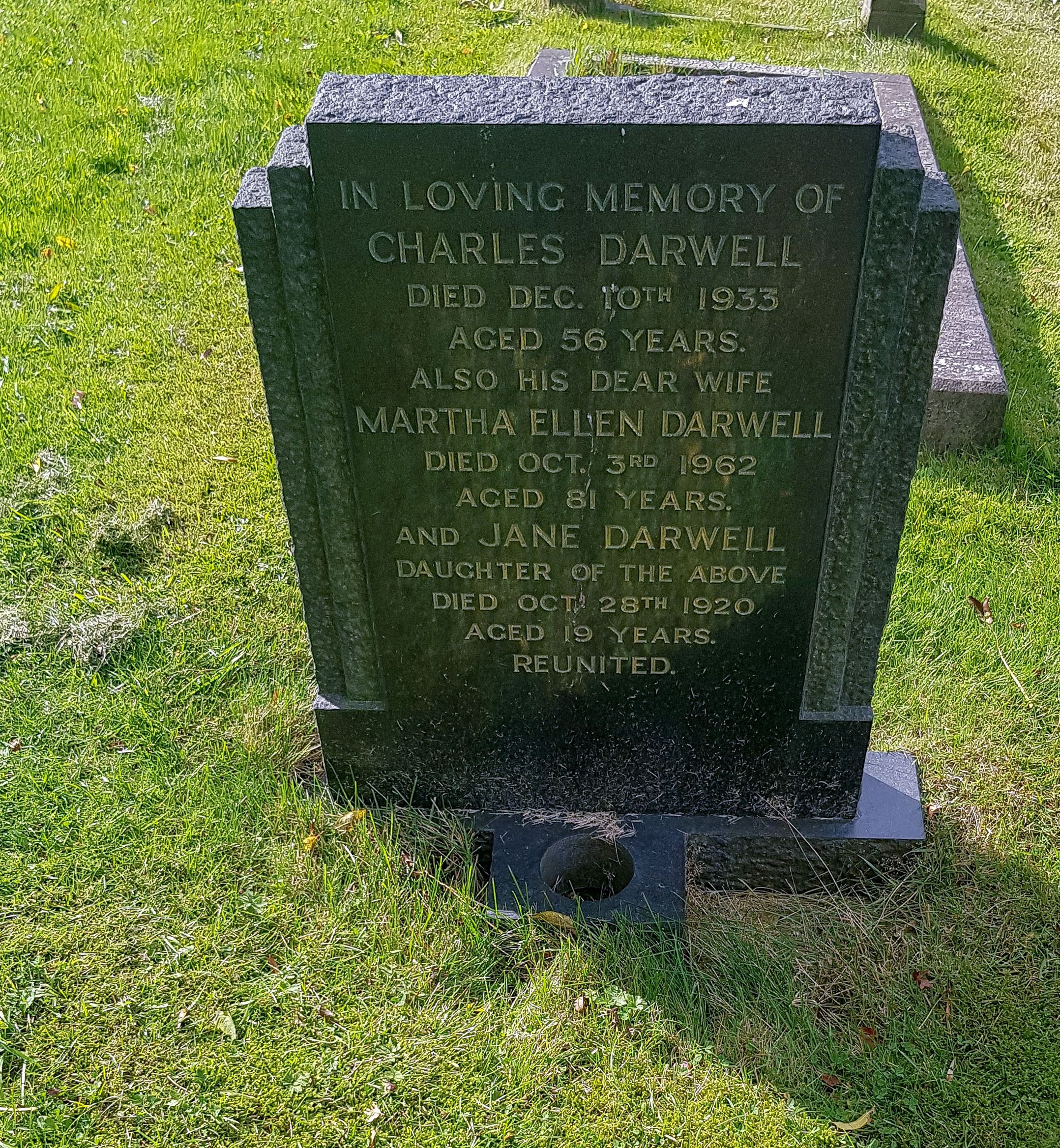
In loving memory of Charles Darwell died Dec 10th 1933 aged 56 years. Also his dear wife Martha Ellen Darwell died Oct, 3rd 1962 aged 81 years, and Jane Darwell daughter of the above died Oct. 28th 1920 aged 19 years. Reunited.
Jane Darwell
Birth 29 Jan 1901 Little Lever, Metropolitan Borough of Bolton, Greater Manchester, England
Death 28 Oct 1920 (aged 19) Crofton, Metropolitan Borough of Wakefield, West Yorkshire, England
Burial All Saints Churchyard Crofton, Metropolitan Borough of Wakefield, West Yorkshire, England
Plot 282
Memorial ID 197329270
Notes
1911 Census Record
Name Jane Darwell
Relationship to Head of Household Daughter
Gender F Age 10
Estimated Year of Birth 1901
Occupation School
Employed Y Working at Home N
Place of Birth Lancashire Little Lover
Enumerator Information Address 16 Norths Yard High Street Crofton Parish Crofton
Town Crofton
Type of Building Private House Number of Rooms 4 Inhabited Y
Reference RG14PN27368 RG78PN1565 RD504 SD2 ED11 SN37
Administrative County Yorkshire (West Riding) Registration District Wakefield
Registration Sub District Sandal Enumeration District 11 Reference Information
Folio 73 Page 1 Piece 27368 RD number 504 SD number 2 ED number 11
Schedule 37
1901 Census Record
Name Edwin Sowerby
Relation to Head of Family Son
Age Last Birthday 9 Sex Male
Profession or Occupation Juvenile
Where Born Yorks Barnsley
Address 9 Second Street Civil Parish Crofton Rural District Wakefield Town or Village or Hamlet Crofton
Ecclesiastical Parish All Saints Crofton Parliamentary Borough or Division Normanton Yorks
County Borough, Municipal Borough or Urban District
Administrative County Yorkshire West Riding Ward of Municipal Borough or Urban District
Reference Information Folio 110 Page 4 Piece 4277
1911 Census Record
Name Edwin Sowerby
Relationship to Head of Household Son
Condition Single Gender M
Age 19 Estimated Year of Birth 1892
Occupation Pit Top Labourer Screener
Employed Y
Working at Home N Industry Colliery
Place of Birth Yorks Barnsley
Enumerator Information Address Knighton Terrace Slack Lane Crofton Parish Crofton
Town Crofton Type of Building House & Shop
Number of Rooms 4 Inhabited Y
Reference RG14PN27368 RG78PN1565 RD504 SD2 ED11 SN11
Administrative County Yorkshire (West Riding) Registration District Wakefield
Registration Sub District Sandal Enumeration District 11 Reference Information
Folio 21 Page 1 Piece 27368 RD number 504 SD number 2 ED number 11
Schedule 11
Sources
Ancestry
Find My Past
WW1 Army Service Record Medal Card 1914-1918
Medal card of Lax, Lorraine
Corps Regiment No Rank -
Somerset Light Infantry 15742 Private
Date 1914-1920
Catalogue reference WO 372/12links to the Catalogue
Dept Records created or inherited by the War Office, Armed Forces, Judge
Advocate General, and related bodies
Series War Office: Service Medal and Award Rolls Index, First World War
Piece Langley P A - McGrath D
Daily Telegraph dated 27th July 2008
"The Sheffield Murders" 1865 -1965" by David Bentley, published 2003 byALD Design & Print, Sharrow Vale Road Sheffield
Somerset Light Infantry - 8th (Service) Battalion
Find A Grave
UK Census
This page was last updated on 11/01/26 11:19