The Sheffield Boiler Disaster - 1st November 1899
‘Three bodies, mangled by fallen brickwork, blackened with ashes, reddened with blood, and swollen with scalds, were lying near together’
Frank Anderson's death featured in all the regional and national newspapers of the time - the disaster that morning received widespread coverage.
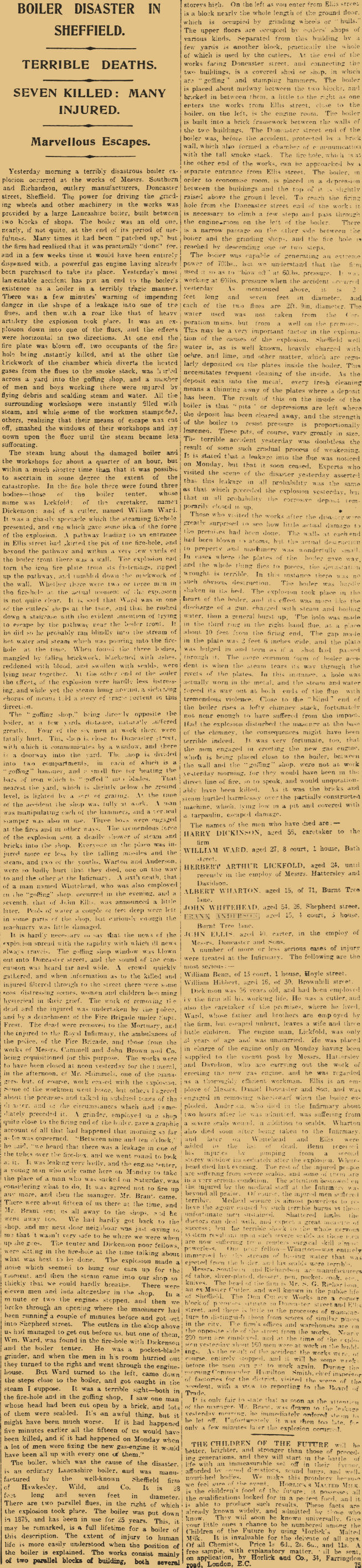
The Sheffield and Rotherham Independent reported the incident on November 2, 1899:
BOILER DISASTER IN SHEFFIELD
TERRIBLE DEATHS
SEVEN KILLED: MANY INJURED
MARVELLOUS ESCAPES
Yesterday morning a terribly disastrous boiler explosion occurred at the
works of Messrs Southern and Richardson, cutlery manufacturers, Doncaster
Street, Sheffield. The power for driving the grinding wheels and other machinery
in the works was provided by a large Lancashire boiler, built between two blocks
of shops. The boiler was an old one, nearly, if not quite, at the end of its
usefulness. Many times it had been ‘patched up’, but the firm had realised it
was practically ‘done’ for, and in a few weeks’ time it would have been entirely
dispensed with, a powerful gas engine having already been purchased to take its
place. Yesterday’s most lamentable accident has put an end to the boiler’s
existence as a boiler in a terribly tragic manner. There was a few minutes’
warning of impending danger in the shape of a leakage into one of the flues, and
then with a roar like that of heavy artillery the explosion took place. It was
an explosion down into one of the flues, and the effects were horizontal in two
directions. At one end the fire plate was blown off, two occupants of the fire
hole being instantly killed, and at the other the brickwork of the chamber which
diverts the heated gases from the flues to the smoke stack, was hurled across a
yard into the goffing shop and a number of men and boys working there were
injured by flying debris and scalding steam and water. All the surrounding
workshops were instantly filled with steam, and while some of the workmen
stampeded, others, realising that their means of escape was cut off, smashed the
windows of their workshops and lay down upon the floor until the steam became
less suffocating.
The steam hung about the damaged boiler and the workshops
for about a quarter of an hour, but within a much shorter time than that it was
possible to ascertain in some degree the extent of the catastrophe. In the fire
hole there were found three bodies – those of the boiler tenter, whose name was
Lickfold; of the caretaker, named Dickinson; and of a cutler, named William
Ward. It was a ghastly spectacle which the steaming fire hole presented, and one
which gave some idea of the force of the explosion. A pathway leading to an
entrance in Ellis Street had skirted the pit of the fire hole, and beyond the
pathway and within a very few yards of the boiler front there was a wall. The
explosion had torn the iron fire plate from its fastenings, ripped up the
pathway, and tumbled down the brickwork of the wall. Whether there were two or
three men in the fire hole at the actual moment of the explosion is not quite
clear. It is said that Ward was in one of the cutlers’ shops at the time, and
that he rushed down a staircase with the evident intention of trying to escape
by the pathway near the boiler front. If he did so he probably ran blindly into
the stream of hot water and steam which was pouring into the fire hole at the
time. When found the three bodies, mangled by fallen brickwork, blackened with
ashes, reddened with blood, and swollen with scalds, were lying near together.
At the other end of the boiler the effects of the explosion were hardly less
distressing, and while yet the steam hung around, a sickening chorus of moans
told a story of tragic portent in this direction.
The ‘goffing shop’ being directly opposite the boiler, at
a few yards distance, naturally suffered greatly. Four of the six men at work
there were fatally hurt. The shop is close to Doncaster Street, with which it
communicates by a window, and there is a doorway into the yard. The shop is
divided into two compartments, in each of which is a ‘goffing’ hammer, and a
small fire for heating the bars of iron which is ‘goffed’ into blades. That
nearest the yard, which is slightly below the ground level, is lighted by a sort
of grating. At the time of the accident the shop was fully at work. A man was
manipulating each of the hammers, and a vertical stamper was also in use. Three
boys were engaged at the fires and in other ways. The tremendous force of the
explosion sent a deadly shower of steam and bricks into the shop. Everyone in
the place was injured more or less by the falling missiles and the steam and two
of the youths, Wharton and Anderson, were so badly hurt that they died, one on
the way to and the other at the Infirmary. A sixth death, that of a man named
Whitehead, who was also employed in the ‘goffing’ shop, occurred in the evening,
and a seventh, that of John Ellis, was announced a little later. Pools of water
a couple of feet deep were left in some parts of the shop, but curiously enough
the machinery was little damaged.
It is hardly necessary to say that the news of the
explosion spread with the rapidity with which ill news always travels. The
goffing shop window was blown out into Doncaster Street, and the sound of the
concussion was heard far and wide. A crowd quickly gathered, and when
information as to the killed and injured filtered through to the street there
were some distressing scenes, women and children becoming hysterical in their
grief. The work of removing the dead and injured was undertaken by the police,
and by a detachment of the Fire Brigade under Superintendent Frost. The dead
were removed to the mortuary, and the injured to the Royal Infirmary, the
ambulances of the police, the Fire Brigade, and those from the works of Messrs
Cammell and John Brown and Co. being requisitioned for this purpose. The works
were to have been closed at noon yesterday for the funeral, in the afternoon, of
Mr Shimmels, one of the managers, but of course work ceased with the explosion.
Some of the workmen went home, but others lingered about the premises and talked
in subdued tones of this disaster, and of the circumstances which had
immediately preceded it. A grinder, employed in a shop quite close to the firing
end of the boiler, gave a graphic account of all that had happened that morning
so far as he was concerned. ‘Between nine and ten o’clock,’ he said, ‘we heard
that there was a leakage in one of the tubes over the fire-box, and we went
round to look at it. It was leaking very badly, and the engine tenter, a young
man who only came here on Monday to take the place of a man who was sacked on
Saturday, was considering what to do. It was agreed not to fire up any more, and
then the manager, Mr Brant, came. There were about fifteen of us there at the
time, and Mr Brant sent us all away to the shops, and he went away too. We had
hardly got back to the shop, and my next door neighbour was saying to me that it
wasn’t very safe to be where we were when up she goes. The tenter and Dickinson,
poor fellows, were sitting in the fire hole at the time talking about what was
best to be done. The explosion made a noise which seemed to bung our ears up for
the moment, and then the steam came into our shop and we could hardly breathe.
There were eleven men and lads altogether in the shop. In a minute or two the
engines stopped, and then we broke through an opening where the machinery had
been running a couple of minutes before and got out into Shepherd Street. The
cutlers in the shop above us had managed to get out before us, but one of them,
William Ward, was found in the fire hole with Dickinson and the boiler tenter.
He was a pocket-blade grinder, and when the men in his room hurried out they
turned to the right and went through the engine house. But Ward turned to the
left, came down the steps close to the boiler, and got caught in the steam I
suppose. It was a terrible sight, both in the fire hole and the goffing shop. I
saw one man whose head had been cut open by a brick, and lots of them were
scalded. It’s an awful thing, but it might have been much worse. If it had
happened five minutes earlier all the fifteen of us would have been killed, and
if it had happened on Monday when a lot of men were fixing the new gas engine it
would have been all up with every one of them.’
The boiler is an ordinary Lancashire boiler, and was
manufactured by the well-known Sheffield firm of Hawksley, Wild and Co. It is 28
feet long and seven feet in diameter. There are two parallel flues, in the right
of which the explosion took place. The boiler was put down in 1875, and has been
in use for 25 years. This, it may be remarked, is a full lifetime for a boiler
of this description. The boiler was capable of generating an extreme power of
70lbs, but we understand that the firm used it so as to ‘blow off’ at 60lbs
pressure. It was working at 60lbs pressure when the accident occurred yesterday.
The water used was not taken from the Corporation mains but from a well on the
premises. This may be a very important factor in the explanation of the causes
of the explosion. Sheffield well water is, as is well known, heavily charged
with ochre, and lime, and other matter, which are regularly deposited on the
plates inside the boiler. This necessitates frequent cleaning of the inside. As
the deposit eats into the metal, every fresh cleaning means a thinning away of
the plates where a deposit has been. The result of this on the inside of the
boiler is that ‘pits’ or depressions are left where the deposit has been cleared
away, and the strength of the boiler to resist pressure is proportionately
lessened.
Those who visited the works after the disaster were greatly surprised to see how
little actual damage to the premises had been done. The walls at each end had
been blown to atoms, but the actual destruction to property and machinery was
wonderfully small.
The names of the men who have died are:-
Harry Dickinson, aged 55, caretaker to the firm.
William Ward, aged 27, 8 court, 1 house, Bath Street.
Herbert Arthur Lickfold, aged 24, until recently in the employ of Messrs
Hattersley and Davidson.
Albert Wharton, aged 15, 71, Burnt Tree Lane.
John Whitehead, aged 54, 26 Shepherd Street.
Frank Anderson, aged 15, 4 court, 3 house, Burnt Tree Lane.
John Ellis, aged 40, carter, in the employ of Messrs Doncaster and Sons.
A number of more or less serious injury were treated at
the Infirmary. The following are the most serious: William Benn, of 13 court, 1
house, Hoyle Street; William Hibbert, aged 16, of 30 Brownhill Street.
An inquest was opened and adjourned until further investigations could take place.
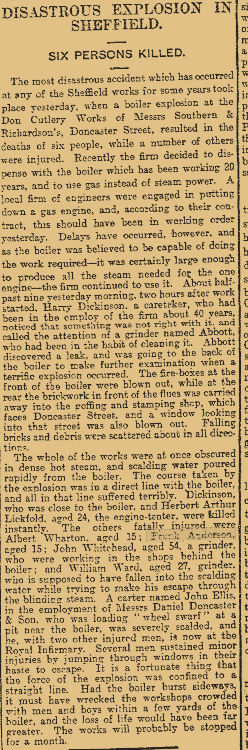
The tragedy was also reported in the national press. The Manchester Guardian dated 2nd November 1899 carried this report

whilst the Glasgow Herald (2nd November 1899) added this report

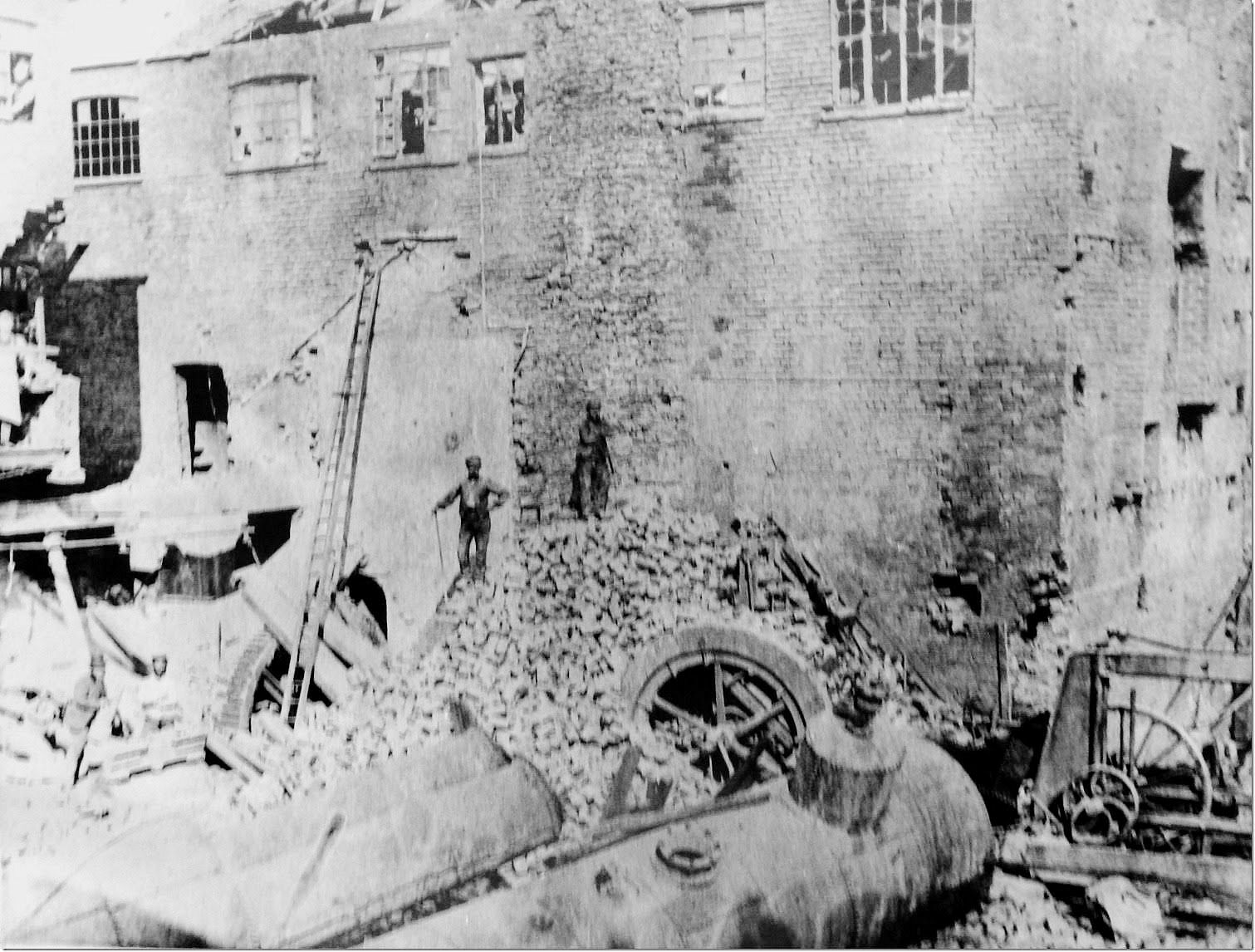
Contemporary photographs taken in the aftermath of the explosion at Messrs Southern and Richardson
(with thanks to Vin Malone)
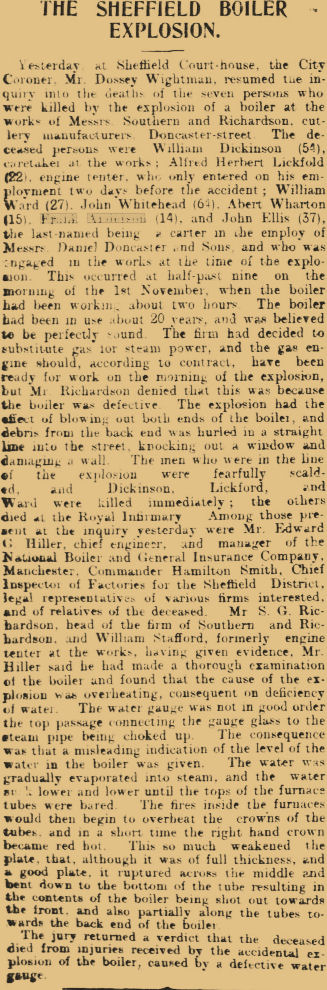
The Inquest resumed on November 23 1899 and was reported the following day in
the Sheffield and Rotherham Independent:
THE SHEFFIELD BOILER EXPLOSION
RESUMED INQUEST
A DEFECTIVE WATER GAUGE
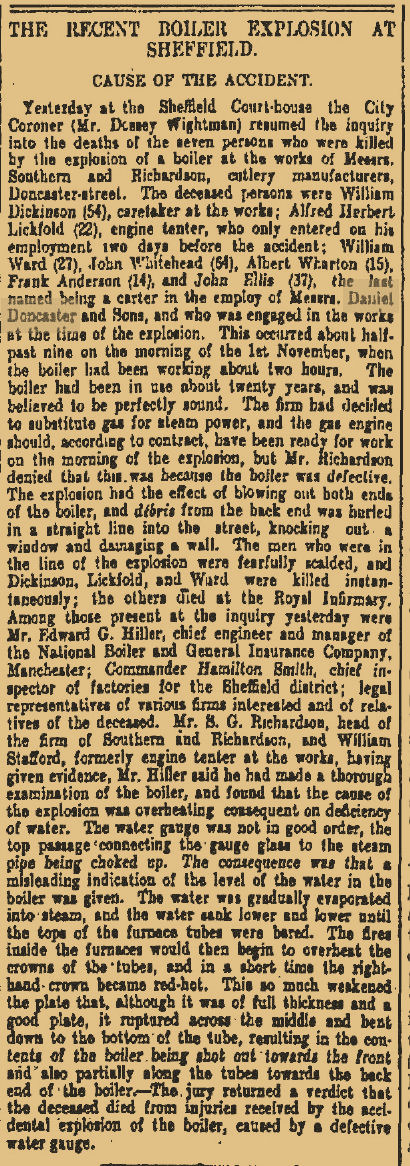
The inquest on the bodies of the seven victims of the terrible boiler explosion which occurred on November 1st at the works of Messrs Southern and Richardson, cutlery manufacturers, Doncaster Street, was resumed yesterday by the City Coroner, Mr Dossey Wightman. The inquiry was held at the City Court House. Mr Edward G. Hiller, chief engineer and manager of the National Boiler and General Insurance Company, Manchester, was present at the inquiry, assisting the Coroner. Commander Hamilton Smith, Chief Inspector of Factories for the Sheffield district, was present, representing the Home Office. The firm of Southern and Richardson was represented by Mr Shepherd, of Leeds (instructed by Messrs Rodgers, Thomas and Sandford); Mr S. N. Hurd represented the Ocean Accident Insurance Company; Mr J. H. Davidson represented Messrs Hattersley and Davidson, by whom the deceased man Lickfold, the engine tenter, was formerly employed; and Mr A. Neal represented the relatives of Ellis, who was employed by Messrs Daniel Doncaster and Sons, but happened to be on the premises at the time of the accident. Mr G. W. Hawksley, of Messrs Hawksley, Wild, and Co., by whom the boiler was supplied, was also present. Mr F. S. H. Wilson was foreman of the jury.
The first witness was Mr Samuel Gray Richardson, who said he was the sole
proprietor of the Don Cutlery Works, Doncaster Street, and traded under the name
of Southern and Richardson. The boiler which exploded was purchased by him from
Messrs Hawksley, Wild, and Co. in 1875, and had been in constant use ever since.
It was insured, and had been insured since 1883 in different companies. He could
not find any policy dated previous to that, but it was his impression that it
was insured soon after it was put down. Since 1885, it had been insured in the
Engine Boiler Employers’ Liability Insurance Corporation Limited. It had been
regularly inspected by one of their inspectors every year, with the exception of
once, when the inspector was ill. That was at the end of 1895. The exterior had
been inspected much more than once a year. The insurance company were allowed to
inspect it when and as they thought fit. He produced a report of the last
inspection, which was made at Christmas, 1898. There was only one boiler in the
works. The Saturday before the explosion, a boiler tenter named Stafford, who
had been in the situation since last Easter, left his employment. When he came,
Stafford was recommended to him by Tasker’s Engineering Company as a thoroughly
capable man.
The Coroner: ‘Why did he leave your employment?
Witness: ‘I was not satisfied with him altogether, and circumstances occurred on
Thursday which caused me to think it desirable to have a change.’
The Coroner: ‘Was it anything connected with the accident?’
Witness replied in the negative, and went on to explain that on Thursday
afternoon one of the grinders came across to the office to say some pieces had
broken out of his stone. Subsequently, witness learned that for the last two or
three weeks the engine had been set to run faster than it used to do. He
telephoned to Hattersley and Davidson’s to send a man up at once, and explained
to them that it would be better it should be set slower rather than have it too
fast. In the meantime, Stafford was told not to leave the place, but to keep his
eye upon the engine. The table knife manager, some time afterwards, found, on
going to the engine house, that he was not there, and saw him afterwards in the
street. It was ascertained that the breaking of the stone had nothing whatever
to do with the running of the engine, but owing to the fact that Stafford had
gone away from the engine house when told not to do so, and that he seemed to
think he knew more about the engine than he (Mr Richardson) or the
representative of Messrs Hattersley and Davidson, witness thought it advisable
that he should go.
The Coroner: ‘You gave him notice because he thought he knew more than you and
the engineer put together?’
Witness said that was so. Stafford would have left under any circumstances when
the gas engine was put down. Afterwards witness spoke to Mr Davidson, and asked
him to supply him with a man in Stafford’s place. He sent the deceased Herbert
Lickfold, who entered upon his duties on the Monday morning, Stafford having
received a week’s wages in lieu of notice. From half-past twelve to one on
Saturday the caretaker took charge of the engine, Lickfold did not before the
explosion tell him anything about the state of the boiler, or make any complaint
about it. The only time witness saw him on duty was on Tuesday afternoon, when
he said everything was going all right. Lickfold had sole charge of the boiler
from the time he came until the explosion. When the explosion occurred, witness
was on his way down to business.
By Mr Shepherd: ‘Is it true that you decided to give up this boiler because it
was done for?’
‘Absolutely untrue.’
‘And that it was at the end of its period of usefulness?’
‘There is not the slightest ground for anything of the kind. I have never had
the faintest suspicion that there was anything the matter with the boiler – the
thought had never crossed my mind.’
‘Had you full confidence in Hattersley and Davidson, and their recommendation of
Lickfold?’
‘Yes, I think him now to have been an efficient man.’
‘Was there also a man called Wright, from Hattersley and Davidson’s, at the
works on Monday morning?’
‘Yes. Wright, who knew the cisterns and supply of the boiler, was sent to
instruct Lickfold in the working of the place.’
‘Will you explain what was exactly the state of things with regard to the
purchase of this gas engine?’
‘Well, for some time the steam engine has not been running satisfactorily. There
was a very considerable amount of time lost, not in long periods, but in small,
irritating stoppages, and I had been considering for some time the desirability
of replacing it. I did not make up my mind for some time whether to put down a
new steam engine, a gas engine, or an electric engine, but I decided this year
in favour of a gas engine. I had had considerable trouble with the Corporation
about blowing off the boiler into the sewers, and I had had to give strict
orders that that was never to be done. The insurance people, on the other hand,
said it was very desirable to do so. They said we should blow off the boiler
occasionally to get rid of the sediment. That finally decided me in favour of a
gas engine. The question of the boiler being nearly worn out did not enter into
it at all. It was not nearly worn out.’
The Coroner: ‘In this report from the Insurance Company who made the examination
of the boiler at Christmas, and the original of which you produce, the Inspector
says: “Remarks. The boiler is too dirty; scale. Too thick to make a satisfactory
examination. Please urge removal of the same, and if possible to change the
water which comes from a well.” Is that a correct copy of the original report?’
Witness: ‘Yes, I think so.’
‘Did you take any steps at all after you got this report?’
‘Yes. At the time the report was taken the boiler had not been properly cleaned.
The men came in accordance with the arrangement, but owing to the Messrs
Hawksley, Wild, and Co. being engaged with the boiler, the men who were cleaning
were unable to make the progress they otherwise would. As a matter of fact, the
boiler was being scaled three days after the inspector’s report was sent in.’
‘You did remedy it?’
‘Yes.’
Commander Hamilton Smith: ‘The report of the Engine Boiler Employers’ Liability
Insurance Company here states that the boiler is too dirty.’
Witness: ‘You had better have the report which came to me.’
‘This appears to be the report made by the inspector to his own society. Was any
other representation made to you that a satisfactory examination of the boiler
had been made in December?’
‘No.’
‘I should like to ask whether, seeing that the inspector reported that a
satisfactory examination had not been made, they urged you to allow them another
opportunity of making a satisfactory examination?’
‘No. Nothing of the kind. They referred to this matter of the scale, which had
been removed before the report reached me.’
‘Has any external examination been made since December last by the Insurance
Company?’
‘No. At least, I have had no report. They have been round and examined it
externally.’
Mr Shepherd: ‘Is it not the practice to periodically examine the inside of the
boiler for the purpose of cleaning it out, and was not a thorough cleaning of
the boiler effected every three months?’
Witness: ‘Yes. At Christmas, Easter, Whitsuntide and August Bank Holiday. The
scale was removed as far as possible.’
‘This boiler would be thoroughly cleaned as late as the beginning of August
before the accident?’
‘Yes.’
William Stafford, engine tenter, said he had charge of the boiler from Easter
week until last Saturday. Witness found no fault whatever with the boiler before
he left. The water gauge was all right when he left. The last time he blew it
off was at 11 o’clock on Saturday morning, two hours before he left. He was in
the habit of blowing it off three or four times a day. There were two gauges,
but one of them was out of order owing to the glass being broken.
By Mr Hurd: ‘One gauge was as good as two.’
Mr Hiller: ‘Did you ever take any steps to ascertain whether the passages of the
water gauges were dirty or had scale in them or not?’
Witness: ‘I never had the opportunity of doing so.’
‘You could have unscrewed the small plug, could you not?’
‘I did not think it was necessary. The gauge was working all right.’
Mr Shepherd: ‘Were you there when the insurance company’s inspector inspected on
the last occasion?’
Witness: ‘Yes.’
‘On that occasion did the inspector adopt the method of unscrewing the water
gauges and taking them apart?’
‘No, sir.’
Mr Neal: ‘Did you take any steps to have the broken gauge put right?’
‘Yes, but I was waiting for another washer to make the joint right at the
bottom.’
‘Why didn’t you get a washer, or ask for one?’
‘Dickinson, the caretaker, was looking around to get me one.’
Commander Hamilton Smith read the recommendation contained in the report of the
insurance company, dated December 31st, that ‘the boiler should be thoroughly
scaled from end to end at the first opportunity, if only for convenience of
working.’ He asked witness if he could say how soon that recommendation was
carried out.
Witness: ‘No, sir. I cannot. I only took charge after Easter. I understand a
certain amount of cleaning was done at Easter, prior to my taking charge.’
‘Since you went there has the boiler ever been thoroughly scaled from end to
end?’
‘Not since I have been there.’
In reply to further questions, witness said the recommendation ‘to use soda in
solution with the feed water’ had been carried out.
A Juryman: ‘At the time you left did you consider there was sufficient water in
the boiler to work it properly?’
Witness: ‘Yes.’
‘During the time you were there had you any misgivings with regard to the boiler
itself?’
‘No.’
‘You were perfectly satisfied in your own mind that the boiler was safe?’
‘So far as I knew, it was.’
Mr Edward George Hiller, chief engineer of the National Boiler and General
Insurance Company, Manchester, said the company had upwards of 20,000 boilers
under their inspection. He read his report of an examination of the boiler,
which he made at the request of the Coroner on the 20th inst. He found that the
third ring of the right furnace had ruptured or torn across about half-way
round, and the back portion of this ring of plate was bent over until the edge
of the ruptured part was only a little distance above the bottom of the tube. A
gap was thus caused, and it was through this gap that water and steam were
expelled with such disastrous results. Apart from this ruptured plate the
structure of the boiler proper was not injured. Inside the boiler the plates of
the outside shell were covered with a varying thickness of incrustation, and at
the water level there was a little evidence of greasy deposit. The flue tubes on
the lower parts had a coating of rough scale of irregular thickness. All the
various fittings were in order except the water gauges. The inspector’s account
of these was as follows:
‘The boiler is equipped with two water gauges with a water level pointer between
them. The left-hand water gauge was shut off at the time of my examination, and
was out of use at the time of the explosion. The reason for this was stated to
be that a new gauge glass required putting in, but that there was no suitable
washer to hand, and consequently the gauge glass could not be packed, and the
water gauge had to be shut off. I carefully examined the plugs and passages of
the right-hand water gauge, which was the one depended on at the time of the
explosion. All the plugs and waterways were free excepting the passage through
the top fitting. In the top of this fitting I found that the small passage was
perfectly choked up with incrustation. The passage between the plug and the
boiler was also was also very nearly filled with incrustation. The result of
this would be in actual working that when the boiler was working with a proper
level of water it would gradually and slowly rise in this gauge glass until the
gauge indicated correctly. When the water in the boiler, however, sank to a
lower level owing to its being evaporated into steam and used in the engine, the
water in the gauge glass would not fall, but would continue at the same level,
and indicate that there was plenty of water in the boiler when the water was
reaching a dangerously low level.’
Mr Hiller’s account of the cause of the explosion was as follows:
‘The cause of the explosion was overheating, consequent on deficiency of water.
The water gauge which was in use was not in good order, the top passage
connecting the gauge glass to the steam space being chocked up. The consequence
of this was that a misleading indication of the level of the water in the boiler
was given. The water in the boiler was gradually evaporated into steam, and the
water sank lower and lower in this way until the tops of the furnace tubes were
bared. When this took place the fires inside the furnaces would begin to
overheat the crowns of the tubes, and there is distinct evidence that this has
been done in both tubes. Probably the overheating allowed some slight escape of
steam such as the leakage which was noticed in the left furnace. Evidently the
fire in the right-hand furnace had been much brighter than that in the left, and
in a short time the right-hand furnace crown became red hot. The plate was so
much weakened by becoming red hot that, although it was of a full thickness and
a good plate, it ruptured across the middle and bent down to the bottom of the
tube, resulting in the contents of the boiler being shot out towards the front
and also partially along the tubes towards the back of the boiler.’
Mr Sherwood: ‘This particular accident was just as likely to have taken place on
a bran-new boiler as in this?’
Witness: ‘Yes, if the gauge was choked. The accident had nothing to with the age
of the boiler.’
The Coroner: ‘The explosion was not caused by corrosion or anything of that
kind, but from the defective gauge?’
Witness: ‘Yes. But for that the boiler would have lasted 20 years longer under
good conditions.’
‘Is there anything unusual in running a boiler of this kind for 24 years?’
‘No, sir.’
The Coroner asked Mr Hawksley, of the firm of Hawksley, Wild, and Co., if he
could throw any further light upon the matter. Did he agree with the report,
read by Mr Hiller?
Mr Hawksley: ‘I do entirely.’
The Coroner: ‘And the evidence he has given in answer to the court?’
Witness: ‘I quite agree with what Mr Hiller has said, and if it had not been for
this accident, and the boiler had been well cared for it would have done for ten
or twenty years.’
‘Can you pass any opinion as to whether Lickfold ought to have foreseen it?’
Mr Hawkesley said the danger was in his not keeping his gauges in proper order.
The Coroner: ‘Is it possible that Lickfold could have allowed this accident
without being guilty of extreme carelessness or foolishness or recklessness? Was
he guilty of all those?’
Witness: ‘I think he has been thoroughly mistaken in the height of his water
through his not thoroughly testing his gauges.’
‘Could he have worked safely with one gauge, the other being out of order?’
‘Undoubtedly.’
The ended the official evidence.
The Coroner, in his summing up, said he had never known a case in the whole of
his experience in which he had heard more reports with regard to the cause of
the accident and the persons to blame for it.
The jury then returned a verdict of accidental death in relation to all the
victims, who had all died as a result of injuries received by the explosion,
which itself was as a result of a defective water gauge.
The Yorkshire Herald, and The York Herald dated 24th November 1899 also carried a report of the inquest
The same day also saw a report in the Manchester Guardian
It is difficult to comprehend how no blame was attached to any person with
regard to the explosion of the boiler. One water gauge had been out of action
for some time and the other was so clogged up with mineral deposits that it gave
an incorrect reading. The owner of the firm, Mr. Richardson, attested to annual
inspections by external examiners, and a three-monthly cycle of cleaning the
inside of the apparatus to remove some of the accumulated scale. However, nobody
from either the insurance company or Mr. Richardson’s company appeared to have
thought to check the water gauges at the same time. To compound the error, all
that was required to repair the broken gauge was a simple washer, which somehow
was not available. Today, Mr, Richardson, as proprietor and therefore the man
ultimately responsible for the maintenance and upkeep of the premises and
everything therein, might find himself the subject of a charge of ‘corporate
manslaughter’, but such an option was not available in English law at the time;
the law maintained the principle laid down in the seventeenth century by the
Lord Chancellor, Edward, First Baron Thurlow, who asked, ‘Did you ever expect a
corporation to have a conscience, when it has no soul to be damned, and no body
to be kicked?’
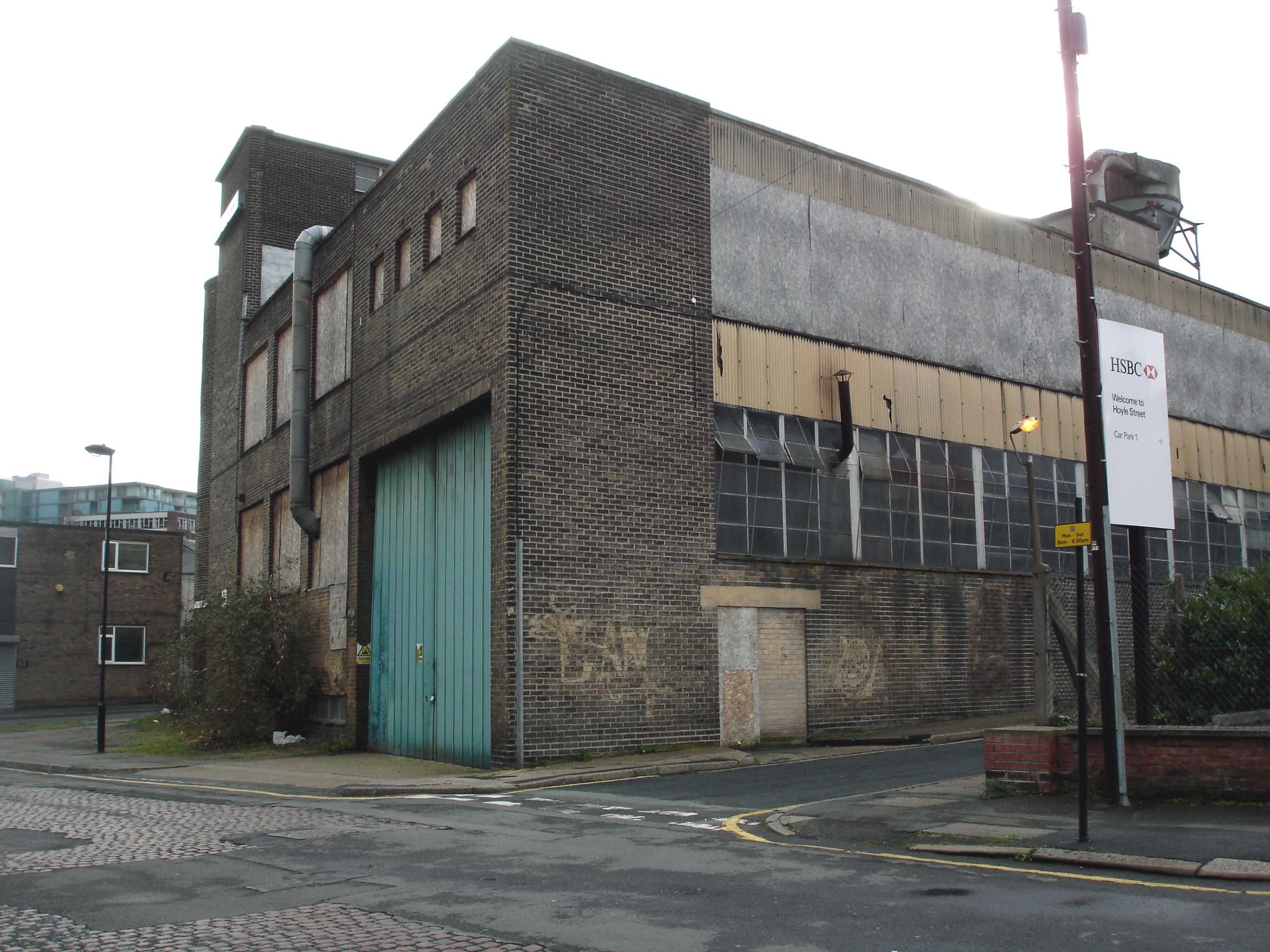
The site of Messrs Southern and Richardson, Doncaster Street, with Shepherd Street in the background and Ellis Street in the foreground.
The current building, now out of use and boarded up, was most recently occupied by toolmakers Record Ridgeway (photograph 2012)
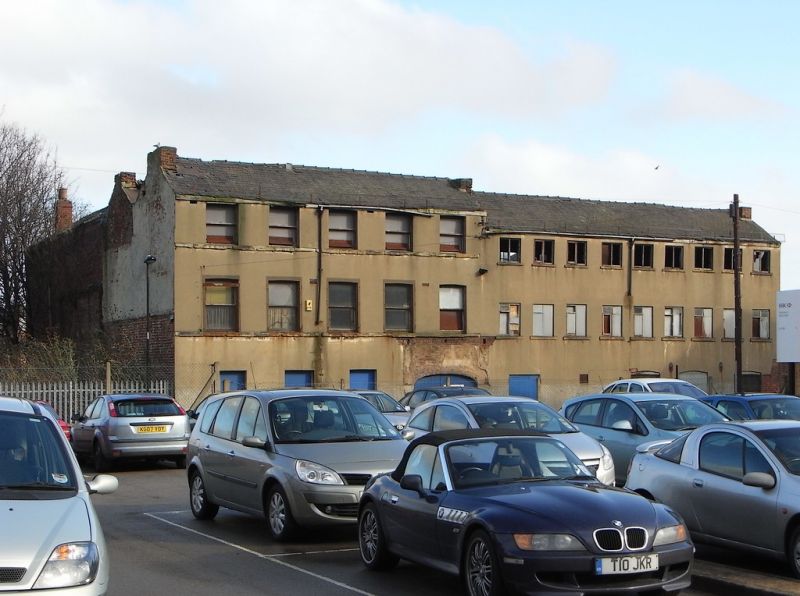
Doncaster Street 2012
A final note that puts a chilling perspective on the tragedy - This devastating explosion in which seven people were killed occurred just fifty yards from and thirteen years after the Matthew Street wall collapse, in which eight children died. It will be noticed that one of the victims of the Matthew Street tragedy was seven-year-old Clifford Anderson, of Burnt Tree Lane, and one of the boys killed in 1899 was Frank Anderson, aged fifteen, of No.4 court, No.3 house, Burnt Tree Lane. They were brothers; a sad and unlikely coincidence.
Notes
The burial places of those who died in the tragedy are as
follows
Harry DICKINSON – Burngreave
DICKINSON, Henry (Cutler, age 55). Died at Doncaster St - Killed; Buried on November 4, 1899 in Consecrated ground; Grave Number 46, Section T2 of Burngreave Cemetery, Sheffield.
Remarks: S Res 46 Doncaster St Attending Minister: F C Witty.
William WARD – City Road WARD, William (S. K. Grinder, age 27). Died at Royal Infirmary; Buried on November 6, 1899 in Consecrated ground;
Grave Number 14955, Section EE of City Road Cemetery, Sheffield. Remarks: Plot Owner: ~ ~ of ~. Page No 1252
Alfred Herbert LICKFOLD – Burngreave LICKFOLD, Alfred Herbert (Engineer, age 22). Died at Doncaster St.- Killed; Buried on November 6, 1899 in Consecrated ground; Grave Number 40, Section S5 of Burngreave Cemetery, Sheffield. Parent or Next of Kin if Available: . Remarks: P Res 44 Ballon St Attending Minister: T Couch. Plot Owner: M WOMERSLEY of 84 Spring Vale Road. Page No
John WHITEHEAD – Burngreave WHITEHEAD, John (T B Forger, age 64). Died at Doncaster St - Killed; Buried on November 4, 1899 in Consecrated ground; Grave Number 151, Section M1 of Burngreave Cemetery, Sheffield.Remarks: Res 56 Shepherd St Attending Minister: F C Witty.
John ELLIS – Burngreave ELLIS, John (Carter, age 39). Died at 14 Kilton St; Buried on November 4, 1899 in General ground; Grave Number 84, Section K1 of Burngreave Cemetery, Sheffield. Parent or Next of Kin if Available: . Remarks: S Attending Minister: C G Holt.
Albert WHARTON – Wardsend (D213 no MI)
Thanks to Hugh Waterhouse for the information regarding the place of burial
Notes
Southern & Richardson Ltd. cutlery manufacturers,
manufacturers of table, silver-plated, dessert,
pen, pocket, cook &c. knives, razors, scissors &c.
Don Cutlery works, Doncaster Street & Ellis Street.
Richardson Saml Gray J P manufacturer (Southern
& R Ltd), house, Stone Grove, Tree Root Walk.
1925 Kelly's directory.
Southern & Richardson Ltd. cutlery manufacturers,
Don cutlery works, Milton Street, S3.
& Thomas Street, S1.
1965 Kelly's directory.
information on Southern and Richardson which I hope is of
interest.
Samuel Richardson Cutlery manufacturer (Southern & Richardson) h. Hanover
Buildings White's 1849
Samuel Richardson Manufacturer (Southern & Richardson) h. Collegiate Crescent
White's 1852
Samuel Richardson Manufacturer Stonegrove White's 1871
Samuel Gray Richardson J. P. (Southern & Richardson Ltd.) h. Stone Grove, Tree
Root Walk White's 1905
Southern & Richardson, Manufacturers of table, silver-plated, dessert knives
etc, Don Cutlery Works, Doncaster Street & Ellis Street White's 1905
Samuel Gray Richardson J. P. (Southern & Richardson Ltd.) h. Stone Grove, Tree
Root Walk White's 1919
Harold Willey Cutlery manufacturer (Southern & Richardson Ltd.) h. 10 Riverdale
Road White's 1919
Henry E. Brant Manager (Southern & Richardson Ltd.) h. 102 Harcourt Road Kelly's
1925
Samuel Gray Richardson JP; manufacturer (Southern & Richardson Ltd.) h. Stone
Grove, Tree Root Walk Kelly's 1925
Harold Willey Cutlery manufacturer (Southern & Richardson Ltd.) h. 10 Riverdale
Road Kelly's 1925
http://www.britishlistedbuildings.co.uk/en-501152-don-cutlery-works-sheffield
Thanks to Matthew Bell for the photographs and transcription
Sources
The Yorkshire Herald, and The York Herald (York, England), Thursday, November 02, 1899; pg. 4; Issue 15102.
The Sheffield & Rotherham Independent (Sheffield, England), Thursday, November 02, 1899; pg. 8; Issue 14033
Glasgow Herald (Glasgow, Scotland), Thursday, November 2, 1899; Issue 262.
Manchester Times (Manchester, England), Friday, November 3, 1899; Issue 2204.
The Derby Mercury (Derby, England), Wednesday, November 8, 1899; Issue 964
The Yorkshire Herald, and The York Herald (York, England), Thursday, November 24, 1899.
The Sheffield & Rotherham Independent (Sheffield, England), Thursday, November 24, 1899
The Manchester Guardian dated Thursday, November 24, 1899
Sheffield Indexers
This page was last updated on 04/02/18 14:53