SYDNEY ALBERT CUTTS - FROM WOODHOUSE (SHEFFIELD) TO ARCHANGEL (RUSSIA)
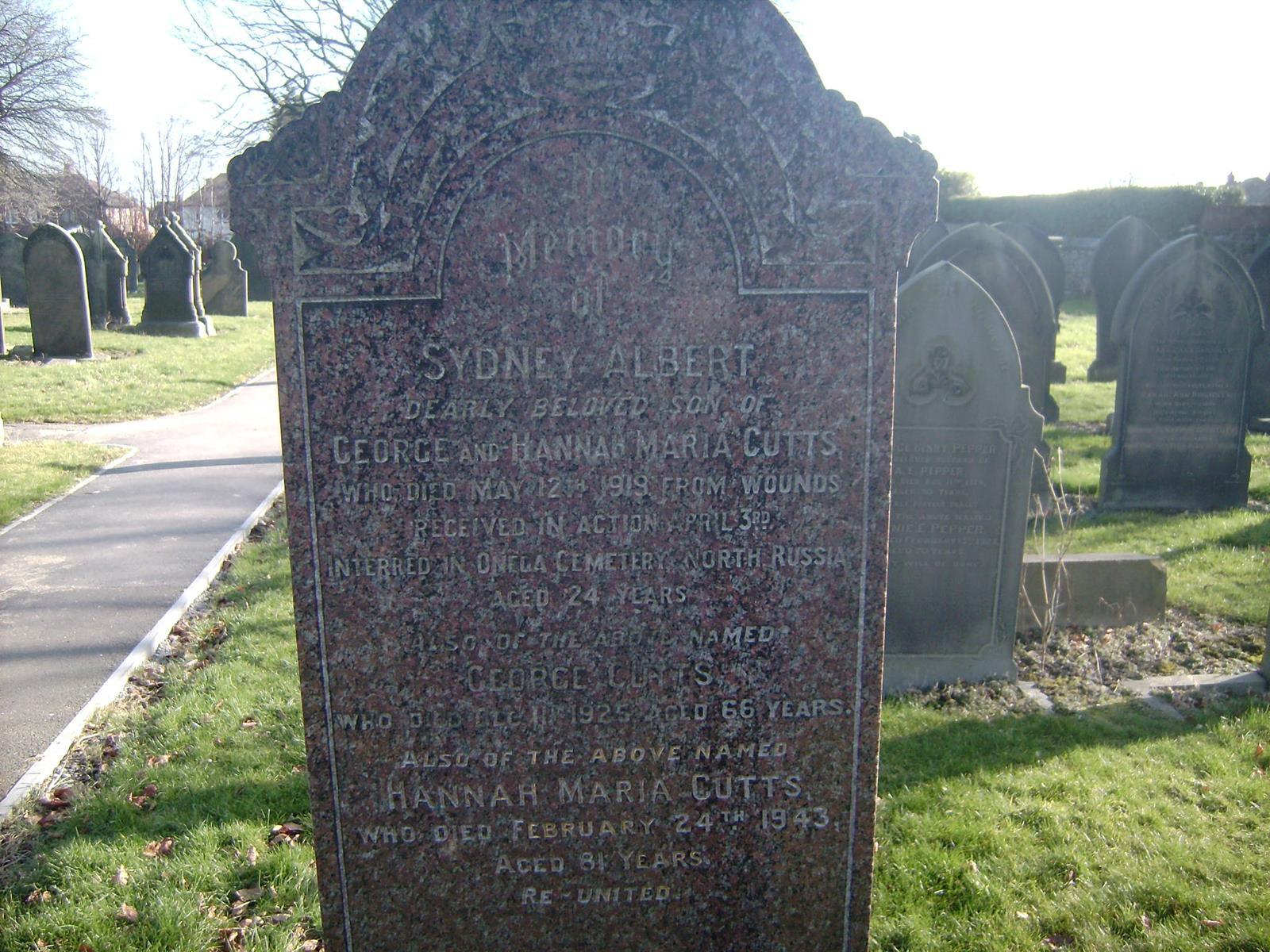
A friend of mine was having a lunchtime break from his job, and decided to go for a walk around the Cemetery at Woodhouse, Sheffield. As he was walking down one of the paths he saw this elaborately carved headstone with a rather unusual and intriguing inscription
IN MEMORY OF SYDNEY ALBERT
DEARLY BELOVED SON OF
GEORGE and HANNAH MARIA CUTTS
WHO DIED MAY 12th 1919 FROM WOUNDS
RECEIVED IN ACTION APRIL 3rd
INTERRED IN ONEGA CEMETERY NORTH RUSSIA
AGE 24 YEARS
ALSO OF THE ABOVE NAMED
GEORGE CUTTS
WHO DIED DECEMBER 11th 1925 AGED 66 YEARS
ALSO OF THE ABOVE NAMED
HANNAH MARIA CUTTS
WHO DIED FEBRUARY 24th 1943
AGED 81 YEARS
RE - UNITED
To confirm this information I checked the Commonwealth War Graves Commission database and found the following entry
CUTTS, S A
Rank: Private
Service No: 57834
Date of Death: 12/05/1919
Age: 24
Regiment/Service: Yorkshire Regiment 6th Bn.
Memorial ARCHANGEL MEMORIAL
Additional Information: (buried Onega Town Cem.).
Battalions of the New Armies - 6th (Service) Battalion
Formed at Richmond on 25 August 1914 as part of K1 and came
under orders of 32nd Brigade, 11th (Northern) Division. Moved to Belton Park
near Grantham. In April 1915 moved to Witley Camp near Godalming in Surrey.
Sailed from Liverpool on 3 July 1915, going via Mudros to Suvla Bay,
disembarking there on 6 August 1915.
December 1915 : evacuated from Gallipoli and moved to Egypt via Imbros.
July 1916 : moved to France.
15 May 1918 : reduced to cadre strength. Cadre was attached to 66th (2nd East
Lancashire) Division for ten days (19 to 29 June).
30 June 1918 : landed at Folkestone and transferred to 75th Brigade, 25th
Division. Moved on to Mytchett near Aldershot.
July 1918 moved on to Margate. Absorbed 19th Bn during August
1918.
9 September 1918 : Brigade re-designated the 236th Brigade, for service in North
Russia. Sailed from Dundee 17 October 1918 and arrived at Murmansk 27 November
1918.
I wondered what Sydney and his regiment were doing in Northern Russia in 1919
given that the war ended in November 1918. The
Commonwealth War Graves Commission's article on the ARCHANGEL MEMORIAL
provides an answer
"The ARCHANGEL MEMORIAL, which consists of panels fixed into the east wall of
the cemetery, commemorates 219 British officers and men who died during the
north Russian campaign and whose graves are not known.
The War Graves and Memorials in the Soviet Republics of Eastern Europe are a
result of the campaigns of 1918-1920 in several parts of European Russia. These
campaigns, which were the outcome of the Russian Revolution of November, 1917,
are closely connected both with events in Asia (particularly in Persia and in
Siberia) and with the general course of the War in the West. The continued
German and Turkish threats to India by way of Persia and Afghanistan, and the
crisis of 1918 in France caused by the withdrawal of Russia from the Entente,
form the background to the North Russian Expedition and the Allied intervention
in South Russia, which are summarised in the following narrative.
In the spring of 1918 the main Russian Government, neutral towards Germany and
Austria, was surrounded by various hostile regional Governments on the fringes
of the former Russian Empire. Its Western front was open, and German troops had
been transferred in very large numbers to France. Finland, independent since
December, 1917, was torn by the struggle between "White" and "Red", and strong
German forces entered the country and secured, in May, 1918, the ascendency of
the "White" Government. The North Russian ports, through which the Allies had
assisted Russia with supplies and munitions, were now open to German occupation.
The Black Sea, the Caucasus and the Caspian Sea were as yet beyond the reach of
Allied forces, and the Russian half of the barrier between the Central Powers
and India had failed. Lastly, there had emerged from the late Russian armies the
two Czechoslovak Divisions, formed of ex-Austrian prisoners, which were known to
be making for Archangel or Vladivostok in order to join the Allies. All these
facts suggested intervention; it took the form of landings in the North and
Military and Naval Missions, armaments and stores in the South and East. The
Northern expedition lasted from 1918 to 1919, and was a separate military
operation. The intervention in the South was linked with the advance of
detachments from the Allied armies in Greece and Mesopotamia, and it lasted from
1919 to 1920. In April, 1918, a force of 150 Royal Marines landed at Murmansk,
off which a British battleship had for some time been stationed. By the end of
May 500 British Marines and sailors, 300 French soldiers, 1,400 Serbian soldiers
and 500 Finnish "Red Guards" (the Finnish Legion) were holding the Kola
Peninsula and Kandalaksha. The danger at present lay in Finland, and the Murman
force, gradually strengthened, occupied the line of the Murmansk railway as far
South as Soroka by the end of June. These operations were begun with the consent
of the main Russian Government. On the 1st-2nd August, 1918, another Allied
force occupied Archangel. It advanced in August and September Westward to Onega
and South and South-East, along the Vologda railway and the Dvina, to Yemtsa and
beyond Bereznik (Semenovka). Behind these two forces were the friendly local
Soviets, but already both had become engaged in hostilities with the Russian
Bolshevik troops. On the 18th September Admiral Kolchak announced the formation
of an anti-Bolshevik Government and "assumed power" over all the Russias, basing
himself on Siberia and the South. By October, 1918, nearly 20,000 British,
French, American, Italian, Polish and Russian troops were on the Archangel
front, and nearly 15,000 British, French, Italian, Serbian and Russian on the
Murmansk front. The danger from Finland disappeared in December, with the
withdrawal of the German troops and the establishment of a friendly Coalition
Government; the hope of junction with the Czechs was disappointed. The winter
was spent in repelling determined Bolshevik attacks on the Archangel force and
in advancing the forward positions of the Murmansk force beyond Segeja. With the
early spring of 1919 news arrived of considerable successes won by Admiral
Kolchak in the East and by General Denikin, the "White Russian" commander in the
South; but in March and April the Allied Governments decided on an early
evacuation of North Russia. War against the Bolshevik Government had not been
one of their objects. The two North Russian forces were to be strengthened,
disengaged by local offensives, and withdrawn; the friendly Governments were to
be helped to establish themselves, if possible, on a firm military basis; and
the Siberian army of Admiral Kolchak might perhaps be linked, before the Allied
soldiers left, with the troops of the Archangel Soviet. General Lord Rawlinson
was sent to co-ordinate the operations. Only the first of these aims could be
realised. The Murmansk force reached Lake Onega by the 18th May and fought small
actions on or near the lake through the summer; it captured Lijma on the
14th-16th September, and within another month it had successfully evacuated
Murmansk. The Archangel force, fighting on a wider front and more severely
attacked, won the Battle of Troitsa on the 10th August, and evacuated Archangel
without further difficulty on the 27th September. The friendly Governments held
out for some months, but the Bolsheviks entered Archangel on the 20th February,
1920. On the Finnish border fighting between Soviet forces and Finnish troops or
Karelian insurgents continued at intervals until the end of 1921. Kolchak's
Siberian forces were decisively defeated in the summer of 1919. Denikin, after a
successful summer campaign which reached as far as Kiev in September, was driven
back throughout the winter of 1919-20 until his last position, at Novorossisk,
was lost in March. In November, 1920, General Wrangel, who still held the
Crimea, was forced out of Sevastopol, and organised resistance to the Russian
Soviet Government ended."
Sydney was from Woodhouse. In the 1911 Census his entry is as follows
Name Sydney Albert Cutts
Relationship to Head of Household Son
Condition Single
Gender Male
Age 16
Estimated Year of Birth 1895
Occupation Colliery Labourer Above Ground
Employed Yes
Working at Home No
Place of Birth Yorkshire Handsworth
Enumerator Information
Address 39 Vicar Lane Woodhouse Sheffield
Parish Handsworth Town Woodhouse Sheffield
Type of Building Private House
Number of Rooms 6
Inhabited Yes
Reference RG14PN28034 RG78PN1601 RD510 SD8 ED8 SN21
Administrative County Yorkshire (West Riding)
Registration District Sheffield
Registration Sub District Handsworth Enumeration District 8
Reference Information
Folio 41
Page 1
Piece 28034
RD number 510
SD number 8
ED number 8
Schedule 21

He was living at home with his parents GEORGE and HANNAH and his two brothers WALTER and REGINALD. The family had already experienced tragedy in their lives. George and Hannah in their twenty year marriage had eight children but only five were living at the time of the census.
George and Hannah must have been devastated by the death of Sydney - the monumental inscription in Woodhouse Cemetery bears this out
Sydney's name also appears on the following War Memorials in Woodhouse
Cutts. S. Died. St Jame's Roll of Honour, Woodhouse.
Cutts. S.A. Died. Woodhouse market square War Memorial.
Cutts. Sydney, Died. Woodhouse Trinity Methodist Church Roll of
Honour.

Woodhouse (Sheffield) War Memorial - supplied by Sheffield Soldiers of the Great War
Sources
Commonwealth War Graves Commission - Archangel Memorial
Sheffield Soldiers of the Great War
1911 Census
This page was last updated on 12/03/13 08:44