The Funerals of Sarah Ramsden - Penistone May 1930
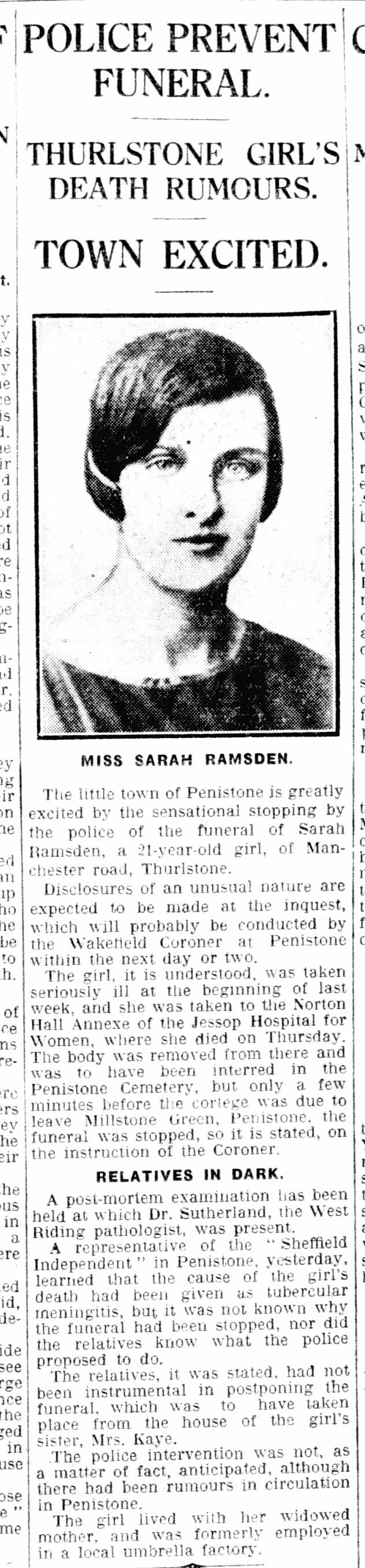
The following newspaper reports detail the death and subsequent burial of Sarah Ramsden, a 21 year old woman from Thurlstone, Penistone who died in the Norton Annexe of Sheffield's Jessops Hospital for Women.
The first report is from the Sheffield Independent dated 8th May 1930
Clearly this is a highly unusual course of action. The death had obviously been certified after a post mortem had been conducted by the West Riding Pathologist Dr. Sutherland. It was found that Sarah had contracted tubercular meningitis which is classed as death by natural causes.
The police it appears were acting solely on the instructions of the coroner in halting the funeral cortege as it left for Sarah's interment. To find out why I checked why the coroner took this very unusual course of action.
This is taken from
Dorries, C P; Coroners’ Courts – a guide to law and practice; [2nd ed. 2004,
OUP Anyone who is concerned about the cause of a death can inform a coroner about it, but in most cases a death will be reported to the coroner by a doctor or the police.
Any death that is violent or unnatural must be reported to the Coroner. The term “unnatural” carries a wide meaning. It is not enough to say that someone has died of natural causes – even so the case may require an Inquest if the surrounding circumstances are such as to make it unnatural or violent. The following list helps explain the types of death that will require a report to the Coroner, but the list is illustrative, not exhaustive.
A death should be reported to HM Coroner if*:
The medical cause of death is unknown
The death cannot readily be certified as being due to natural causes
The deceased was not attended by a doctor during his or her last illness or was not seen within the 28 days prior to death
There are any suspicious circumstances or any history of violence
The death may be linked to an accident (whenever and wherever it might have occurred)
The death may be due to acute alcohol poisoning
There is any question of self-neglect or neglect by others
The death has occurred or the illness has arisen during or shortly after detention in police or prison custody (including voluntary attendance at a police station)
The death has occurred whilst the patient is involuntarily detained under the provisions of the Mental Health Act
The death is linked with abortion
The death might have been contributed to by the actions of the deceased him/her self (e.g. drug abuse, solvent abuse, self-injury or overdose)
The death might be due to industrial disease or related in any way to the deceased’s former employment, however long ago.
The death occurred during or within 14 days after an operation or comparable clinical procedure. This includes deaths that might in any way be related to an anaesthetic. If the operation was performed for an injury of any kind, irrespective of how or when it occurred, the coroner should be informed since the death may be consequent upon and not merely subsequent to the accident.
The death may be related to a clinical procedure or treatment
The death might be due to lack of medical care
The death might be related to a blood transfusion
The death might be related to an adverse reaction to a drug or to poisoning of any kind
The death occurs within 24 hours of admission to hospital, unless the admission is solely to provide terminal care
The death is unusual or raises disturbing features
It is usually prudent to report any death where there have been allegations of medical mismanagement or alleged negligence.
An exhaustive list but the newspaper report stated that rumours had been circulating in Penistone about Sarah's death and that is why the Coroner halted the burial.
The following day Sheffield Independent dated 9th May 1930 reported that Sarah had been interred
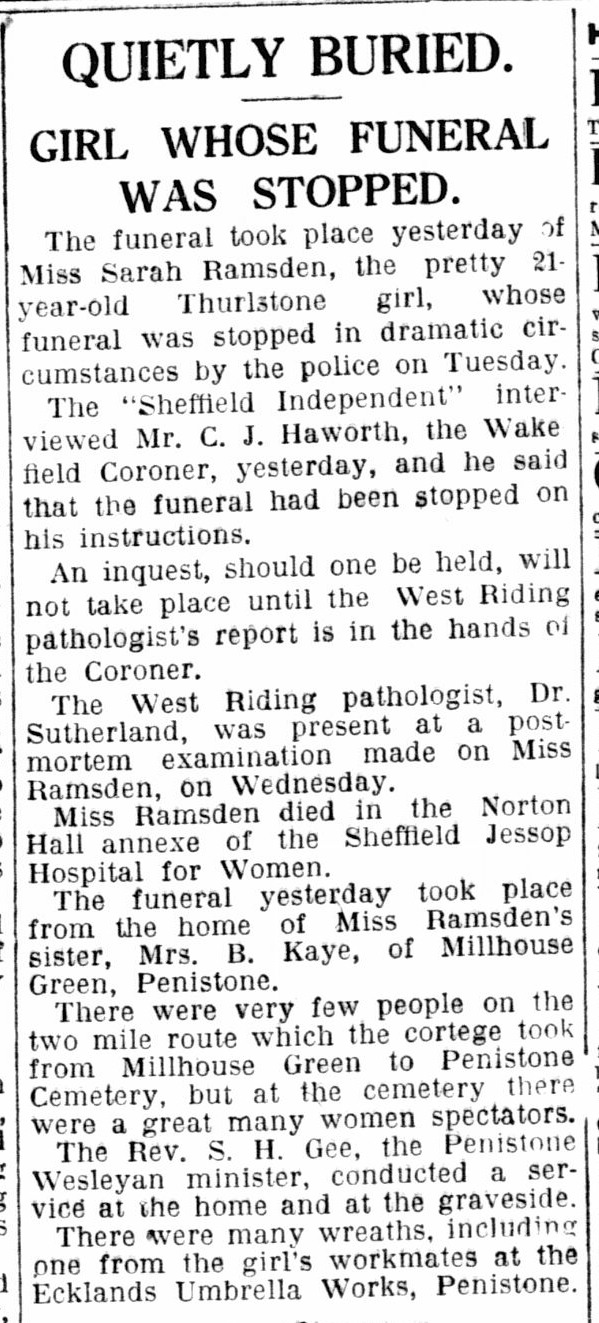
But twelve days later the inquest gave an inkling of why the rumours were circulating in Penistone. Sarah was unmarried and seven months pregnant at the time of her death. I believe that the coroner got to hear that they may have been an attempt at a termination of the pregnancy and so halted the funeral. These rumours were totally unfounded by nevertheless the Coroner had to act.
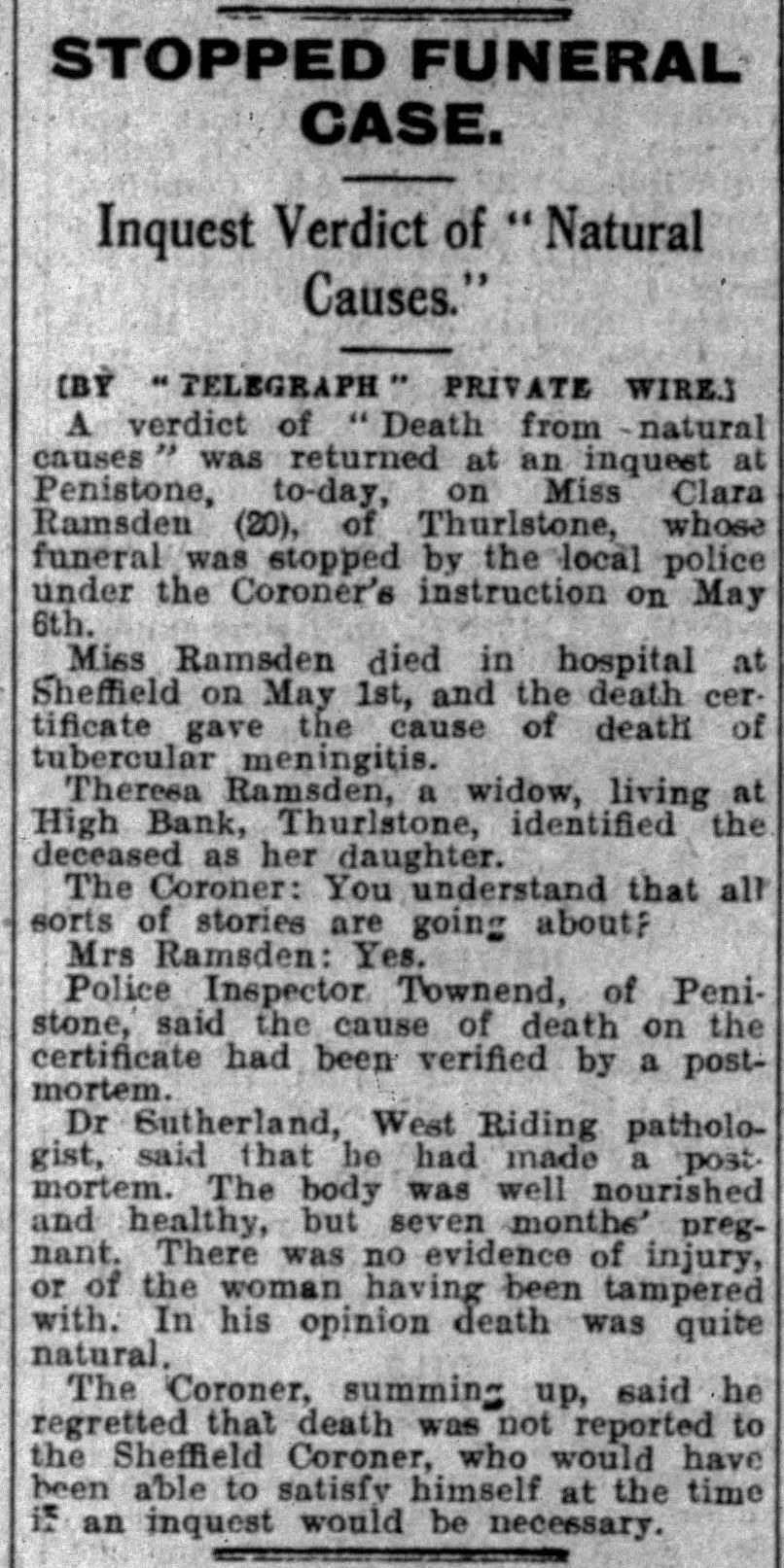
Grimsby Daily Telegraph dated 21st May 1930
Sources
Grimsby Daily Telegraph dated 21st May 1930
Sheffield Independent dated 8th May 1930 and 9th May 1930
Dorries, C P; Coroners’ Courts – a guide to law and practice; [2nd ed. 2004, OUP
This page was last updated on 17/11/26 10:00