
Sheffield's First Air Raid - 25th September 1916
"There is no such thing as a non-combatant in this war". David Lloyd George
The raid occurred on the night of Monday 25th September 1916 when a single Zeppelin dropped 36 bombs in a line between Burngreave and through Attercliffe to Darnall. The Zeppelin in question was a German Naval Zeppelin L22 that was under the command of Kapitanleutnant Martin Dietrich
Photo of the German Zeppelin L22 which bombed Sheffield - 25th September 1916
The Zeppelin approached the city from the south east and circled clockwise over the city before dropping incendiaries and high explosives in a south easterly and then easterly direction over the northern districts of Pitsmoor and Attercliffe. The first bomb fell in Burngreave Cemetery where it demolished a boundary wall and the second close to Danville Street where the first fatality occurred. The next bomb claimed the lives of two elderly women in a house in Grimethorpe Road. At the corner of Petre Street and Lyon Road a man who I now believe was 59 year old Thomas Wilson, was looking out of a window only to be killed by shrapnel and at 43 Writtle Street a 57 year old woman died from wounds and shock. (see note 1)

Ref No: s00146
Title: Nos 24-28 Cossey Road, Burngreave, searching for survivors after the Zeppelin raid on Sheffield on the night of 25/26 September 1916.
Location: Sheffield_Burngreave Date: 26/09/1916 Copyright: Weston Park Museum (?)
However far worse was to come. Two bombs fell in rapid succession in Cossey Road, the first of which demolished three houses in a row and penetrated the cellar of the middle one - 26 Cossey Road. In the cellar of no 26, four families were sheltering from the raid but stood little chance of surviving the explosion - three men, four women and three children were killed outright. The second bomb hit 10 Cossey Road killing a young couple Levi (23) and Beatrice Hames (22) and their baby son Horace William (1) as they lay together in bed.
The next bomb fell in Corby Street a further nine victims. Corby Street ran parallel to the Atlas Steel and Iron Works and the Norfolk Steel Works but the works remained untouched. At number 136 Corby Street, seven people in the same family, the Tyler's, were killed, five of which were children. In total the bomb claimed a further nine victims.
A bomb in Princess Street demolished the Primitive Methodist Chapel. Further bombs exploded near to Washford Road bridge and in Woodbourn Road where a man was blown to pieces as he warned a household to put out their lights. The Zeppelin finally disappeared east over the Darnall district of Sheffield.
The bombing had resulted in 24 fatalities outright. There was a further four fatalities in the days after the raid, leading to an overall total of 28. There were also 19 persons who received injuries in the raid. With regard to property, 89 houses were seriously damaged whilst another 150 suffered minor damage. The Baltic Arms at 420 Effingham Road was damaged in the raid.
The final summary is as follows - There
were nine deaths in Corby Street; thirteen in Cossey Road; one in Petre Street;
one in Writtle Street; two in Grimesthorpe Road; one in Danville Street, and one
in Kilton Street.
The damaged property was situated as follows,-
Attercliffe Road - 3 houses
Bacon Lane (off Lovetot Road) - 12 houses
Brittania Road (fire) - 2 houses
Corby Street - 4 houses
Danville Street - 9 houses and hotel
Earldom Street - 4 houses
Forncett Stree (fire) - 2 houses
Grimesthorpe Road - 7 houses
Peter Street and Earldom Street - 6 houses
Princess Street - Chapel and cottage
Writtle Street - 3 houses
Trent Street - 12 houses
Washford Road - 10 houses
Woodburn Hill - 9 houses
All but three of the victims were buried in Sheffield's Burngreave Cemetery. The exception were the Hames family who are buried together in Sheffield's Abbey Lane Cemetery
The City's defences at the time of the attack were described as a "fiasco" and "shambolic". The officers of the local anti-aircraft defences were attending a ball at the Grand Hotel in Sheffield City Centre and so no order was given or received to engage the L22. I have looked through The Air Defence of Britain 1914-1918 and can't find any reference to suggest that any RFC aeroplanes saw/chased the L22.The airship remained unmolested. Needless to say, the bombing did lead to the installation of extra searchlights and guns on the hills that surround the city but it proved to be a case of shutting the stable door after the horse had bolted.
It is worth noting that there was another aspect to the city's air raid precautions and this was the "electric buzzers".
The Sheffield Daily Telegraph dated 17th February 1916 carried this report of the event
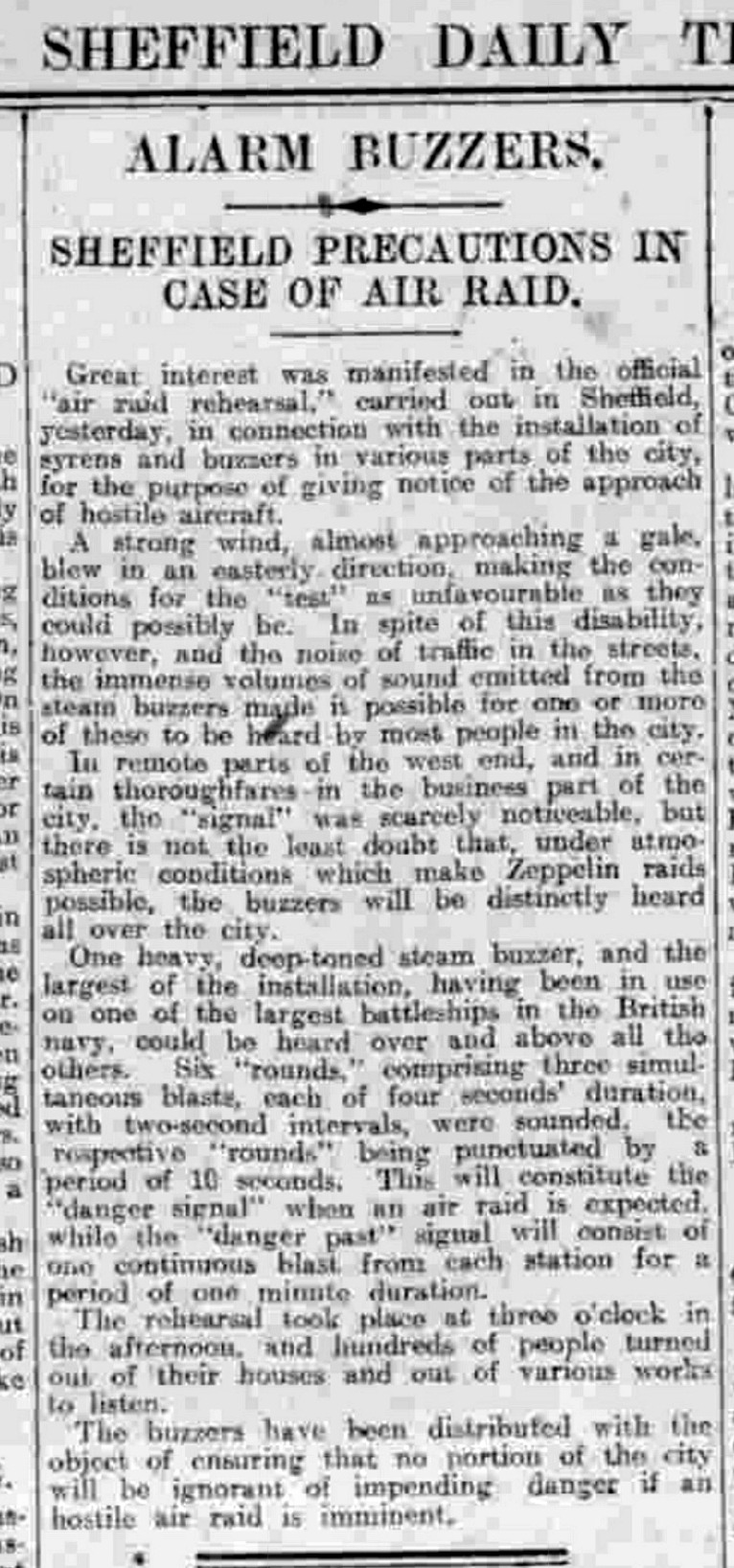
And on 17Feb1916 there is another article. I've transcribed it here:
“Disappointing “Buzzer” Test in Sheffield
The testing of the air raid alarms in Sheffield yesterday afternoon were hampered by the weather conditions. The high wind whistling amid overhead wires had the tendency to nullify other sounds and also prevent sound carrying effectively. Of course, in a real alarm, the buzzers will not have to overcome these difficulties, for no Zeppelin would be
traveling in such weather.
Altogether eighteen buzzers were sounded simultaneously at three o’clock yesterday afternoon, but the noise made was not sufficient to attract the attention of anyone who was not waiting purposely to observe the effect. Given at any time when works’ buzzers were sounded the alarm would pass unheeded, judged on yesterday’s performance.
Eighteen Buzzers
Thirteen ships steam sirens were sounded from:
Sheffield Forge and Rolling Mills, Millsands
Central Police Office, Water Lane
Hardy Patent Pick Works, Heeley
Kelham Island Power Station
Neepsend Power Station
Sheaf Street
Lumley Street Destructor
William Cooper and Co., Tinsley
Sunlight Laundry, Greystones
Solvo Laundry, Lydgate Lane, Crookes
Cammel Laird Cyclops Works
Cammel Laird Grimesthorpe Works
Brown Bayley Ltd, Attercliffe
There were “Klaxon” horns at the Woodseats, Millhouses, Broomhill, Attercliffe and Darnall police stations.
These should have been plainly heard, but in the centre of the city, from the roof of the Town Hall, the sound was somewhat akin to … a musical motor horn, but with out as many musical notes. On a still night, however, the effect would probably much better. At Ranmoor, the buzzer at Lydgate lane could be heard, but not that at Greystones.
In offices in the centre of the city several of the buzzers could easily be heard. Though there was nothing characteristic about their sound to distinguish it from that of many other syrens heard during the day.
Disappointing Effect
At Hillsbro’ a commonly expressed opinion was that the buzzers were a failure. The district was supposed to hear the syrens placed at the Neepsend (Owlerton) power station, but residents on the hillside, just way from the Hillsbro’ tram route did not hear them. This is more surprising because the power station is not more than a mile away as the crow flies. A few people who stood at their doors to listen heard the buzzers, but the time rather than the sound indicated what they were.
Despite the howling of the wind the sounds could be distinctly heard at Nether Edge, but they created no sensation save of disappointment at their inadequacy as a warning. “I had forgotten all about the buzzers”, said one resident, “until a casual glance at the clock, which showed the hour of three, reminded me of them and I began to listen. I head one, then another. The sound was not very clear, so I went into to the garden to hear better. A few other people across the way did the same. They did not seem greatly impressed. When the real thing comes, if ever it does, I wonder whether we shall rush indoors out of the way of the ‘Zepps’ or go outside to listen to the buzzers.”
I cannot find any information about the objectives of the raid. A number of accounts point to the fact that Sheffield was one of the world's largest armaments producers and local industry was critical in the supply of material to the armies fighting the war against Germany and her allies. If this is the case then the raid can only count as being a spectacular failure - minimal if any damage was caused to local industry. However if the aim of the raid was to spread fear and anger among the civilian population then the raid can be classed as a success.
"In the vast majority of cases, the
Zeppelin crews did not know where they were, over England. Obviously they knew,
most of the time, that they were, for example, over the East coast or near the
Midlands. But that was about the extent of the accuracy.
For example, Martin Dietrich was unsure if he had bombed Lincoln or Sheffield,
though he was 'inclined' to believe it was Sheffield (as his landmark was,
correctly, Mablethorpe)"
On Armistice Day 1922 a Memorial was unveiled outside the Baltic Works in Effingham Road, Sheffield. To quote
"the memorial was intended to perpetuate the infamy of the Germans as much as remember the dead"
The chairman of the Baltic Works told the large crowd attending the ceremony that if the Germans had had their way, the works and the surrounding houses would have ceased to exist. The memorial still stands near the entrance to the now defunct steel works. It reads
"Lest we Forget' on September 26th 1916 nine men, ten women and ten children were killed by a German air raid on Sheffield. One of the bombs fell close to this spot"
As for the L22 it had a short career. It's first mission was on March 3rd 1916 and in total covered 30 reconnaissance missions; it's eight attacks on England resulted in the dropping of 9215 kg in bomb weight. It was finally destroyed by a British Curtis H12 Flying Boat flown by RNAS Flight Commander Robert Leckie (later Air Vice Marshal) near Terschelling, Northern Netherlands on May 14th, 1917 during a reconnaissance mission. All the crew members perished in the attack.
The New York Times dated 15th May 1917 carried the following report

Footnote
1. In
June 2007 a post was made to a local history message board in which a
contributor points out that the casualty was his great grandmother
"My Great Grandma, Elizabeth Bellamy (57) nee Pigott was killed during the raid
by Zeppellin L22 on 26 Sep 1916. She was living at 43 Writtle Street (off Petre
Street) and was protecting my mum who was 11 months old and in a cot at the same
house". Five
months later, in November 2007, the same contributor to the excellent
Sheffield and District Family History Society website
gave the following information about his great grandmother (Elizabeth Bellamy)
who was killed in the attack, and additional details of the raid itself. It is
an rather moving and at times harrowing account of the raid
"A report of the Coroners inquest was given in the Sheffield Daily Independent on 29 September 1916, in which the circumstances of each fatality were given. The following passage referred to Elizabeth Bellamy: "An elderly married woman got out of bed when the first bomb dropped and was passing across the room to get a child when a bomb struck her in the back, tearing it open. Her body was nearly severed at the trunk. She died in hospital."

Photo of Elizabeth Bellamy - a
victim of the air raid
The Sheffield Daily Telegraph of the same day reported. "The husband of one of
one victim said his wife was rushing across the bedroom to get at her child when
a bomb struck her in the back."..........
The Raid
During the early afternoon of Monday 25 September 1916, five Zeppelins took off
from their bases in northern Germany with orders to attack England. Three of the
airships were heading for London and the South of England. The remaining two
Zeppelins, L-21 and L-22, respectively commanded by Kapitänleutnant Frankenburg
and Kapitänleutnant Martin Dietrich were to attack the North Midlands industrial
towns. Dietrich's target was Sheffield.
Many of Britain's leading armament and munitions firms were based in Sheffield;
it was therefore a prime target for the German Zeppelins. Indeed, Sheffield had
been the intended target on previous raids, but on each occasion the attacking
Zeppelins failed to find the city.
L-21 crossed the Lincolnshire coast at 9.45 pm, about 45 minutes ahead of
Dietrich in L-22. It was heading in the general direction of Sheffield and
triggered an air raid warning. Throughout the city electric 'buzzers' warned
people to take cover. This was Sheffield's 14th air raid warning, but so far the
city had escaped attack. For some the warnings created a sense of panic and they
fled to the city's parks and woods hoping they would be safe from falling bombs.
Many followed the official advice and took refuge in their cellars. Others saw
the warnings as a spectacle believing that Sheffield's inland location and
surrounding hills would make it impossible for a Zeppelin to find the city at
night.
Shortly after the warning was given, Thomas Wilson, a 59 year old engineer's
fitter of 73 Petre Street, came out of his house to and chatted with neighbours.
He was sceptical of the Zeppelin threat and told a next-door neighbour that they
would never come to Sheffield. Ninety minutes later he became one of the raid's
first fatalities.
At 10.56 pm, as L-21 approached Sheffield, Captain Edward Clifton, Royal Flying
Corps, took off from Coal Aston airfield in a BE 2C biplane night-fighter to
intercept it (the old airfield site now lies beneath the modern Jordanthorpe
estate). The weather over Sheffield was cloudy with poor visibility. Finding the
Zeppelin in such conditions was hopeless and Captain Clifton attempted to land
back at Coal Aston, but crashed on high ground. Although the aircraft was
damaged he escaped injury. L-21 turned away just before reaching Sheffield and
skirted around the north of the city before heading off to drop its bombs in
Lancashire.
About 12.20 am L-22 arrived over the city. At 585 ft 5 in long with a maximum
diameter of 61 ft 4 in, even by modern aviation standards its size was
impressive. The airship was constructed from an aluminium framework covered with
waterproofed cotton. Within the framework were eighteen gas cells filled with
hydrogen, a lighter than air gas, which kept the machine in the air. It was
powered by four petrol engines and had a top speed of around 60 miles per hour.
The Zeppelin flew across the city to the Fulwood and Redmires areas and then
turned east towards Attercliffe. L-22 accelerated to full speed and began
zigzagging its way across the city, a tactic employed to make it a more
difficult for defending anti-aircraft guns to score a hit.
The first bombs, two incendiaries, were dropped around 12.25 am and fell in
Burngreave Cemetery, near to the Melrose Road entrance. Other than scorching
some grass and a notice board no damage was caused.
The first high explosive bomb fell in Danville Street killing 49 year old
Frederick Stratford, who was struck by shrapnel whilst in bed. In nearby
Grimesthorpe Road a bomb fell on No 112 and exploded killing 76 year old Ann
Coogan and her 56 year old daughter, Margaret Taylor.
At 73 Petre Street, Thomas Wilson, who had retired to bed, heard the exploding
bombs and rushed to his bedroom window. His timing could not have been worse. As
he looked out a bomb fell on a nearby outbuilding and exploded. He was struck on
the chin by a bomb fragment and died instantly.
The next bomb, a high explosive, fell on Writtle Street (now Maxwell Way).
Shrapnel from the bomb hit 57 year old Elizabeth Bellamy in the back as she
rushed across her bedroom. She was taken to the Royal Hospital, off West Street,
where three hours later she died from her injuries.
Two high explosives bombs fell in Cossey Road causing dreadful loss of life. The
first landed on a block of three terrace houses comprising No's 26, 28 and 30.
In No 28 Alice and Albert Newton were killed as they lay in bed. Luckily, their
infant son was spending the night with his grandmother in a nearby street and
was unharmed. George and Eliza Harrison lived at No 26 with their two daughters
and two grandchildren. After the warning had sounded they were joined by their
neighbours from No 24, William and Sarah Southerington. George and William
stayed in the living room while everyone else took shelter in the cellar. All
eight were killed in the explosion. The Southeringtons' house suffered only
minor damage and had they stayed at home would probably have survived. The
second Cossey Road bomb landed on No 10 killing Levi and Beatrice Hames and
their one year old son.

In Corby Street (now Fred Mulley Road) a high explosive bomb demolished No 142
killing Selina (41) and Joseph Tyler (45) and their five children Joseph Henry
(14),Ernest (11), Albert (8), Amelia (5) and John (2). The same bomb also killed
11 year old Richard Brewington of 134 Corby Street and fatally injured Martha
Shakespeare of 143 Corby Street, who died later in the day in the Royal
Infirmary, Infirmary Road.
The last casualty of the raid was in Woodbourne Hill where William Guest, a
Corporation wagon driver, was killed in the street by a bomb as he tried to warn
the occupants of a house that they were showing a light.
The final few high explosive bombs fell near to Manor Lane, but did little
damage. The Zeppelin then flew over Darnall and Tinsley Park Colliery where it
dropped several incendiary bombs, before heading out to sea and returning safely
to Germany.
Although a number of anti-aircraft guns were located around Sheffield, cloud
prevented their crews from seeing the Zeppelin. A gun sited at Shiregreen was
the only one to take action. It fired two rounds in the approximate direction of
the airship without result.
After the raid came the grim task of recovering the bodies of those buried in
wrecked houses. Over the following week funerals for the victims were held; all
but three were buried in the Burngreave Cemetery. (Other authorities state that
only 20 of the fatalities are buried in Burngreave Cemeterey)
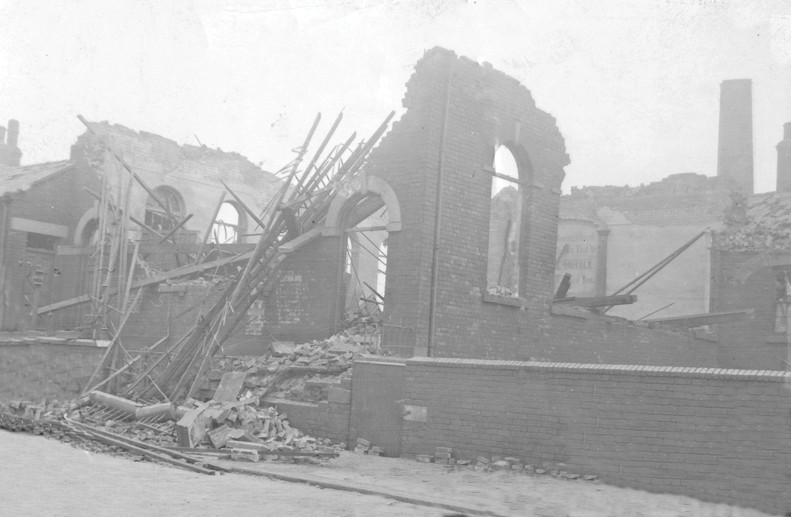
The Wesleyan Chapel, Princess Street, Sheffield
The full list of the fatalities is as follows
Bellamy. Elizabeth, Died.
Brewington. Richard, Died.
Coogan. Ann, Died.
Guest. William, Died.
Hames. Beatrice, Died.
Hames. Horace William, Died.
Hames. Levi, Died.
Harrison. George, Died.
Harrison. Vera, Died.
Harrison.Eliza Ann, Died.
Newton. Albert, Died.
Newton. Alice, Died.
Rhodes. Elsie Mary, Died.
Rhodes. Nellie, Died.
Rhodes. Phyllis Irene, Died.
Shakespeare. Martha, Died.
Southerington. Sarah Ann, Died.
Southerington. William, Died.
Stratford. Frederick, Died.
Taylor. Margaret, Died.
Tyler. Albert, Died.
Tyler. Amelia, Died.
Tyler. Ernest, Died.
Tyler. John, Died.
Tyler. Joseph Henry, age 14. Died.
Tyler. Joseph Henry, age 45. Died.
Tyler. Selina, Died.
Wilson. Thomas, Died.
The Tyler family were buried together on Saturday 30th September 1915 in Burngreave Cemetery - the grave reference is E3 093 (Gen)
The Inquest was held a couple of days after the attack and was reported in the local paper - Sheffield Daily Telegraph. It should be borne in mind that the press was subject to censorship and so Sheffield is described as a "North Midlands" town
RECENT RAID
CORONER AND WORTHLESS VERDICTS
MOTHERS ANXIETY
Inquests were held by a North Midland coroner yesterday on the bodies of the victims of the recent air raid. The majority of the bodies werethose of women and children.
The Coroner expressed very sincere and deep sympathy with the relatives of the unfortunate persons who met their deaths in the raid.
The course he had decided to adopt was to identify the unfortunate victims, hear short evidence as to their injuries and the cause of death, and then to adjourn the enquiry for possibly for a fortnight. In the meantime he proposed to confer with the authorities to see whether at the adjourned inquiry any statement or key evidence or any information could be put before a Court which may have the effect of reassuring the public.
The Coroner continuing said he was going to appeal to their common-sense not to come to such a conclusion as to return a verdict of "Wilful Murder" against the Kaiser as a jury had done in another part of the country. It was an absurd verdict, for there was no evidence to implicate the Kaiser, and their opinion and his opinion were after all worthless in Germany. Another jury returned a verdict of "Murder" against the crew of the Zeppelin but that was equally absurd. The soldiers and sailors who were bombing the towns on instructions.
Evidence was given by a an institutional surgeon as to the injuries sustained by a woman and a boy who died in a hospital some hours after admission. The woman was suffering from a fracture of the right femur, and extensive lacerations to the right leg and the boy was covered with contusions as though he had been crushed by something falling upon him. Death in such instance was due to shock caused by the injuries.
In the case of the woman it was stated by her husband that she was about to follow him into the cellar where he had taken the children for safety when she was struck. She called out to him for assistance and as she was badly injured he went out of the house and procured assistance. Another woman was stated to have succumbed to injuries to the back and the shoulders, the doctor saying that practically all the muscles were torn. (57 year old Elizabeth Bellamy)
Giving evidence as to the identification of a sister, brother in law, four nephews and a niece, one witness said that with the exception of one little nephew, the victims were all dead when they were recovered from the house that had been struck by a bomb. (The Tyler Family). The little boy died in the hospital a few hours after admission. The husband of one victim said his wife was rushing across the bedroom to get he child when a bomb struck her in the back.
The son of a man killed said that they were sleeping in the same room when three bombs were dropped in the vicinity. He went to see if his father was safe but found him dead on the bed, Witness received injuries to his hand and knee from the bomb.
With regard to the death of an elderly man who made his home with his son, evidence was given to the effect that as soon as the first bomb dropped he jumped out of bed and ran to the window. As he was looking out of the window another bomb exploded and he was struck by a piece of flying fragment on the chin and killed instantly. (Thomas Wilson)
In another case where the victims were a young married couple and their baby the evidence was that they were in bed when a bomb dropped wrecking the house and the three were dead when recovered from the debris of the house later. (Levi and Beatrice Hames and their one year old son Horace)
As to the fate of a mother and two girls dated six and four years respectively it was stated that the bodies of the victims were recovered from the debris of the house which had been demolished but the witness was unable to say whether they were killed by the explosion of a bomb or by falling wreckage.. in the same house the father, the mother and the sister of the mother of the two children also succumbed, a witness stating that he believed they were suffocated.
Two neighbours who were in the same house were also killed. Another young couple had been blown out of their house in different directions, the wife being found on the pavement at the opposite side and the husband in the back yard. The evidence relating to the date of a mother and a grandmother, the latter aged 76 years showed that after the house was struck by a bomb screaming was heard but before assistance was forthcoming, the whole fabric collapsed burying the occupants in the debris. Both persons were dead when recovered from the the ruins. (76 year old Ann Coogan and her 56 year old daughter, Margaret Taylor)
Another victim was a boy who had no sooner shouted "The Zepps are here" than the house collapsed after being struck by a bomb. The mother and a lodger escaped.
A police sergeant giving evidence said that he found the body of a man lying in a yard within three yards of a bomb that exploded.
At this stage the Coroner adjourned the inquiry until 12th of October
The inquest resumed on October 12
1916 and was reported the following day in the Sheffield Daily Telegraph:
ZEPPELIN VICTIMS
JURY’S CRITICISM OF AIR RAID DEFENCES
The Coroner of a North Midland town resumed the hearing yesterday of the inquest of the 28 victims of the Zeppelin raid, which took place in his area recently. In his address to the jury, the Coroner said the inquiry had been adjourned to see whether evidence could be put before them on certain points. Since then he had consulted with the local authorities, and they had informed him that with one exception these points were not within the control of his powers, but of the military authorities. Their unanimous view was that it was no possible to place before them the full evidence on any of the points. Even if it were possible it would not be expedient to do so.
After careful consideration he had decided to agree with the view of the authorities and to call no further evidence, but to ask them to bring in a verdict that these 28 deaths were due to injuries caused by the dropping of explosive bombs. As strongly as he could, and for reasons he previously explained to them, and which seemed to him to be conclusive ones, he desired them to be satisfied in framing such a verdict, and refrain from adding anything else thereto.
Of the main fact that an enemy airship came over the town and destroyed lives there was not the slightest shadow of doubt. On details, there were many opinions, but obviously at the best they were very imperfect, and in most cases erroneous. As to the future, he assured the jury and the public that there had been no lack of effort on the part of the authorities to do whatever was possible in their power. He went on to explain that representations had been made to high authorities, and these had been received sympathetically, and whilst he could not in any way prophesy, he felt sure that military interests if the country must have first attention, the interests of the public would be safeguarded. Whatever the local authorities could do to bring the position before the higher authorities had been done, and they must leave it there.
The foreman of the jury said it seemed to him that there was blame perhaps somewhere for things not being done that ought to have been done before. The Coroner intervened with the remark that he could not allow any expression of individual opinion. He hoped they would arrive at the verdict he suggested. The jury retired for a quarter of an hour, and on returning the foreman said they were agreed to a verdict in accordance with the Coroner’s recommendation. Without adding a rider, they wished to express their dissatisfaction with the anti-aircraft preparations on that occasion. ‘We think,’ he added, ‘they have been very bad indeed.’ They were appreciative of the way the court investigations had been conducted, and strongly sympathised with the relatives of the victims.
In September 2009 I received an e-mail from a visitor to this site who informed me that
" You say that the victim of the bomb dropped at the corner of Petre St and Lyon Road may have been Thomas Wilson. I can confirm to you that it was Thomas Wilson. He was apparently stood in the upstairs room of the house with his Granddaughter Nelly, looking out for the Zeppelin. My Grandfather, Bill Wilson (who just turned 4 years old a few days before), was downstairs with the rest of the family. I understand that shrapnel from the bomb killed Thomas instantly (he was almost decapitated), and my Great Aunt Nelly was apparently scarred from all the glass shards from the window."
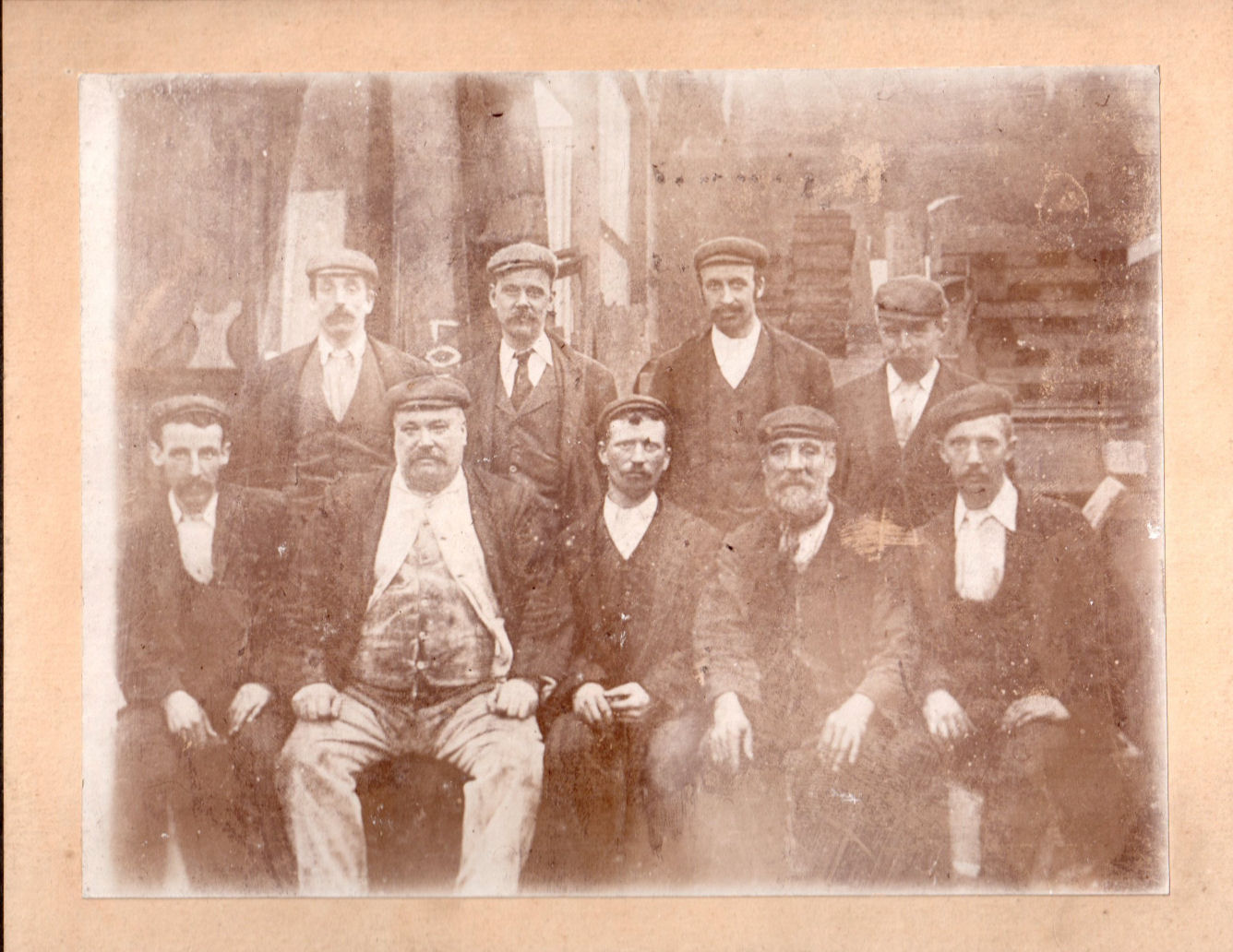
In August 2010 the same descendent kindly provided me with a photo of Thomas and his work colleagues
"Thomas Wilson is the large man, second from the left on the front row. Apparently he got to be that size because of the beer he drank! According to my grandfather, he was not only provided with beer at work to keep cooler around the furnaces, but also a dray cart from the brewery also dropped a barrel off at his house every week!!!"
In November 2014 I located Thomas's grave in Sheffield's Burngreave Cemetery
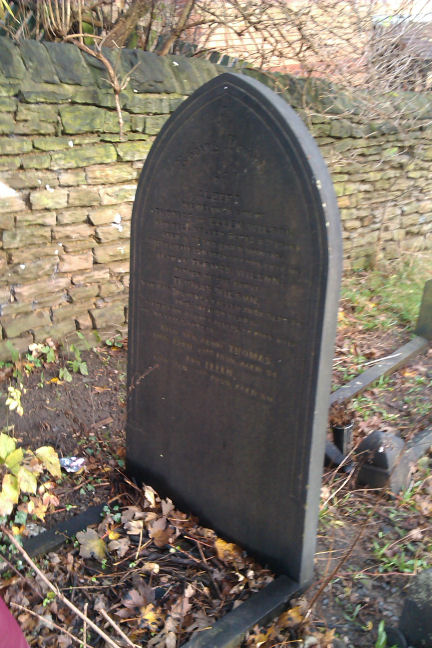
WILSON, Thomas (Fitter, age 59). Died at 73 Petre Street; Buried on September 30, 1916 in Consecrated ground; Grave Number 542, Section BB of Burngreave Cemetery, Sheffield
2.The message board at The Sheffield History Forum also points out that the Sheffield Local Studies Library has in its possession a notebook that has the writers personal reminiscences of a Zeppelin raid in Sheffield
"From Matilda Street the Zeppelin sounded like a traction engine coming from
Darnall. The sound seemed to go by Woodseats, Ecclesall and Crookes. And shortly
I saw flashes of blue light and heard sharp, very loud reports. Over the Midland
Station it appeared to be. But the first bomb dropped on the corner of
Burngreave cemetery. Most damage and loss of life was done on Petre Street where
most was killed. Houses were wiped out and windows and rooms wrecked in the
vicinity. A chapel in Princess Street was demolished. There were [AA] batteries
at the Manor, Wincobank Hill and Ecclesall. But not a shot was fired. The
officers were at a ball at the Grand. "
The writer then goes on to detail the location of the AA guns
One set of guns and a searchlight was just off High Storrs Road, about where the
infant school is now, and the other site was along Marsh House Rd, which was a
track across a field at the time. Apparently they used to practice with the
lights, and it was a public entertainment to go up there and watch the lights
from these sites and others at Norton and Wincobank Hill.
3. Specification of the L22 Zeppelin ( From The Zeppelin Museum Website)
Baunummer: LZ 64
Typ: q
Länge: 178,5 m
Durchmesser: 18,7 m
Volumen: 35.800 m3
Zellenanzahl: 18
Leergewicht: 24.100 kg
Nutzlast: 17.498 kg
Motorenanzahl: 4
Motorleistung: 240 PS
Gesamtleistung: 960 PS
Geschwindigkeit: 26,4 m/s
1. Fahrt: 03.03.1916
Außer Dienst: 14.05.1917
Eigentümer: Marine
Kommandant: Kapitänleutnant Martin Dietrich
ab 07.10.1916 Kapitänleutnant Hollender
ab 14.02.1917 Kapitänleutnant Hankow
ab 22.02.1917 Oberleutnant z. See Lehmann
Bauwerft: Löwenthal
Standorte: Tondern
ab 15.03.1916 Nordholz
ab 16.04.1916 Tondern
ab 20.09.1916 Nordholz
ab 03.03.1917 Hage
ab 05.04.1917 Wittmundhaven
Einsätze: 30 Aufklärungen
8 Angriffe mit 9.215 kg Bomben
Bemerkung:
Am 14. Mai 1917 kehrte L22 von einer Aufklärungsfahrt nicht mehr zurück. In den USA gebaute Curtiss-Flugboote mit großer Reichweite hatten es bei Terschelling abgeschossen. Es gab keine Überlebenden.
4.
In mid 2006 two authors called Mark Goodwill and Glynn May wrote a two
part article in The Star about the Zeppelin Raids of 26 Sept 1916. They also
have a very informative web-site that gives further details of the
Zeppelin raid on Sheffield in 1916.
An Overview of the Zeppelin Raids on England 1914 - 1918 (from Wikipedia)
The first ever aerial bombardment of civilians was on January 19, 1915, in which two German Zeppelins dropped 24 fifty-kilogram high-explosive bombs and ineffective three-kilogram incendiaries on the English towns of Great Yarmouth, Sherringham, Kings Lynn, and the surrounding villages. In all, four people were killed, sixteen injured, and monetary damage was estimated at £7,740, although the public and media reaction were out of proportion to the death toll.
London was accidentally bombed in May, and, in July 1916, the Kaiser allowed directed raids against urban centres. There were 23 airship raids in 1916 in which 125 tons of ordnance were dropped, killing 293 people and injuring 691. Gradually British air defences improved. In 1917 and 1918 there were only eleven Zeppelin raids against England, with and the final raid occurred on August 5, 1918, which resulted in the death of KK Peter Strasser, commander of the German Naval Airship Department. By the end of the war, 51 raids had been undertaken, in which 5,806 bombs were dropped, killing 557 people and injuring 1,358. It has been argued that the raids were effective far beyond material damage in diverting and hampering wartime production, and diverting twelve squadrons and over 10,000 men to air defences.
The Imperial War Museum quotes the following figures that includes aircraft - Nearly 9,000 German bombs of a total weight of 280 tons were dropped on British soil in fifty-one airship and fifty-two aeroplane attacks during the First World War. In all 1,412 people were killed and 3,408 others were wounded as a result of these raids, London suffering more than half of the casualties -670 killed and 1,962 injured.

The grave of William Guest in Burngreave Cemeterey Sheffield. His wife Elizabeth was to live for another fifty years before being reunited with her husband
LAPIDGE, Esther (wife of J Lapidge, age 46).
Died at 28 Irving St; Buried on March 11, 1905 in Consecrated ground;
Grave Number 23, Section K5 of Burngreave Cemetery, Sheffield.
Parent or Next of Kin if Available: . Remarks: ~ Officiating Minister, C W North Ivens.
Plot Owner: John LAPEDGE of 28 Irving Street. Page No
LAPIDGE, John (Engineers turner, age 57).
Died at 143 Corby St; Buried on March 2, 1914 in Consecrated ground;
Grave Number 23, Section K5 of Burngreave Cemetery, Sheffield.
Parent or Next of Kin if Available: . Remarks: Officiating Minister: C W Swann, Removed from Emmanuel Parish.
MOORE, Catherine Kate (Daughter of Arthur Moore, age 1).
Died at 4-10 Creswick Street; Buried on February 24, 1884 in Consecrated ground;
Grave Number 23, Section K5 of Burngreave Cemetery, Sheffield.
Parent or Next of Kin if Available: . Remarks: S.
SHAKESPEARE, Esther E (Widow, age 58).
Died at 216 Buchanan Rd; Buried on December 19, 1944 in Consecrated ground;
Grave Number 23, Section K5 of Burngreave Cemetery, Sheffield.
Parent or Next of Kin if Available: . Remarks: Officiating Minister: A W Harrison: Removed from Sheffield Parish.
SHAKESPEARE, Martha (Wife of W H Shakespeare, age 36).
Died at 143 Corby Street; Buried on October 2, 1916 in Consecrated ground;
Grave Number 23, Section K5 of Burngreave Cemetery, Sheffield.
Parent or Next of Kin if Available: . Remarks: Killed in Zeppelin raid: Officiating Minister W A Martin, Removed from Emmanuel Parish.
SHAKESPEARE, William H (Labourer, age 63).
Died at 18 Donovan Rd; Buried on January 20, 1940 in Consecrated ground;
Grave Number 23, Section K5 of Burngreave Cemetery, Sheffield.
Parent or Next of Kin if Available: . Remarks: Officiating Minister: R W Fitton: Removed from Sheffield Parish.
5. Taken from a local pamphlet describing the aftermath of the raid


6. The Baby Killers (Pen and
Sword), by Thomas Fegan: gives the following information about the raid. The
sentence "A bomb in Princess Street demolished the Primitive Methodist Chapel,
all except for one wall on which a text read above the ruins: `A new commandment
I give unto you, that ye love one another'. is rather poignant!
"The industrial city of Sheffield was one of the
largest armaments producers in the Empire and was vital to the war effort. When
a German Navy Zeppelin raided it on the night of 25/26 September 1916 bombs only
narrowly missed the city's factories, striking closely built workers' houses
instead. The raid was conducted by Kapitanleutnant Martin Dietrich in L22, who
approached Sheffield from the south-east. The Zeppelin circled clockwise over
the city before dropping incendiaries and high explosives in a south-easterly
and then easterly direction over Pitsmoor and
Attercliffe, suburbs north of the city centre.
The first bomb fell in Burngreave Cemetery, the second close to Danville Street
where a man was killed. In Grimesthorpe Road, the next bomb split a house in two
and killed its two elderly female inhabitants; at the corner of Petre Street and
Lyons Road an old man was struck dead by shrapnel as he looked out of his
window; an elderly woman died from wounds and shock caused by a bomb in Writtle
Street. Nearing the heart of Sheffield's munitions works, two high explosives
fell in rapid succession in Cossey Road. The first demolished three houses in a
row and penetrated the cellar of the middle one, number 26, where four families
were sheltering; three men, four women and three children were killed by the
explosion. The second landed at number 10, blowing up a young couple and their
baby son as they slept together in bed. In Corby Street, on the other side of
the steel and iron works, a bomb accounted for a further nine victims, seven of
them at number 136, where five of the family were children. A bomb in Princess
Street demolished the Primitive Methodist Chapel, all except for one wall on
which a text read above the ruins: `A new commandment I give unto you, that ye
love one another'. Further bombs fell close to the bridge beside Washford Road
and in Woodbourn Road where a man in the street was blown up while warning a
household to put out their lights. The Zeppelin finally disappeared east over
Darnall, leaving behind twenty-eight dead and nineteen injured. The total could
have been much worse. Sheffield's defences were afterwards described as a
fiasco, no order having been given for AA to open fire during the raid. To
address deficiencies, extra searchlights and guns were mounted on the hills
around the city against future attacks.
Bitterness about the raid continued after the war. When a memorial was unveiled
outside the Baltic Steel Works on Armistice Day 1922, it was intended to
perpetuate the infamy of the Germans as much as remember the dead. The Chairman
of the works told the large gathering assembled for the ceremony that if the
Germans had had their way neither the works nor they would still exist. Although
no longer a steelworks, the building and memorial still stand on Effingham Road,
off Attercliffe Road. Fifty yards left of the Baltic Works entrance, the large
grey stone set back in the brick wall reads:
`Lest we Forget' on September 26th 1916 nine men, ten women and ten children
were killed by a German air raid on Sheffield. One of the bombs fell close to
this spot. (The bomb referred to is probably the one that landed near Washford
Road)."
8. From the 1911
Census Levi Hames
Relationship to Head of Household Son
Condition Single Gender Male
Age 17
Estimated Year of Birth 1894
Occupation Engine Cleaner
Employed Yes Working at Home No
Industry Locomotive Dept Railway Co
Place of Birth Leicestershire Swannington
Enumerator Information
Address Sunny Side 157 London Road Coalville Parish Coalville Town Coalville
Type of Building Private House Number of Rooms 7 Inhabited Y
Reference RG14PN19091 RG78PN1143 RD404 SD4 ED11 SN416 Administrative County
Leicestershire Registration District Ashby De La Zouch
Registration Sub District Whitwick Enumeration District 11
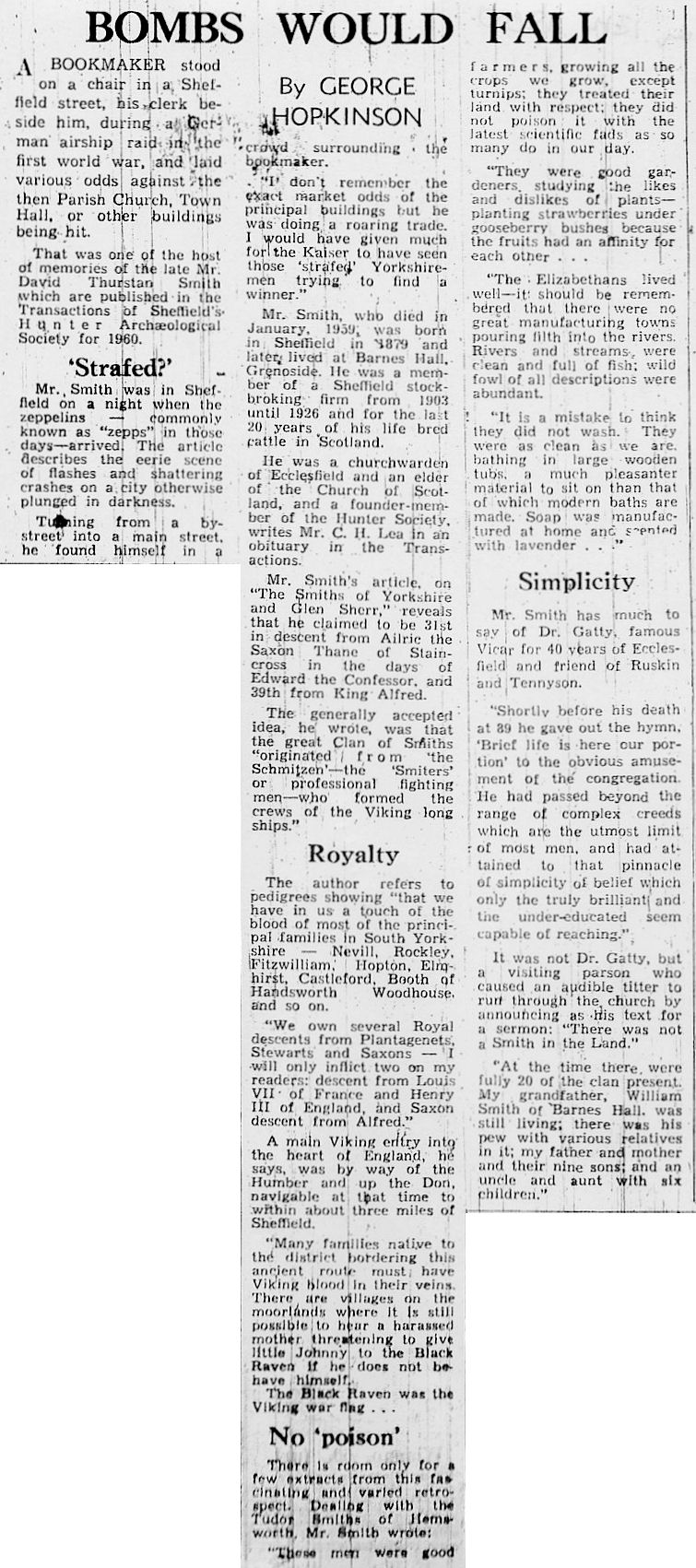
9. Whilst I was researching another article for the site in the I came across this report that throws a different perspective on the events of 25th September 1916. It is from the Sheffield Telegraph dated 19th June 1960
.
A month later in October 2010 I found, purely by chance, another article from The Sheffield Star dated April 1961 which provides a fascinating insight into the events of that Monday night in 1916
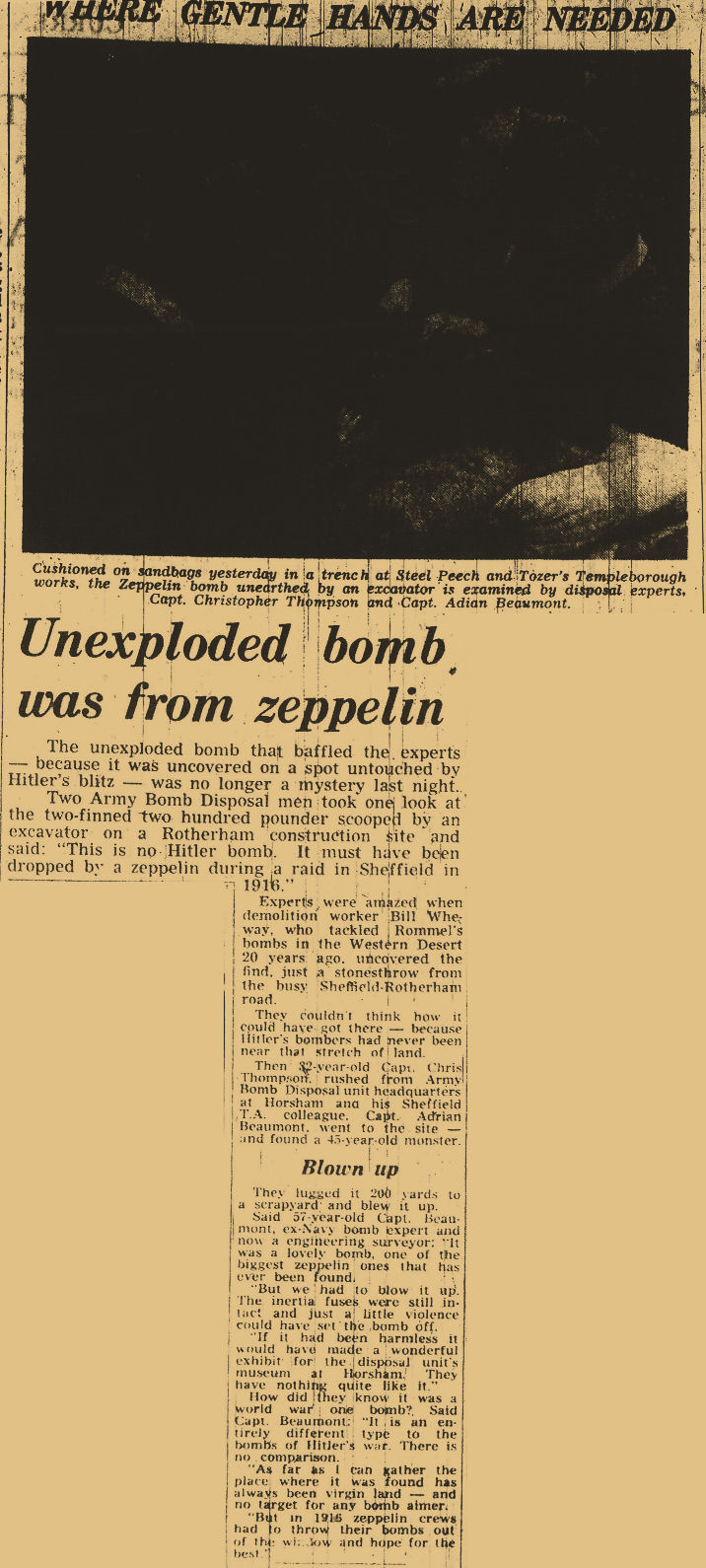
From accounts at the time we know the L-22 travelled
east from Sheffield and followed a route taking it over Mexborough and
Finningley near Doncaster towards the coast. There were other raids in the area
but not at that time Exactly a year later on 24-25th September 1917 a Zeppelin
dropped several bombs harmlessly in fields near an ironworks at Rotherham.
The Sheffield Daily Independent published an account of the "1916 Sheffield
raid" on 3rd December 1918. The article also made reference to a subsequent
raid:
“On one occasion afterwards – when a Zeppelin visited Rawmarsh and the district
between Rotherham and Mexbro’ not a few people formed view that the raider
narrowly missed Sheffield again, and passing wide of the city on the southern
and western sides wandered somewhere round by Bradfield and Langsett, and in a
circle through the Barnsley, Cudworth and Rawmarsh area, and back to the coast.
The explosion of the bombs dropped was heard in Sheffield.”
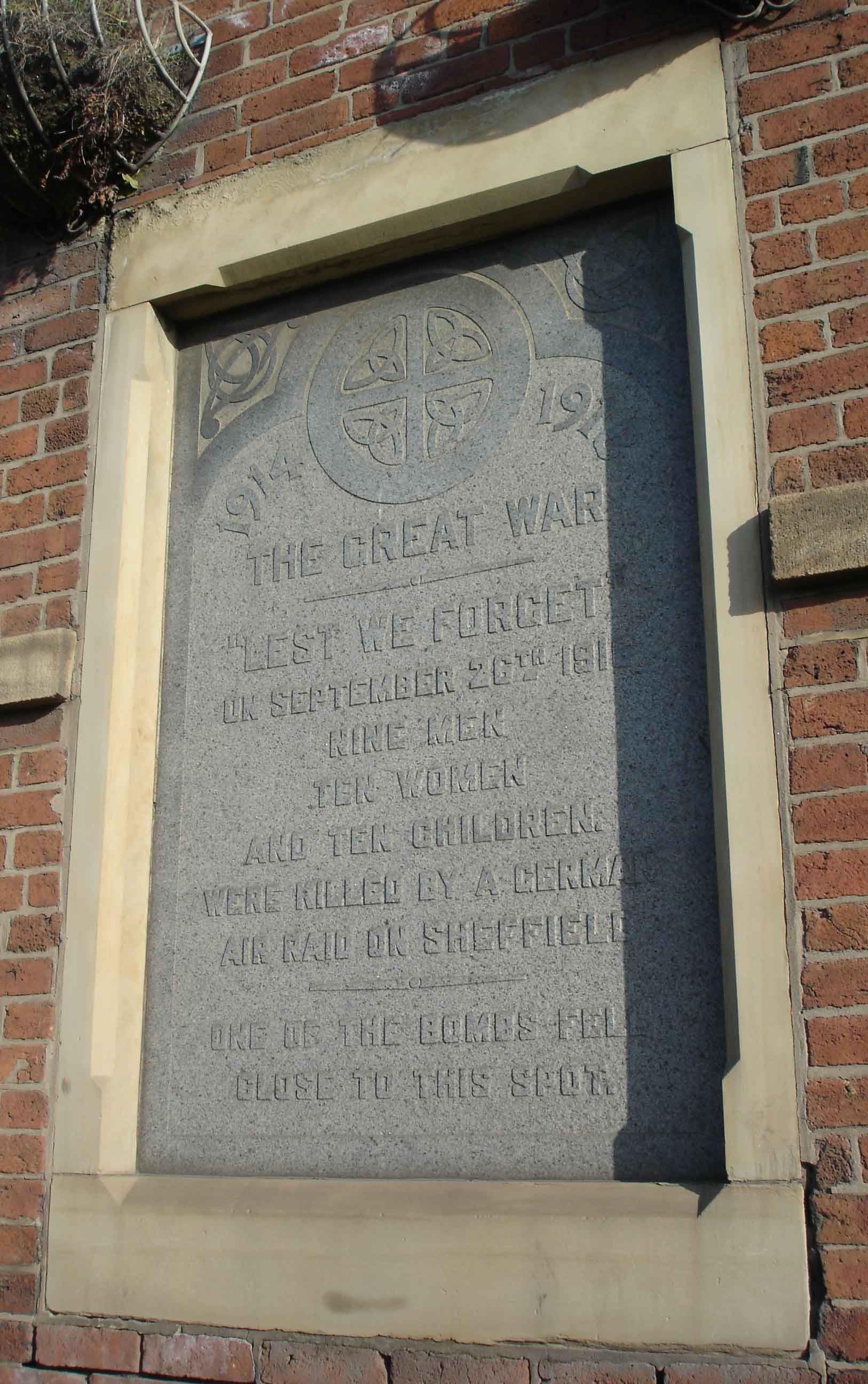
The Memorial to the Nine Men, Ten Women and Ten Children who died in the Raid - Photograph taken March 2012
And in October 2013 I received this e-mail from a descendent of someone who actually witnessed the attack that day
"Dear Chris,
I am in the process of transcribing the memoirs of my wife’s great-grandfather,
who grew up in Sheffield before and during WWI. I have recently transcribed the
below passage which describes him having witnessed a Zeppelin attack over the
city; having looked at your website, I presume that this is the attack of Sept.
1916. It is not a very detailed description but I thought it might be of
interest to you and have pasted it below.
When I used to carry out Visiting Rounds, in the winter and had to trump through
Owlerton, down a narrow lane past Wenton and Buts Forge then along both sides of
the cemetery and on ***** Lane where the wind whistled and moaned through the
trees. I don’t mind confessing I got small comfort from the sword which we
carried in those days. After having visited all the sentries and seeing
everything was in order, discipline was relaxed somewhat inside the guardroom
(we were not commissioned then) and I did my share in consuming [PAGE 44] the
large and always ample steak and kidney pie provided for us by the local
authorities. Often when on duty with the Home Guard my mind has gone back to
those days of thirty years ago when the same keen spirit was in evidence,
although we had no regular night visitors, I did see one night visitor, a
Zeppelin which came right over our house with riding lights quite visible and
the hum of its engines quite unmistakable. It circled round for quite a time,
evidently having lost its bearings until a train from Rotherham came towards the
Sheffield Station. The Zeppelin dived at once and released three or four bombs,
which fell on both sides of the line but missed the train, demolishing two
houses and killing two or three people. I saw the flashes from our upstairs
windows and heard the dull ‘cough’ with which were to become so dreadfully
familiar some years later. The only other Zeppelin I saw during that war was in
1918 after I had returned from France and was stationed near Sunderland. It was
coming down in flames several miles away".
10. From History of the First World War Magazine - Issue 23 - The cupola of a Zeppelin L2

11. The following appeared in the Sheffield Daily Independent dated 17th October 1916
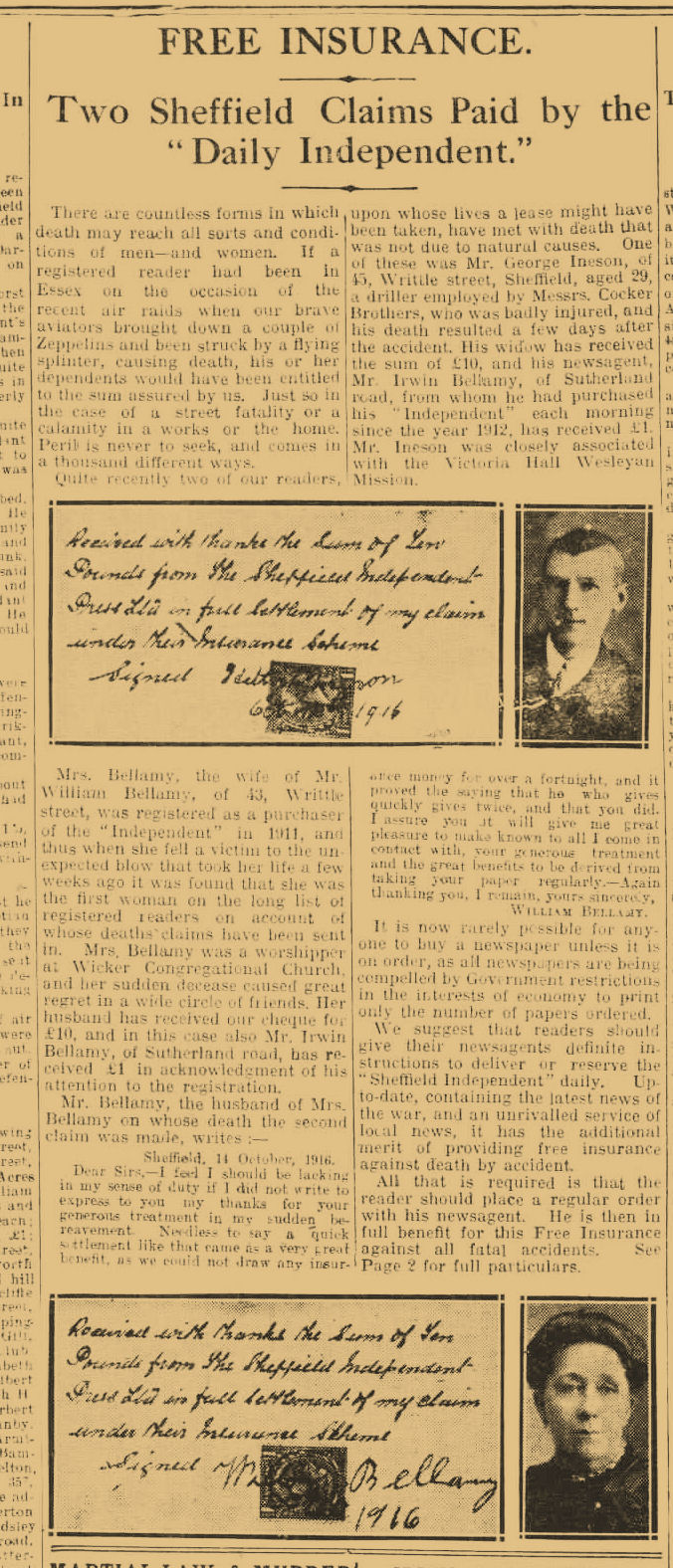
Sources
New York Times dated 15th May 1917
The First Blitz - Andrew Hyde
The Baby Killers - Thomas Fegan
The Zeppelin in Combat - Douglas Robinson
Sheffield Daily Telegraph dated 17th February 1916
Sheffield Daily Independent dated 16th February 1916
Sheffield Daily Independent dated 17th October 1916
Yorkshire Post 2nd January 1919
Sheffield Telegraph dated 19th June 1960
The Sheffield Star dated April 1961
Sheffield Independent dated 3rd December 1918
Sheffield and District Family History Society website
History of the First World War Magazine - Issue 23
This page was last updated on 31/08/25 15:43