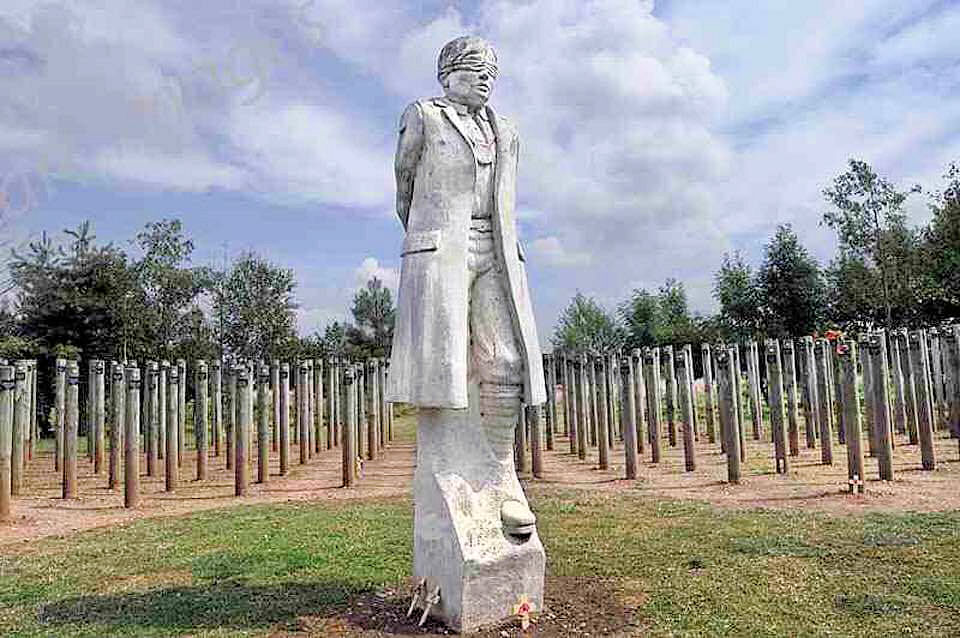
THE EXECUTION OF SHEFFIELD SOLDIERS IN THE FIRST WORLD
WAR
"A shocking crime was committed on the unscrupulous initiative of few individuals, with the blessing of more, and amid the passive acquiescence of all". - Tacitus
"Our country sinks beneath the yoke, it weeps, it bleeds, and each day a fresh gash is added to her wounds."
William Shakespeare Macbeth Act 4 Scene 3
When I posted the page on the execution of Private Henry Hughes in 1918 I was aware that he was not the only soldier to be executed by the British Army who came from Sheffield. In one book I read it stated that there were two more soldiers from Sheffield that shared Henry's fate. However a reader of the article contacted me and informed me that at least SIX soldiers from Sheffield were executed during the First World War. Thankfully he supplied me with the names of the others and after a few hours of research I was at least able to identify them and locate their final resting places.
The six soldiers executed (and their date of execution) were
Pte James A. Haddock - 16th September 1916 - age 32
Pte Ernest Walter Jack Harris - 3rd February 1917 - age 20
Pte Henry Hughes - 10th April 1918 - age 27
Pte Walter Dossett - 25th June 1918 - age 22
Pte George Ainley - 30th July 1918 - age 20
Pte Frank Bateman - 10th September 1918 - age 28
Pte George Ernest Roe - 11th June 1915 - age 19 - see below Pte Harry Poole - 9th December 1916 - age 22 - see below
However in July 2007 I received the following e-mail
" I work in Sheffield Local Studies Library and came across your fabulous site while researching a local man who was executed for desertion in the First World War. He is not named in your list of Sheffielders but in the report mentioned on p44 of Shot at Dawn there is no indication that he was local apart from he was in the KOYLIs.
George Ernest Roe of the 2nd Bn, 3/1433 was shot on 11 June 1915 aged 19. This makes him the first, unless there are others yet to uncover. His next of kin was Mrs Mary Roe, mother of 24 Brough Street and I have found that although not named on the city's Role of Honour his name is listed on the one for the nearest parish church St Bartholomew's, off Langsett Road. This was put on at the time so it seems people were again unaware of true circumstances.
Hope this gives you further material for research, by far the best information I gathered on the subject and will be recommending it to our users".
Details are scarce but George was definitely from Sheffield which makes a total of eight soldiers from the city that were executed by the British Army.
But in June 2010 I came across yet another soldier from Sheffield who was executed by the British Army - Pte Harry Poole. It is beginning to look as though the British Army was harbouring some deep prejudices about working class men from Sheffield who had enlisted in the British Army. Harry's execution now means that I now have identified eight soldiers from Sheffield who were summarily executed in the Great War
As I stated in the article on Henry Hughes there is an excellent web-site Shot at Dawn that deals comprehensively with the many, often complex issues, that surround this harrowing aspect of the war. The analysis and arguments put forward on the site are well thought out and convincing and I have no hesitation in recommending the content wholeheartedly. Unfortunately I have been unable to locate any detailed statistical analysis of those 306 British soldiers that were executed but several points arise that may put some perspective on what is an emotive issue.
1. All the soldiers listed above were Private's the lowest rank in the British Army. The records show that only three officers were executed during the whole war and one of those was for murder.
2. Five of the eight were 22 years of age and under. The British Army had no reservations about sentencing and executing soldiers who were just in their teens. The state forbid the execution of anyone under the age of 19 but the Army ensured that they were exempt from this legislation by stressing the primacy of the Army Act. Soldiers aged 17 were executed
3. With the possible exception of Jack Harris, all the above were from some of the poorest parts of the city. The family's they left behind were working class in the literal sense of the word. Given the atrocious state of education in the UK at the time they would have been poorly equipped to deal with the charges that they faced. Many would have been more or less illiterate.
4. All eight were executed for the military offence of desertion. The offence was by far the most common to attract the death sentence in the first world war. All these offences took place in France and Belgium. Even though the rate of desertion was 4.3 times higher in the United Kingdom no soldier was ever executed for desertion at home. The reason for this is that the executions abroad could be largely covered up by the military establishment whereas any conducted at home would have undoubtedly have provoked riots and demonstrations. This was especially the case after the futile loss of life that occurred during the Somme Offensive of 1916. By 1917 morale in the civilian population was plummeting as the casualties escalated and there were genuine fears that the fabric of society was collapsing.
5. All eight served with regiments that were based in the North of England. This fact alone often meant that the chances of being executed for military offences was that much greater. To give two examples. Of the 53 soldiers in the Yorkshire and Lancashire Regiment who were sentenced to death, eight were executed i.e. 15%. A similar ratio exists for the Lancashire Fusiliers - 52 soldiers were sentenced to death and eight were executed including Jack Harris. Two of the army's most prestigious regiments The Cavalry Regiment and the Grenadier Guards had 26 and 12 soldiers respectively sentenced to death but, and you guessed it, not one soldier was ever executed. The pattern was repeated through the British Army. Some regiments such as the Cheshire and the West Riding executed approximately 25% of those sentenced to death whilst the Bedfordshire Regiment did not execute any of their 22 convicted soldiers. It was that capricious!!
6.Again there is no detailed statistical analysis but it has been suggested that the rate of executions increased at times when the British and French Army's were under pressure from German advances. This certainly appears to be the case here with three executions coinciding with the aftermath of German Spring Offensive of 1918.
7. Listed are the file references at the National Archives for each individual case
Pte James A. Haddock
- 16th September 1916 - age 32 WO71/499
Pte Ernest Walter Jack Harris - 3rd February 1917 - age 20 WO71/542
Pte Henry Hughes - 10th April 1918 - age 27 WO71/638
Pte Walter Dossett - 25th June 1918 - age 22 WO71/650
Pte George Ainley - 30th July 1918 - age 20 WO71/658
Pte Frank Bateman - 10th September 1918 - age 28 WO71/666
Pte George Ernest Roe - 11th June 1915 - age 19 WO71/417
Pte Harry Poole - 9th December 1916 - age 22 WO71/530
There are a set of guidance notes that explain the archives and a search facility to assist in locating the file
8. Additional references
Piece details WO 71/
WO Records created or inherited by the War Office, Armed Forces, Judge Advocate
General, and related bodies
Division within WO Records of the Judge Advocate General
WO 71 Judge Advocate General's Office: Courts Martial Proceedings and Board of
General Officers' Minutes
Subseries within WO 71 HOME AND OVERSEAS
Subsubseries within WO 71 FIELD GENERAL COURTS MARTIAL
Record Summary
Scope and content
Availability Open Document, Open Description, Closed For 75 years
Further information about access conditions is available
9. After the war His Majesty’s Stationary Office had produced a large series of books under the title; ’Soldiers died in the Great War 1914-1919’, which in seventy four volumes lists by regiment the names of the men who had died during the war, and nowhere in part 61, which covers the casualties of the York and Lancaster Regiment, does the name of James Crampton appear. This was due to an order, which had been made by the War Office when the volumes were being compiled, forbidding the inclusion of the names of the men who had been executed during the war.
Notes
1. I have not been able to find eyewitness accounts for any of the eight Sheffield soldiers that were executed. However nearly all the executions conducted by the British Army more or less followed the same pattern as described below
" ... The officer had loaded the rifles and had left them laying on the ground at our position. We got into position and were warned to fire straight, or we may have to suffer the same fate. The prisoner was taken out of a car (we saw him get out, with a black cap over his head and guarded) and placed on the other side of the curtain.
If we did not kill him, the Officer would have to. As soon as the curtain dropped (the prisoner was tied in a chair five paces away from us, a black cap over his heart) we got the order to fire. One blank and nine live rounds. It went off as one. I did not have the blank. The prisoner did not feel it. His body moved when we fired, then the curtain went up. That was the easiest way for an execution I had heard of. The firing squad only saw him for a few minutes. We went back to the Battalion Orderly Room and got a big tumbler of rum each, and we went back to our billets, ate, and went to bed. We had the rest of the day off. It was a job I never wanted.
13 March 1918
Away from noise of battle
Away from bombs and shells,
I’ll lie where browse the cattle,
Or pluck the purple bells;
I’ll lie among the heather,
And watch the distant plain,
Through all the summer weather,
Nor go to fight again.
The last verse of the poem “When the last long trek is over”, by Lieutenant Alec de Candole, 4th Battalion Wiltshire Regiment.
Two days after writing the poem, he was killed on 4th September, 1918.
Sources
Unquiet Graves Guide Execution sites of the First World War in Flanders - Piet Chielens and Julian Putkowski
Rusteloze graven gids – Executieplaatsen uit de Eerste Wereldoorlog in de Westhoek
The Guide is centred on the countryside around Ieper (Ypres) and Poperinge in the Westhoek of Flanders and visits the places of execution and graves of men 'shot at dawn' by the British Army in the Great War.It Made You Think of Home the journal of Deward Barnes, CEF
Shot at Dawn - Julian Putkowski and Julian Sykes - The standard reference work about soldiers executed under the British Army Act in the First World War (1989).
U.K. Military Executions 1914 - 1918
Commonwealth War Graves Commission
"What the horrors of war are, no one can imagine. They are not wounds and blood and fever, spotted and low, or dysentery, chronic and acute, cold and heat and famine. They are intoxication, drunken brutality, demoralization and disorder on the part of the inferior... jealousies, meanness, indifference, selfish brutality on the part of the superior." - Florence Nightingale
This page was last updated on 20/12/25 08:21